

"Which is the best generator?" – we hear this question at Kipor.org almost every day. The honest answer from more than 18 years of hands-on experience: there is no single best generator, but there is a suitable model for every application. This test and comparison guide shows you which generator really suits camping, home backup power, a heat pump, the construction site or emission-free use indoors – with specific recommendations from our own workshop and our sales data.
Key Points at a Glance
- The application decides: the "best" generator is not the one with the highest wattage, but the model that suits your use – from the 18 kg camping inverter to the 400 V diesel on the construction site.
- Inverter is the standard in 2026: pure sine wave with total harmonic distortion (THD) below 3% – essential for routers, heating controls, laptops and smart home devices.
- Starting current determines the size: motors and compressors draw 3–6 times their rated power at start-up – this, not the rated power, determines the minimum size.
- Fuel by usage: petrol for occasional use and camping, diesel from approx. 5 kW and for continuous operation, dual fuel for maximum self-sufficiency and long storage.
- Portable power station for indoors: emission-free and silent for short outages (0–4 h) in a flat, cellar or on the balcony – the ideal complement to a generator.
- Safety: carbon monoxide is odourless and deadly – only run a generator outdoors, at least 5 m from building openings. Only feed power into the house wiring via a changeover switch installed by a qualified electrical contractor (VDE 0100-551).
- Which generator suits you? Recommendations by application
- How we compare: the 5 criteria that really count
- Camping, motorhome & outdoors: quiet and light
- Backup power for your home: basic to comfort supply
- Heat pump & continuous operation: diesel inverters compared
- Maximum self-sufficiency: dual fuel & long storage
- Construction site, trades & three-phase: rugged professional units
- Emission-free indoors: a portable power station as a complement
- Fuels compared: petrol, diesel, dual fuel, gas
- Safety: CO, feeding in power and VDE 0100-551
- FAQ on comparing generators
- Conclusion: the best model is the one that suits you
Which Generator Suits You? Recommendations by Application
There is no such thing as the best generator – only the best generator for your application. An 18-kilogram camping inverter is useless on a construction site, while a 400-volt diesel is oversized and too loud for a residential area. If you answer honestly before buying what you need the unit for, you can easily save several hundred euros and avoid regretting the wrong choice later.
The following overview matches the six most common use cases to the appropriate class of generator. It forms the framework for this entire guide – we then look at each application in detail, including a specific model recommendation, power range and honest limitations.
Fig. 1: The six most common applications and the matching class of generator (source: Kipor.org, advisory practice)
"The most common mistake when buying is that customers look at the wattage first and only then think about what they actually need. In our consultations we always turn this around: first the application, then the generator. If you do that, you will almost never buy too big – and therefore not more expensive or louder than necessary."
– Alexander Harlinghausen, Managing Director of Kipor.org GmbH, 18+ years of experience with generators
How We Compare: The 5 Criteria That Really Count
A generator is good if, for its application, it offers the right power quality, enough starting reserve, a suitable noise level, the sensible fuel and reliable starting after storage. We apply these five criteria to every recommendation – they matter more than any star rating based purely on data sheets.
Unlike many comparison sites that simply rank units by reviews, at Kipor.org we have been testing, servicing and repairing all units in our own workshop since 2007. That shapes our assessment: we know which models start after months in storage and which weaknesses only show up in the third year of use. Our sales data from the last twelve months also feeds in – the maXpeedingrods MXR 3500, for example, is by far our best-selling generator.
Power Quality – Inverter, AVR or SVR?
The most important technical distinction is power quality: inverter generators deliver a pure sine wave with total harmonic distortion (THD) below 3%, AVR generators only regulate the voltage and fluctuate by up to ±10%, and SVR technology is optimised for feeding into photovoltaic systems. For sensitive electronics – routers, laptops, modern heating controls, smart home devices – the clean sine wave of an inverter is a must.
Fig. 2: Inverters deliver a clean sine wave (THD < 3%), AVR fluctuates by up to ±10%, SVR is optimised for PV feed-in (source: Kipor.org)
For typical home use and all sensitive appliances, inverter generators are therefore our standard recommendation – you will find a wide selection in our inverter generator collection. AVR models still make sense for robust loads such as pumps, compressors and simple tools – cheaper to buy, but with voltage fluctuations that can damage modern control systems.
Why Starting Current Determines the Size
The minimum size of a generator is determined not by the sum of the rated outputs but by the highest starting current. Appliances with an electric motor or compressor – fridge, heat pump, submersible pump, circular saw – briefly draw 3–6 times their rated power at start-up. A fridge with a rated power of 150 watts demands up to 900 watts when starting, and a heat pump with 2,500 watts of continuous power briefly 7,500 watts or more.
The rule of thumb for sizing: add up the rated power of all appliances running at the same time, add the highest single starting current and allow around 30% reserve. If you leave out this reserve, you risk the generator tripping its overload protection when the fridge starts – and in an emergency, of all times. You will find a detailed calculation aid including an appliance list in our guide to generators for home use.
Expert tip: Check the rating plate of your largest appliances. The starting current is often given there as "LRA" (locked rotor amperage) in amps. Multiply this value by 230 V to get the peak in watts: 35 A × 230 V = 8,050 watts. That is your minimum requirement – not the rated power stated in the brochure.
Camping, Motorhome & Outdoors: Quiet and Light
For camping, motorhomes and outdoor use, what counts is not maximum output but low weight, a low noise level and a clean sine wave for your laptop, cool box and smartphone. An inverter generator of around 2,000 watts reliably covers this need and stays portable at under 20 kilograms. More output here only means more weight and more noise – neither of which you want on your pitch.
Our entry-level recommendation is the maXpeedingrods MXR 2300: with 1,800 watts rated power, 2,300 watts maximum power and a weight of just 18 kilograms, it is light enough for the car boot and delivers pure sine wave power thanks to inverter technology. In eco mode it runs for over ten hours on a 4-litre tank – enough for a whole day at the campsite.
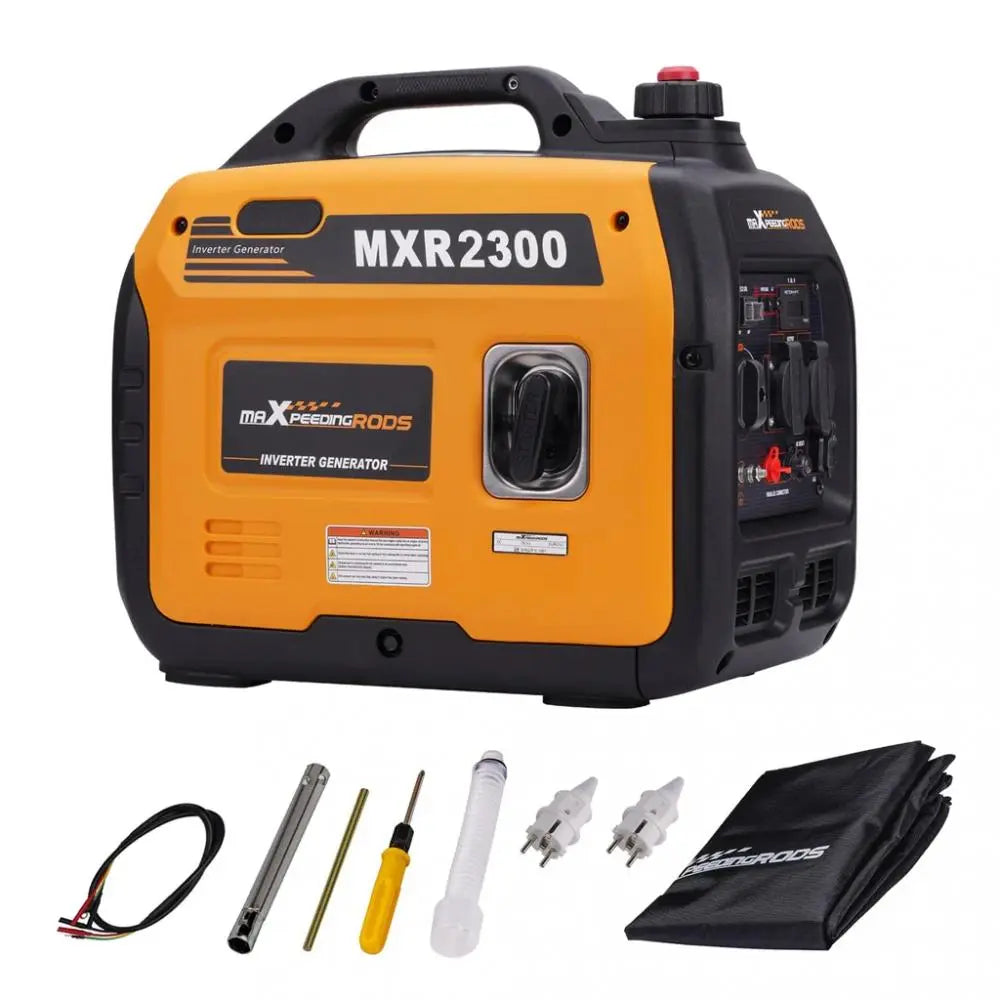
maXpeedingrods MXR 2300 – entry-level inverter for on the go
- Output: 1,800 W rated / 2,300 W max – powers cool box, laptop, lights and chargers
- Weight: just 18 kg – easy to carry and stow
- Runtime: 4 L tank, over 10 hours in eco mode
- Inverter technology: pure sine wave – safe for sensitive electronics
- Price: approx. 399,95 € – affordable inverter back-up for camping and emergencies
If you want something even lighter in a suitcase design, the Champion MightyAtom 2200 is an alternative – according to the manufacturer, the lightest 2,000-watt inverter in its class. For the tightest budget, the Voltherr KGE 950Pro with 950 watts covers lighting, charging and small appliances. You will find a curated selection of suitable units in our camping & motorhome collection.
Expert tip: Many campsites have fixed quiet hours. So don't just look at the dB rating but also at eco mode: it adjusts the engine speed to the actual power draw, noticeably reduces the noise level and significantly extends the runtime per tank.
Backup Power for Your Home: Basic to Comfort Supply
For a basic supply to a detached house during a power cut, 3,000–4,000 watts of maximum power is enough – that powers the fridge, heating controls, router and lighting at the same time. If you also want to run a microwave, washing machine and TV, you should go for the comfort class with 4,500–5,500 watts. Statistically, this is rarely necessary: according to the Bundesnetzagentur (the German Federal Network Agency), the average power cut in Germany in 2024 lasted just 11.7 minutes per consumer – a generator is a precaution, not something that runs all the time.
Our mid-range bestseller is the FME XG-SF 4000ER: 3,600 watts rated power, 3,800 watts maximum power and, at under 55 dB(A) at 7 metres, about as loud as a normal conversation – so acceptable even in a residential area. Electric start and wireless remote control let you start the generator from inside the house while it stands outside in the garden. The pure sine wave (THD < 3%) makes it safe for all your home's technology.

FME XG-SF 4000ER – inverter with wireless remote control
- Output: 3,600 W rated / 3,800 W max – fridge, heating, router and TV at the same time
- Noise level: under 55 dB(A) at 7 m – the quietest in its class, suitable for residential areas
- Convenience: electric start + wireless remote, trolley, digital display, low-oil warning
- Inverter: pure sine wave (THD < 3%) – safe for all sensitive devices
- Price: approx. 1.049,95 € – well-balanced value for money
If you need more comfort on a permanent basis, a model such as the maXpeedingrods MXR 5500i (around 5,000 W rated / 5,500 W max) is the right choice. If you want the generator to start automatically while you are away, it is worth looking at units with ATS (automatic transfer switch), which switch over automatically when the mains fails. We have set out the complete sizing logic with three supply scenarios in our guide to home use.
Heat Pump & Continuous Operation: Diesel Inverters Compared
For households with a heat pump, a diesel inverter generator with 5,000–8,000 watts of continuous power is recommended, because the compressor draws 3–5 times its rated power when starting and the generator has to run efficiently through a longer outage. What matters is not the continuous power of the heat pump but its starting current – modern models with soft start reduce the factor to about twice, while older models without soft start demand many times more.
Our most requested diesel model is the FME XG-SF 5600D Carbon: 5,000 watts rated and 5,500 watts maximum power, combined with inverter power quality. Diesel pays off twice here – diesel engines use around 20–30% less fuel than comparable petrol engines at half load and are designed for long-term operation. For purely three-phase loads and even more reserve, the professional FME 8000iD diesel or the three-phase Hyundai DHY8600SE-T are the next step up.

FME XG-SF 5600D Carbon – diesel inverter for demanding building services
- Output: 5,000 W rated / 5,500 W max – covers the starting peaks of modern heat pumps
- Diesel efficiency: around 20–30% lower consumption at half load than petrol
- Inverter power quality: safe for heating controls and sensitive electronics
- Continuous operation: designed for longer outages and load peaks
- Price: approx. 2.699,95 € – diesel efficiency for demanding building services
If the starting reserve of your existing inverter generator is just short of what your heat pump needs, you don't necessarily need a bigger unit: a Softlife RS-1 soft starter reduces the starting peak and can protect a 3.5 kW inverter from overload. We explain in detail which generator suits which heat pump in our guide to the backup generator for a heat pump. As the heat pump is usually hard-wired into the house wiring, the connection must always be made by a qualified electrical contractor (more on this in the safety section).
Maximum Self-Sufficiency: Dual Fuel & Long Storage
For maximum self-sufficiency and infrequent use, a dual fuel generator is the smartest choice, because it runs on both petrol and liquefied petroleum gas (LPG). The decisive advantage is storage life: petrol starts to go stale after just 3–6 months and causes starting problems, whereas LPG can be stored practically indefinitely. A backup generator that sits unused for months and has to start immediately in an emergency benefits from exactly this.
Our best-selling dual fuel model is the maXpeedingrods MXR 3500S with around 3,500 watts – sold more than 110 times last year. If you value remote monitoring via an app, the MXR 4000GT is a smart alternative. Both combine the flexibility of two fuels with a pure sine wave. We show in detail how a dual fuel generator performs in everyday use in our dual fuel generator review (MXR 3800DF).
"We see it every autumn: customers take the generator out of the cellar where it has been standing since last winter with old petrol in the tank – and it won't start. That doesn't happen with gas. For pure emergency preparedness, where the unit may only run twice a year, dual fuel is therefore often the more reliable choice than a petrol-only generator."
– Alexander Harlinghausen, Managing Director of Kipor.org GmbH, 18+ years of experience with generators
Expert tip: If you use a petrol-only generator as an emergency unit, don't fill the tank to the brim before storing it; instead, run it dry under load for a short time every few months. This prevents gummed-up petrol in the carburettor – the most common reason why a backup generator won't start after storage.
Construction Site, Trades & Three-Phase: Rugged Professional Units
On the construction site, what counts is ruggedness, continuous load capacity and often 400-volt three-phase power rather than maximum power quality. Pumps, compressors, plate compactors and large circular saws are insensitive to slight voltage fluctuations but need plenty of starting reserve and a unit that can run under load for hours. AVR and diesel generators from 5,500 watts are the right class here.
Our all-rounder for robust loads is the FME SP7000D Same Power: around 5,500 watts, AVR technology, diesel and both 230 V and 400 V three-phase. Many tradespeople who prefer the well-known brand choose the DeWalt DXGNP65E (6,500 W petrol AVR), and for three-phase continuous operation the Hyundai DHY8600SE-T (7.9 kVA diesel, 230/400 V). All three have one thing in common: powerful and rugged, but with voltage fluctuations of up to ±10% due to the AVR technology.

FME SP7000D Same Power – diesel AVR with three-phase
- Output: approx. 5,500 W – robust reserve for pumps, compressors and construction equipment
- Outputs: 230 V and 400 V three-phase – for single-phase and three-phase loads
- Diesel: designed for continuous operation and long-term use
- AVR technology: powerful and rugged – not for sensitive electronics
- Price: approx. 1.799,95 € – a solid professional unit for the construction site
Safety note: AVR generators do not deliver a pure sine wave and their voltage fluctuates by up to ±10%. Do not connect sensitive electronics (laptops, modern battery chargers, control systems) to them without additional protection – you need an inverter generator for that. On a construction site this is no problem for most tools, but it is for photographic or measuring equipment in the site cabin.
Emission-Free Indoors: A Portable Power Station as a Complement
For short power cuts (0–4 hours) in a flat, cellar or on the balcony, a portable power station is a better choice than a generator, because it is completely emission-free and almost silent, which makes it safe to use indoors. A combustion engine must never be used indoors – a power station can be. It bridges the gap for your router, laptop, lights and small appliances instantly and without fuel.
A portable power station makes sense as a complement to a generator, not a replacement. During longer outages, under a high continuous load or with a heat pump, every battery reaches its capacity limit. The ideal backup power strategy combines both: the power station silently bridges the first few minutes, the generator takes over the longer supply and recharges the power station when needed. For our emission-free range, we rely on the Genergy GZE series – from the compact 512 Wh model to the 5,040 Wh storage unit for home backup.
An all-round portable recommendation is the Genergy GZE-1012-C with 992 Wh and 3,600 W maximum output – suitable for camping, motorhomes and short outages. You will find the complete selection in our portable power station collection. Together, the power station and generator form a 3-stage backup power model: the battery bridges the gap instantly and silently, the generator secures the longer supply.
Expert tip: When choosing a portable power station, don't just look at the capacity in watt-hours (Wh) but also at the maximum continuous output in watts (W). A large battery is of little use if the inverter only delivers 600 W and shuts down as soon as you switch on your 2,000 W kettle. Capacity determines how long it lasts; output determines what you can connect at all.
Fuels Compared: Petrol, Diesel, Dual Fuel, Gas
The choice of fuel follows your usage profile: petrol is cheap and compact for occasional use, diesel efficient and durable for continuous operation from around 5 kW, dual fuel maximally flexible and storable for infrequent emergency use. Finally, three-phase gas generators are the specialists for food trucks, events and commercial use. No option is "better" across the board – what matters is how often and for how long you run the generator.
Fig. 3: Strengths of petrol, diesel and dual fuel compared – the choice follows your usage profile (source: Kipor.org)
The following table summarises the key differences. It helps you match your choice of fuel to your own usage profile in two minutes.
| Criterion | Petrol | Diesel | Dual fuel |
|---|---|---|---|
| Purchase price | low | higher | medium |
| Consumption (half load) | reference | approx. 20–30% less | as petrol / gas |
| Storage life | 3–6 months | 12+ months | LPG almost indefinitely |
| Ideal from | occasional use | approx. 5 kW, continuous operation | rare emergency use |
| Typical use | camping, emergencies | heat pump, construction site | self-sufficiency, long storage |
For more in-depth guidance specifically on diesel – including a cost-effectiveness calculation – see our diesel generator buying guide.
Safety: CO, Feeding In Power and VDE 0100-551
Whatever the application, two safety rules apply without exception: a generator with a combustion engine only ever runs outdoors, and connecting it to the house wiring is a job for a qualified contractor. Neither point is a formality – in an emergency, breaches can cost lives or your insurance cover. If you plan for both from the outset, you will run your generator safely for years.
CO safety note: Carbon monoxide (CO) is odourless and deadly. Only ever run a combustion-engine generator outdoors, at least 5 metres away from windows, doors and ventilation openings – never in a garage, cellar or indoors, not even with the door open. An exhaust hose helps direct the fumes but does not replace this rule.
For a permanent backup power supply in the house, you need a changeover switch that cleanly isolates the generator from the public grid. This connection may only be made by a licensed electrical contractor in accordance with VDE 0100-551 (VDE: the German Association for Electrical, Electronic & Information Technologies). DIY set-ups or "back-feeding" via a socket are life-threatening – for you and for the grid operator's staff – and illegal.
Safety note on feeding in power: Connecting a generator to the house wiring requires a changeover switch (ATS or manual) and a licensed electrician. A ready-made retrofit solution is the universal ATS box 63 A – to be installed by a qualified electrical contractor only (VDE 0100-551).
If you want to prepare for power cuts in general, the BBK (Federal Office of Civil Protection and Disaster Assistance) provides a well-founded preparedness checklist – including the recommendation that, ideally, you should be able to look after yourself for ten days. A generator is one building block among several.
FAQ on Comparing Generators
Which is the best generator?
There is no single best generator, but there is a suitable model for every application. For camping, a light inverter of around 2,000 watts is what counts; for home backup power, an inverter with 3,300–5,500 watts; for a heat pump, a diesel inverter from 5,000 watts; and for the construction site, a rugged AVR or diesel generator with three-phase output. Decide on the application first, then the generator.
How much power do I really need?
Add up the rated power of all appliances running at the same time, add the highest single starting current and allow around 30% reserve. Appliances with a motor or compressor draw 3–6 times their rated power at start-up – this starting current, not the rated power, determines the minimum size. For a basic supply to a house, 3,000–4,000 watts of maximum power is usually enough.
Inverter or conventional generator?
For sensitive electronics such as routers, laptops, heating controls and smart home devices, an inverter is a must, because it delivers a pure sine wave with total harmonic distortion below 3%. A conventional AVR generator is cheaper but its voltage fluctuates by up to ±10% – fine for robust loads such as pumps and tools, but not for modern control systems.
Petrol or diesel?
Petrol is cheaper to buy, compact and ideal for occasional and camping use, but goes stale after 3–6 months. Diesel pays off from around 5 kW and with regular use: around 20–30% lower consumption at half load and a storage life of over 12 months. If you want maximum storage stability for infrequent emergency use, dual fuel is your best bet.
Portable power station or generator?
A portable power station is ideal for short outages (0–4 hours) in a flat, cellar or on the balcony, because it is emission-free and silent and can be used indoors. For longer outages, high continuous loads or a heat pump, you need a generator. The best strategy combines both: the power station bridges the gap instantly, the generator takes over the longer supply.
Can I feed generator power into my house wiring?
Only via a changeover switch and a licensed electrical contractor in accordance with VDE 0100-551. The generator must be cleanly isolated from the public grid. DIY set-ups or feeding in power via a socket are life-threatening and illegal. A ready-made retrofit solution is an ATS box, but its installation is also reserved for a qualified contractor.
Conclusion: The Best Model Is the One That Suits You
The best generator is not the one with the highest wattage but the one that suits your application. For camping we recommend a light inverter such as the maXpeedingrods MXR 2300, for home backup power the FME XG-SF 4000ER, for a heat pump the FME XG-SF 5600D Carbon diesel inverter, for maximum self-sufficiency a dual fuel model such as the MXR 3500S and for the construction site the rugged FME SP7000D. If you want to bridge outages indoors, add a portable power station from the Genergy GZE series. In every case, the key remains: first the application, then the power quality, then the right size based on the starting current.
Not sure which model suits your application? Browse our complete generator collection or contact us for personal advice – we will work out your exact power requirement and find the right unit with you, from a camping inverter to an industrial standby power system.

 Knetterhauser Straße 26

