A backup generator for your heat pump reliably protects your heating system during a power cut. If the power goes off in winter, your heat pump stops – and with it, your home's entire heating supply, unless you have a generator. A suitable generator delivers the power needed to keep the compressor and control electronics running. That way your home stays warm even during longer power cuts, and the system is protected from frost damage.
Key points at a glance
- Power requirement: An average heat pump in a detached house needs 5,000–10,000 watts of continuous power – the starting current can be 3–5 times higher
- Technology: Inverter generators with a pure sine wave protect sensitive electronics – AVR voltage regulation is the minimum requirement
- Safety: Installation by a qualified electrician is mandatory – a changeover switch prevents dangerous backfeeding into the public grid
- Cost: 2.000–5.000 € to buy – pays for itself by preventing frost damage and ensuring reliable heating
- Alternative: PV battery storage (from 10 kWh) for short outages – a hybrid solution with a generator as backup is recommended for power cuts lasting several days
Why a power cut is a problem for your heat pump
A heat pump runs 100 per cent on electricity. Without a power supply, the compressor stops immediately, the refrigerant no longer circulates and heat extraction from the air, ground or groundwater comes to an abrupt end. Unlike an oil or gas boiler, a heat pump has no fuel reserve that could bridge short blackouts. When outdoor temperatures are low, the house cools down noticeably within a few hours because the heating no longer works.
The risks go beyond a loss of comfort. If the temperature in the heating circuit drops below freezing, pipes and heat exchangers can suffer frost damage. In homes with underfloor heating, the heating water stands still in the pipes – a serious problem in freezing conditions. The sensitive electronics of modern monobloc heat pumps can also be damaged by an uncontrolled shutdown. The situation becomes particularly critical in Berlin and other large cities: local power cuts occur more frequently here than in rural areas, while the dense development offers few options for alternative heating. A well-planned backup power supply protects your installation against these scenarios.
Explosion risk with monobloc heat pumps: a warning about frost damage
This issue is a particular challenge for homeowners – and not only in densely built-up Berlin. When the lights go out, the water-carrying outdoor unit also stops. If you haven't thought about this yet, you should take seriously the warning from expert André Habedank, who shared his assessment of the issue:
"The units affected are so-called monobloc heat pumps that run on the refrigerant R290, which is nothing other than highly explosive propane gas. [...] Because of the power cut, the heat pump's heating fails, and the sub-zero temperatures cause the water in the pipes to freeze, expand and damage or destroy the heat exchanger. If the heat exchanger breaks, the refrigerant has direct access to the domestic hot water or the heating water and can thus enter the house through defective pipes or leaking valves."
Answers for your safety: antifreeze alone is often not a sufficient solution. Our conclusion: to avoid costly repairs and damage to sensitive components, an active backup power supply is the safest option. A generator that feeds in on the correct phase and delivers a clean sine-wave voltage keeps the circuit moving. We hope this article helps you protect your system.
Choosing the right backup generator for your heat pump
Not every generator is suitable for running a heat pump during a power cut. Three requirements are crucial:
- Sufficient power: The generator must provide enough continuous and starting power. Rule of thumb: at least 2–3 times the heat pump's rated electrical power as short-term peak power.
- Clean sine wave: The power quality should match mains voltage so as not to damage the electronics.
- Voltage stabilisation: Fluctuations in voltage (230 V) and frequency (50 Hz) must be kept to a minimum. Generators with AVR (automatic voltage regulation) or inverter technology, which deliver grid-like voltage, help here.
Important: backup power vs. full home standby power
- Backup power supplies selected loads (e.g. the heat pump and heating circulation pump). Changeover can be manual or automatic.
- Full standby power supplies the house far more comprehensively in island mode. This usually requires more power, a clean phase supply and a permanent installation.
Quick decision: which solution is right for you?
| Scenario | Recommendation |
|---|---|
| Monobloc + risk of frost | Inverter generator + changeover switch or ATS |
| Short outage (minutes to hours) | PV battery storage with backup or full standby power function |
| Longer blackout (winter) | Hybrid: PV battery storage + generator as backup |
| Three-phase heat pump (400 V) | Three-phase generator + professionally installed changeover |
Safety & installation (mandatory)
- The connection is made via a changeover switch, which safely isolates the house from the public grid.
- Backfeeding into the public grid is dangerous and not permitted. It must be technically ruled out.
- Installation and commissioning must be carried out by a qualified electrician.
Choosing the right generator depends on your system's electrical power consumption and the compressor's starting current.
Quick example (rule-of-thumb check): If your heat pump has a continuous electrical draw of about 2,500 W and pulls around 3 times that when starting, you briefly reach a peak load of around 7,500 W. You then need a generator that can deliver this peak – plus a reserve.
Modern inverter generators meet these requirements best. They produce a pure sine wave with a stable frequency – exactly what the sensitive electronics of your heat pump need from a backup supply. An automatic transfer switch (ATS) detects the grid failure and switches over to generator operation within seconds. For backup power in a detached house, experts recommend units with at least 8 kVA of continuous power. When buying, look for models from reputable manufacturers with a rugged engine and integrated AVR voltage regulation. A qualified installer can advise you on the optimum sizing for your specific system.
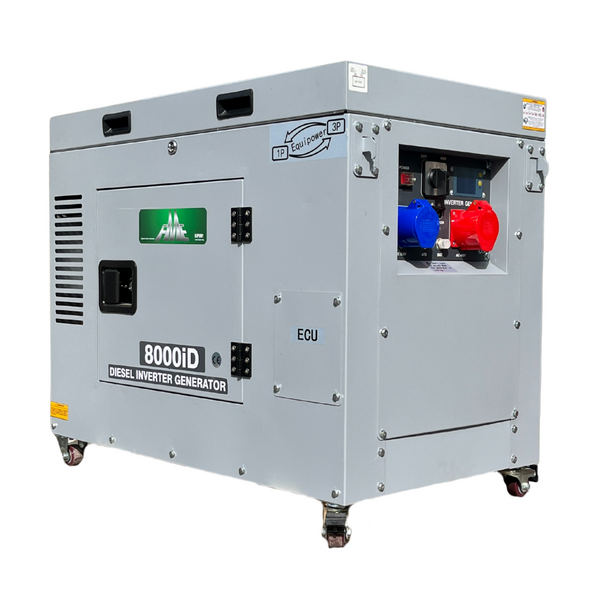
FME 8000iD Diesel Inverter
- 8,000 W continuous power – ideal for average heat pumps in detached houses
- 230V + 400V simultaneously – supplies single-phase and three-phase devices in parallel
- Pure sine wave with inverter technology – protects sensitive heat pump electronics
- ATS input for automatic backup power changeover – frost protection even when you're away
- Automatic CO shutdown – maximum safety when operating in enclosed spaces
Pure sine wave: why it's essential for heat pumps
The control electronics of modern heat pumps are sensitive to voltage fluctuations. Cheap generators often produce only a modified sine wave with harmonics and frequency fluctuations. This poor power quality can damage inverter boards, frequency converters and capacitors. Monobloc heat pumps with an integrated outdoor unit are particularly susceptible to such disturbances.
An inverter generator with a pure sine wave, on the other hand, delivers grid-quality power. The electronics can't tell the difference from normal operation. With diesel or petrol generators without inverter technology, an external UPS can act as a buffer between generator and heat pump. It filters out voltage spikes and stabilises the frequency at exactly 50 Hz. This reliably protects your heat pump's components from damage in an emergency.
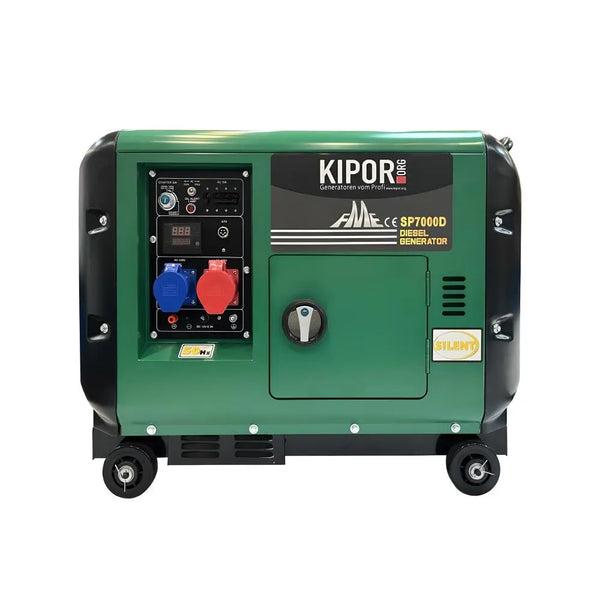
FME SP7000D AVR Diesel
- 7,000 W continuous power – powerful enough for demanding applications and larger loads
- AVR voltage regulation – stable 230V for reliable continuous operation
- Same Power technology – constant output in both 230V and 400V operation
- Rugged diesel engine – durable and low-maintenance for trades and businesses
- Proven in professional use – ideal for building sites, workshops and backup power systems
Calculating power and starting current correctly
The starting current determines the size of generator you need. When starting, the compressor motor briefly draws three to five times its rated power. A heat pump with 2,500 watts of continuous power therefore needs a generator with at least 7,500 to 10,000 watts of peak power. Modern inverter heat pumps with a soft-start function reduce this factor to around two. Check your system's rating plate or ask the manufacturer for the exact power consumption and starting current figures. As a rule of thumb: the generator's continuous power should equal the heat pump's rated power plus 30 per cent reserve.
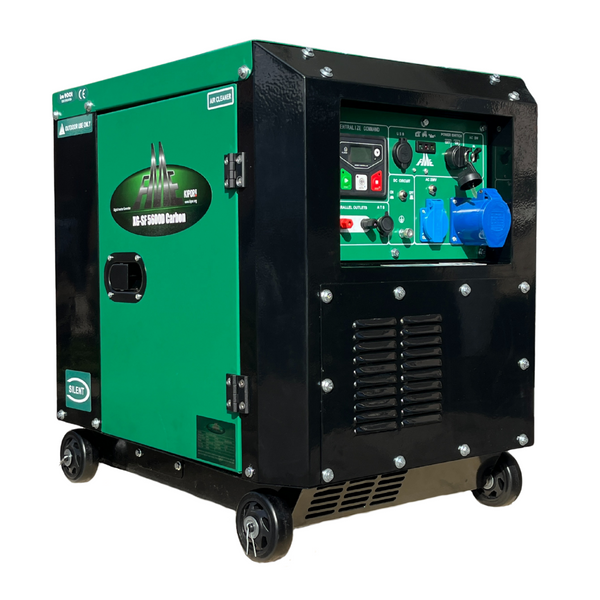
FME XG-SF 5600D Carbon
- 5,500 W continuous power – ideal for smaller heat pumps and mobile backup power
- Runs on diesel and heating oil – flexible choice of fuel for maximum independence
- Inverter technology with pure sine wave – safe power supply for sensitive electronics
- ECO mode – reduces fuel consumption and noise at partial load
- Electric start – convenient push-button operation
Alternative: PV system with battery storage as backup power
A PV system with battery storage offers an emission-free alternative to a conventional generator. During a power cut, a backup-capable inverter automatically switches to island mode. The battery then supplies the heat pump and other loads such as the fridge or lighting. This requires a battery with sufficient capacity – for an average heat pump in a detached house, at least 10 kWh of usable energy is recommended. This solution runs silently and needs no fuel supply.
Its limits become apparent during longer blackouts or in winter. Without sunshine, the battery doesn't recharge. During power cuts lasting several days, the stored energy is often not enough to prevent frost damage. Hybrid solutions therefore combine PV battery storage with a generator as backup. The battery automatically covers short outages, while the generator steps in when power is scarce for longer. An electric car with vehicle-to-home capability can also extend your storage options. Combining both systems significantly increases security and covers a range of situations.
Professional technology for private and business users alike
Behind Kipor.org there are no anonymous dealers, but Alexander and Tizian Harlinghausen. We combine technical innovation with absolute reliability. When it comes to an independent power supply, your home deserves the same high standards as critical infrastructure.
That's why it's not only demanding private users and tradespeople who trust our expertise, but also public institutions for whom reliability is not an option but an obligation:
- Supplier to the THW (German Federal Agency for Technical Relief) & police authorities: Our generators are designed for tough continuous use – ideal for running your heat pump safely in an emergency.
- Genuine inverter technology: We know that sensitive controls need clean power. Our units deliver a pure sine wave that protects your electronics.
- Developed from real-world experience: We understand the challenges of a modern heating system. Our solutions are designed to cushion high starting currents and run stably.
Our promise to you: we don't sell you an off-the-shelf unit – we sell you the certainty that your home stays warm and protected. Whether for blackout preparedness or mobile use – with Kipor you become independent.
Want to find out more? Read part 2: Installation & technology – how to connect your heat pump safely to backup power.
Frequently asked questions about backup generators for heat pumps
Can I run my heat pump with any backup generator?
No. During a power cut, a heat pump needs a generator with a pure sine wave and sufficient power reserve. Simple site generators often deliver unclean power that can damage the compressor and electronics. Inverter generators or synchronous generators with AVR voltage regulation are suitable for safe operation.
How many watts does a backup generator for a heat pump need?
For a detached house with an average heat pump, the requirement is 5,000 to 10,000 watts of continuous power. The starting current is decisive: when starting, the outdoor unit briefly draws three to five times its rated power. For an 8 kW heat pump, an inverter generator with at least 10 kVA of peak power is therefore recommended.
How much does a suitable backup generator for a detached house cost?
A high-quality generator for supplying your home costs between 2.000 € and 5.000 €. Diesel models cost more but offer lower consumption during longer operation. A backup battery as an alternative starts at around 3.000 € – yet reliably protects against freezing and total damage to pipes.
Is an inverter generator better than a conventional generator?
For heat pumps, an inverter generator is the better choice. It produces a pure sine wave and so protects sensitive electronics such as frequency converters and control boards. A conventional synchronous generator only works reliably for this purpose with additional AVR voltage regulation.
How do I connect a backup generator safely to my heat pump?
The connection is made via a changeover switch that disconnects the link to the public grid. This electrical installation must be carried out by a qualified electrician – backfeeding into the grid endangers line workers and neighbours. An automatic transfer switch (ATS) handles the changeover automatically, ensuring frost protection and heating even when you're away.
 Knetterhauser Straße 26