

A backup generator that fails to start in an emergency because the petrol in its tank has turned to gum after two years – that is one of the most common frustrations we see in our workshop. A dual fuel generator solves exactly this problem: it runs on either petrol or LPG (liquefied petroleum gas), giving you the freedom to use whichever fuel suits you at any given moment. Based on more than 18 years of hands-on experience, this guide shows you what LPG and dual fuel generators can really do, what running on gas costs you – and which model suits your application.
Key points at a glance
- Two fuels, one generator: A dual fuel generator runs on petrol or LPG (propane/butane) and can be switched over during operation.
- Gas can be stored indefinitely: LPG in a cylinder does not age – petrol, on the other hand, starts to lose its starting ability after just 3–6 months.
- Power loss on gas: In gas mode, most generators deliver around 10% less continuous power than on petrol.
- Long runtime: An 11 kg gas cylinder provides basic supply from a 3.5 kW-class generator for around 15–20 hours depending on load – and practically indefinitely if you swap cylinders.
- Bestseller at Kipor.org: The maXpeedingrods MXR 3500S is our best-selling dual fuel inverter generator (113 orders in the past year).
- Safety: Gas cylinders never belong in the cellar, and the generator only runs outdoors – carbon monoxide is odourless and deadly.
- What is a dual fuel generator?
- Why LPG? The real benefits for backup power
- Petrol, LPG or dual fuel – a direct comparison
- How much power do you lose on gas?
- How long does an 11 kg gas cylinder last?
- Which dual fuel generator is right for you?
- Connecting and storing gas cylinders safely
- FAQs about LPG and dual fuel generators
- Conclusion: flexibility that counts in an emergency
What is a dual fuel generator?
A dual fuel generator is a generator whose engine can run on both petrol and liquefied petroleum gas (LPG, i.e. propane or butane) – you switch between them with a selector switch or valve, without any conversion. The unit has a normal petrol tank plus a gas connection to which you attach a standard gas cylinder via a pressure regulator. Both fuels drive the same combustion engine, which in turn powers the alternator or the inverter electronics.
The practical benefit is independence: you are not reliant on a single energy source. If you have petrol in a jerry can, the generator starts straight away. If a gas cylinder is ready, you switch to gas and keep running for hours without refuelling. This is a real advantage for emergency preparedness in particular, because a generator is only useful if it starts reliably after months or years of standing idle.
Most dual fuel generators in the Kipor.org range are inverter generators. They produce a pure sine wave with total harmonic distortion (THD) below 3% – on both petrol and gas. This matters because sensitive loads such as heating controls, routers, laptops and medical devices need clean power. A dual fuel inverter generator therefore combines fuel flexibility with mains-quality electricity.
“The most common reason a backup generator fails in an emergency is stale petrol. If you buy a generator once and then leave it standing in the shed for years, you often end up with nothing more than an expensive paperweight during a blackout. With dual fuel, you avoid that completely: you store a gas cylinder, connect it, and the generator runs – even after three years in storage.”
– Alexander Harlinghausen, Managing Director of Kipor.org GmbH, 18+ years of experience with generators
Why LPG? The real benefits for backup power
For backup power, LPG is attractive above all because of one property: LPG in a cylinder keeps practically indefinitely, which solves the biggest problem of emergency preparedness with combustion engines. On top of that, it burns more cleanly and is often cheaper to run. Below, we separate the real benefits from the marketing promises you read in many online shops.
Unlimited shelf life – the petrol problem
LPG keeps indefinitely and can be stored in cylinders without any loss of quality – as confirmed by the German LPG Association (Deutscher Verband Flüssiggas). Petrol, by contrast, ages: after just 3–6 months it begins to oxidise, forms deposits and gums up the carburettor, which leads to starting problems. For a unit that is meant to stand by as a reserve for months or years, that is a decisive difference.
With LPG, you fill an 11 kg cylinder once, store it safely and have ready-to-use fuel for years. The gas does not lose its energy, and the generator starts reliably. If you still prefer petrol, you should rotate the fuel every few months – old petrol into the car, fresh petrol into the jerry can. A dual fuel generator spares you this routine, because the gas cylinder serves as the long-term reserve and the petrol is only kept on hand for a quick start. Find out more in our guide on how to start a generator after long storage.
Cleaner combustion, less maintenance
LPG burns with far fewer residues than petrol, which reduces deposits in the engine and carburettor. In practice, this means longer maintenance intervals and fewer of the typical storage-related faults such as gummed-up carburettor jets. The engine oil stays clean for longer on gas because less unburnt fuel finds its way into it.
What's more, running on LPG is often slightly quieter and smoother than running on petrol. This is not marketing but a result of the more even combustion of the gaseous fuel. If you regularly use your generator with a motorhome or near residential areas, that is a welcome side effect. Even so, a gas-powered generator is no quiet cordless DIY tool – at around 62 dB(A) at 7 metres, a good inverter generator is roughly as loud as a normal conversation.
Costs and availability
11 kg propane cylinders are widely available in Germany at petrol stations, DIY stores and specialist dealers, and are refilled through an exchange or deposit scheme. Per operating hour, gas is in many cases cheaper than petrol, even though the quantity consumed is similar depending on load. Petrol, on the other hand, scores with its universal availability at every petrol station – ideal if you need power spontaneously and without preparation.
This is exactly where the strength of the dual fuel solution lies: you do not have to commit. For long-term preparedness, you use the storable gas cylinder; for spontaneous use, you reach for petrol. This two-pronged strategy is the real reason dual fuel generators have become the choice of forward-thinking buyers.
Petrol, LPG or dual fuel – a direct comparison
In a direct comparison, no fuel wins across the board – each has a clear profile of strengths. Petrol stands out for instant availability and full power, LPG for shelf life and clean combustion, and dual fuel combines the best of both worlds for a small extra cost. The following table summarises the key differences.
| Criterion | Petrol | LPG (gas) | Dual fuel |
|---|---|---|---|
| Shelf life | 3–6 months (ages) | Unlimited | Both usable |
| Continuous power | 100% | approx. 10% less | Full on petrol |
| Combustion / maintenance | Residues, carburettor gums up | Clean, protects the carburettor | Gas mode protects the unit |
| Availability | Every petrol station | Cylinder from DIY store/petrol station | Both sources |
| Continuous runtime | Limited by tank size | Swap cylinders – virtually unlimited | Gas for continuous running |
| Instant start | Very good | Good | Petrol for a quick start |
| Ideal for | Spontaneous short jobs | Reserve and continuous operation | Maximum flexibility |
Fig. 1: Strengths of the three fuel options – dual fuel combines the advantages of petrol and LPG (source: Kipor.org)
How much power do you lose on gas?
On gas, most dual fuel generators deliver around 10% less continuous power than on petrol – this is down to physics and should honestly be factored in, even though many shops advertise “no loss of power”. A generator that manages 3,200 watts of continuous power on petrol typically delivers around 2,900 watts on gas. This order of magnitude is consistent across models from different manufacturers, for example Champion (3,500 W on petrol vs. 3,150 W on gas) or Einhell (1,800 W vs. 1,600 W).
In practice, this means you should size your generator so that it still has enough reserve for your appliances on gas. If you want to run a fridge, heating pump and lighting at the same time in an emergency, plan the load against the lower gas output – not against the peak petrol figure. With this reserve, you are on the safe side if you switch to gas for continuous operation.
The small loss of power is more than offset by one big advantage: runtime. While the petrol tank is limited by its volume, you can simply swap gas cylinders and keep running practically indefinitely. So if you want to bridge an outage lasting several days, you gain more with gas than you lose in peak power.
Fig. 2: Power and runtime compared – example values for the 3.5 kW class (source: Kipor.org / manufacturer and consumer data)
Expert tip: Always calculate your power requirement against the gas output, not the peak petrol figure. And remember the starting current: appliances with a motor or compressor – fridges, heating pumps, heat pumps – briefly draw 3 to 6 times their rated power when starting. If you are running on gas at 2,900 watts, the total of your continuous load should be well below that so there is still reserve when the fridge starts up. We show you how to calculate your requirement properly in our guide to generators for home use.
How long does an 11 kg gas cylinder last?
An 11 kg propane cylinder lasts around 15 to 20 hours, depending on load, when a 3.5 kW-class generator provides typical basic supply – fridge, heating pump, router and lighting. At full load, the runtime drops accordingly; in economical ECO mode at low load, it increases. The key point: as soon as the cylinder is empty, you swap it for a full one in a few minutes – and keep running.
This makes dual fuel particularly suitable for outages lasting several days. With two or three spare cylinders, you can bridge longer emergencies too, without depending on a working petrol station. The German Federal Office of Civil Protection and Disaster Assistance (BBK) recommends being prepared for around 10 days anyway – with storable gas, this target can realistically be met for your power supply.
Our best-selling dual fuel inverter generator is the maXpeedingrods MXR 3500S: 113 orders in the past year make it the clear bestseller in this category. It offers 3,200 watts of rated power, a 5.7-litre petrol tank and – with a gas cylinder connected – virtually unlimited runtime.
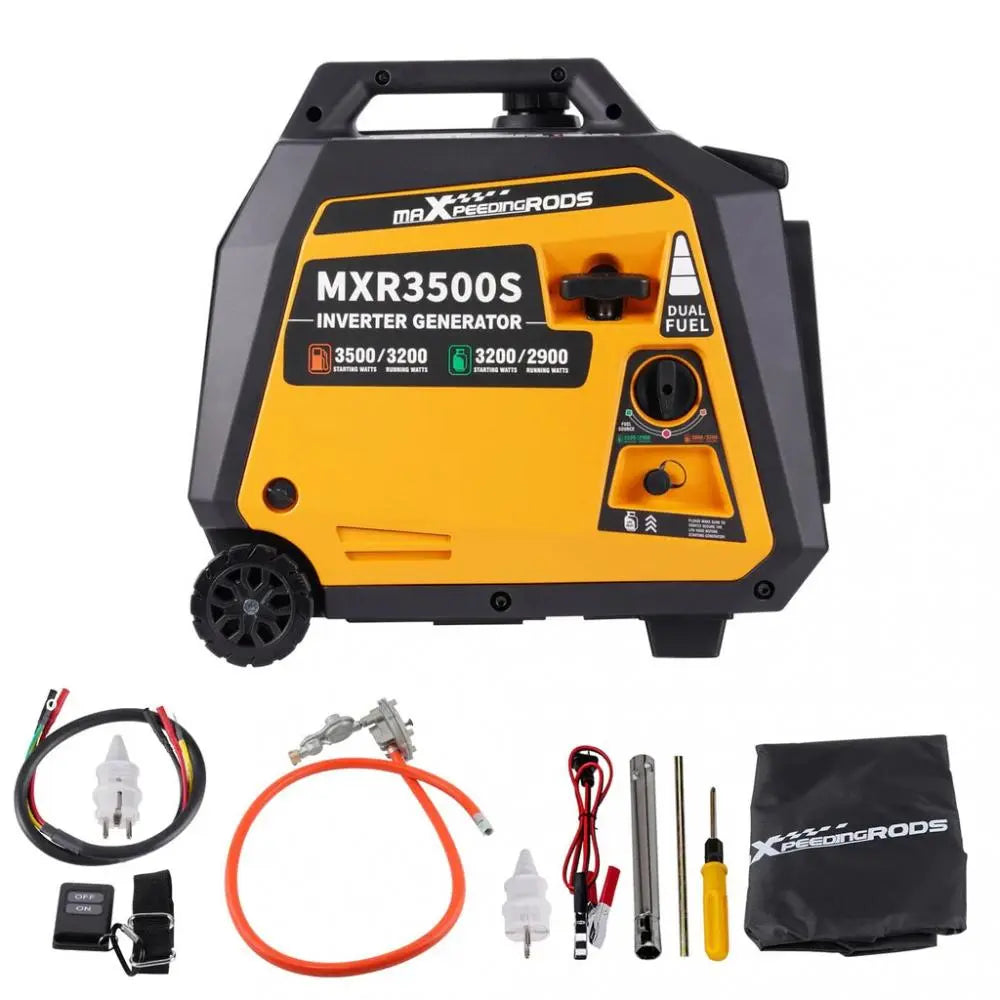
maXpeedingrods MXR 3500S – dual fuel inverter generator
- Petrol or LPG – switchable while running, for an instant start and continuous operation
- 3,200 W rated / 3,500 W maximum power – pure sine wave (THD < 3%) for sensitive electronics
- 5.7 L tank + gas connection – practically unlimited runtime with a cylinder
- 62 dB(A) at 7 m, 25 kg – 3 ways to start: recoil start, electric start and wireless remote control
- Price: approx. 749,95 € – best-selling dual fuel generator at Kipor.org (please check the current price in the shop)
Which dual fuel generator is right for you?
Which dual fuel generator is right for you depends on how you use it: maximum self-sufficiency at home, quiet comfort in a motorhome or high output for commercial use. For most households, a 3.5 kW-class generator is sufficient, while food trucks or events call for three-phase power and significantly more output. Below, we match the right models to their applications.
Backup power and maximum self-sufficiency
For backup power at home, a 3.5 kW-class dual fuel inverter generator is the recommended choice, because it covers basic supply and comfort appliances and remains ready for use for years thanks to the gas cylinder. If value for money matters more to you than maximum convenience, the maXpeedingrods MXR 3800DF is a solid classic – the same power range, a leaner feature set and a lower price. We have described it in detail in our dual fuel generator review for home use.
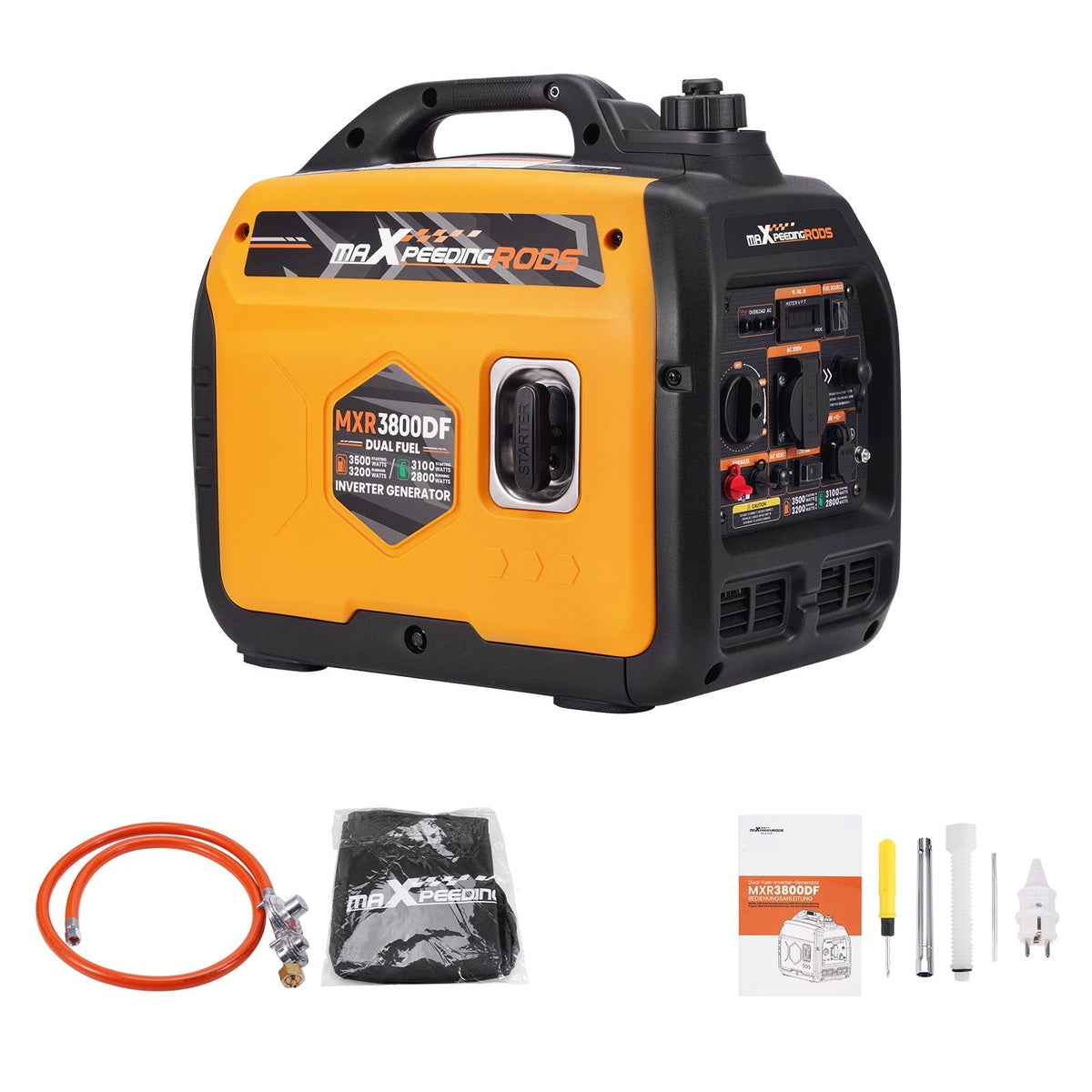
maXpeedingrods MXR 3800DF – the dual fuel classic
- Petrol + LPG, around 3,500 W – for basic supply and backup power in a detached house
- Inverter generator with pure sine wave – safe for heating controls, routers and laptops
- LPG reserve can be stored indefinitely – starts reliably even after months in storage
- Affordable entry into dual fuel technology based on the proven maXpeedingrods platform
- Price: approx. 545,00 € – the most affordable dual fuel generator in our range (please check the current price in the shop)
If you like to monitor your generator remotely, the maXpeedingrods MXR 4000GT is a dual fuel inverter generator with app control – handy if the unit stands in the garden or shed and you want to keep an eye on fuel level and load from the sofa.
Camping and motorhomes
For camping and motorhomes, low weight combined with clean, quiet power is what matters most – and this is exactly where the gas option comes into its own. If you already carry a gas cylinder on board for the cooker or heater, you can use the same fuel for the generator. Compact dual fuel generators such as the Champion Atom Fusion 3000 DF with around 3,000 watts offer brand quality in a handy format – practical if you want to save storage space anyway.
A practical advantage in everyday camping: on gas, the engine runs cleaner and the carburettor stays clear – especially with units that stand idle for long periods between trips. This way, you avoid the classic “it won't start after the winter” problem that plagues many petrol generators.
Commercial use, events and three-phase power
For food trucks, events and businesses that need three-phase power, dual fuel is also available in the big league – for example the Kompak KGG90Ei-DF with 11 kVA and a 400-volt connection. Here, the gas option pays off twice: at events, supplying gas cylinders is often easier to organise than constant petrol refuelling, and cleaner combustion reduces odour and maintenance during continuous operation. If you are unsure which power class suits your business, take a look at our gas generator collection or get some quick advice.
Connecting and storing gas cylinders safely
Clear safety rules apply when handling LPG, because liquefied petroleum gas is heavier than air and, in the event of a leak, collects at ground level, where it can form an explosive mixture. That is why gas cylinders must never be stored in cellars or rooms below ground level – in Germany, this is set out in the Technical Rules for LPG (TRF 2021). If you know these basic rules, you can operate a dual fuel generator completely safely.
How to connect the gas cylinder correctly
The connection is made via a pressure regulator and a gas hose, which are included with most dual fuel generators. Note the left-hand thread on the cylinder valve, check all connections for leaks with leak detection spray before starting, and only open the cylinder valve once everything is tight. The cylinder stands upright next to the generator, secured against tipping over – outdoors, never in an enclosed space.
CO safety warning: A generator – whether running on petrol or gas – produces carbon monoxide (CO). CO is odourless and deadly. Only ever operate the generator outdoors, at least 5 metres away from windows, doors and ventilation openings. Never let it run in a garage, cellar or living space – not even “just for a moment”. Find out how to plan the set-up and exhaust routing correctly in our guide to safe operation in a garage or basement.
Fig. 3: Safe handling of gas cylinders in accordance with TRF 2021 (source: Kipor.org / German LPG Association)
Storing gas cylinders correctly
In a private household, no more than two LPG cylinders (5 or 11 kg each) may be kept inside the building, and only one of them may be connected – the second is stored in a different room. Cellars, bedrooms, stairwells and hallways are off-limits; the storage location must be above ground level and ventilated. These requirements are clearly summarised in the LPG guide from Rheingas. Spare cylinders beyond this quantity belong outdoors – in a well-ventilated garden cabinet, for example.
Storage safety warning: Never store gas cylinders in the cellar or in rooms below ground level. Because LPG is heavier than air, it collects at the lowest point in the event of a leak and can ignite. Always keep cylinders upright, secured and with the valve protection cap fitted – and remove them from bedrooms and passageways.
Expert tip: In cold weather, the gas supply can weaken – this mainly affects butane, which barely vaporises below around 0 °C. For winter and backup power use, you should therefore use pure propane cylinders: propane delivers reliable pressure even in sub-zero temperatures. Also, do not store the cylinder in an ice-cold shed but in a frost-protected, ventilated place above ground level – then the gas will ignite immediately even in January.
FAQs about LPG and dual fuel generators
Does a dual fuel generator lose power when running on gas?
Yes, usually by around 10%. A generator with 3,200 watts of continuous power on petrol typically delivers around 2,900 watts on gas. You should therefore size your generator against the lower gas output and allow a reserve for the starting current of motor-driven appliances to avoid overload during continuous operation.
How long does a gas cylinder last on a generator?
An 11 kg propane cylinder lasts around 15 to 20 hours with a 3.5 kW generator providing basic supply, depending on load. At full load the runtime drops; in ECO mode it increases. As you can swap the cylinder for a full one in minutes, the total runtime is practically unlimited – ideal for power cuts lasting several days.
Can LPG really be stored indefinitely?
Yes. LPG in a cylinder does not age and does not lose energy, even after years – as confirmed by the German LPG Association. This means LPG solves the biggest problem of backup power with combustion engines: petrol gums up after just 3–6 months and causes starting problems, while gas stays ready for use permanently.
Can I store the gas cylinder in the cellar?
No. LPG is heavier than air and, in the event of a leak, collects at floor level, where it can form an explosive mixture. Storage in cellars, rooms below ground level, bedrooms and hallways is prohibited under TRF 2021. Ventilated rooms above ground level are permitted – with a maximum of two cylinders per household.
Which dual fuel model is right for backup power at home?
For most detached houses, a 3.5 kW-class dual fuel inverter generator is the right fit. Our best-selling model is the maXpeedingrods MXR 3500S with 3,200 watts of rated power, three starting methods and a pure sine wave. If you want an affordable entry point, go for the MXR 3800DF. If you are unsure, we will be happy to calculate your requirements personally.
Conclusion: flexibility that counts in an emergency
A dual fuel generator is the smartest choice for anyone who wants to combine emergency preparedness with everyday practicality: you use petrol for a spontaneous instant start and storable LPG for a long-term reserve that will still start years later. The small loss of around 10% power on gas is more than outweighed by the almost unlimited runtime. For most households, the maXpeedingrods MXR 3500S is the right all-rounder, while budget-conscious beginners are well served by the MXR 3800DF.
Not sure which model and power class suits your needs? Browse our complete gas generator collection or contact us for personal advice. We will calculate your exact power requirement and work with you to find the right backup power solution for your home.

 Knetterhauser Straße 26

