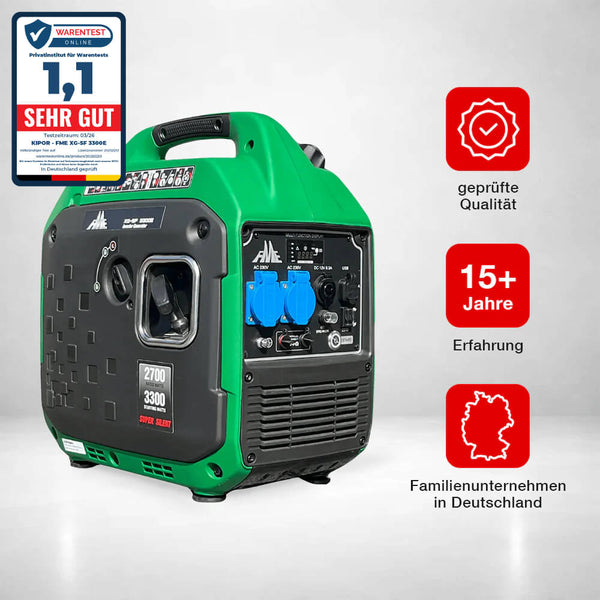
3300 W Petrol Inverter Generator with Electric Start, only 21.4 kg – FME XG-SF 3300E
2.9 kW
Max. output
5.8 L
Tank capacity
Recoil start;…
Start type


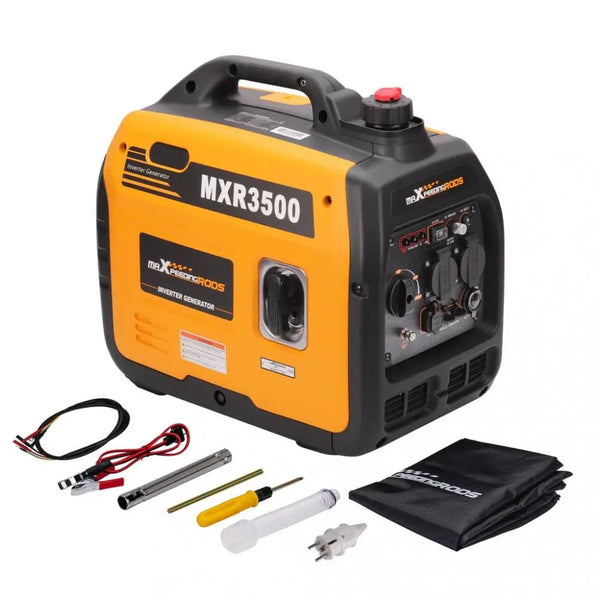


Our digital Generator Advisor finds the right generator for your needs in 60 seconds.
Pure sine wave – safe for laptops, TVs, CPAP machines, drones and all sensitive devices
Quiet operation – typically 55–65 dB(A) in eco mode, campsite-friendly
Light & portable – models from 21.4 kg, with carry handles and a compact design
Eco mode for economical consumption – engine speed adapts automatically to the load
A complete energy range – inverter generators, portable power stations and foldable solar panels from a single source
Personal advice for your trip – free on +49 (0) 5423 477400 or 24/7 online
Whether you're on a campsite, in a motorhome, by a lake, at a festival or in a food truck – on the road you want power that flows just as reliably as it does at home. But not every generator is suited to mobile use: on a campsite, noise and weight are what count; in a motorhome, it's a clean sine wave and compact dimensions; and everywhere, it's better to start light and power your kit safely than to buy too big.
At Kipor.org you'll find the right setup for every trip – from compact 2 kW camping inverters and 3–4 kW motorhome models with wireless remote control to a portable power station and solar combination for completely silent, emission-free power.
At Kipor.org we tell you the truth before you spend your money:
A portable power station is the right choice if:
– You only want to run low-power devices (smartphone, laptop, LED lights, small cool box, CPAP).
– You need silent, emission-free power – for example on your pitch at night or in a tent.
– You go on short trips or can regularly recharge from the mains or with solar.
A generator is the right choice if:
– You want to run power-hungry appliances (coffee maker, kettle, microwave, air conditioning, tools).
– You're off-grid for longer and need the range a fuel tank gives you.
– You need to handle higher starting currents – e.g. from air conditioners or compressor fridges.
The ideal solution for many motorhome and camping fans is to combine the two: a portable power station for quiet, emission-free power during the day and at night – plus an inverter generator as backup when solar isn't enough or you need a reserve.
1. Pure sine wave (inverter): Motorhomes often have on-board electronics, heating controls, inverters, TVs and laptops installed. Conventional AVR generators with unstable voltage can damage these devices over time. So: inverter generators only, with a true sine wave. In our camping range at Kipor.org you'll find inverter models exclusively.
2. Noise level: Many campsites have strict quiet hours and noise limits (often 65 dB(A) during the day, 50 dB(A) at night). Inverter models in eco mode run at 55–65 dB(A) – usually acceptable. Conventional AVR units at 75–90 dB(A) often won't be allowed on campsites.
3. Weight & transport: Motorhome owners often have to carry the generator themselves. Models from 21 kg (FME XG-SF 3300E) can be carried by one person. Larger models from 25 kg are easier to handle with carry handles or built-in wheels.
4. Eco mode: Inverter generators with eco mode adapt the engine speed to the actual load – saving fuel and noticeably reducing noise when you don't need full power.
5. Parallel operation: Some inverter models can be linked in pairs – doubling the output without having to buy a bigger, heavier generator. Handy when you occasionally need to run a powerful air conditioner.
1,000–2,000 W: Compact camping inverters for lighter loads – charging phones and laptops, lighting, a small cool box, LED string lights. Ideal for tent camping, outdoor photography trips or small caravans.
2,000–3,000 W: The best-selling camping class. Powers a coffee maker, toaster, small kettle, motorhome fridge, heating and lighting – everything you need in everyday motorhome life. Models such as the KIPOR IG2000iS and IG3500 cover this class.
3,000–4,000 W: The comfort class for larger motorhomes, food trucks and mobile catering. Powers several appliances at once and also runs motorhome air conditioners (note: high starting currents – check the data sheet!). Here you'll find the FME XG-SF 3300E (3.3 kW, just 21.4 kg) and the FME XG-SF 4000ER (3.8 kW with wireless remote control).
Over 4,000 W: For more power-hungry applications, fully equipped food trucks or as a central generator for several motorhomes travelling in a group. For these we generally recommend diesel inverter models.
FME XG-SF 3300E – the ultra-light champion: 3.3 kW continuous power, just 21.4 kg, compact design, recoil and electric start, parallel-capable. The top choice for motorhomes, mobile catering and caravans.
FME XG-SF 4000ER – the comfortable one: 3.8 kW continuous power with wireless remote control, electric start and quiet eco mode. Ideal if you want to start the generator from inside your motorhome without having to go outside.
KIPOR IG2000iS & IG3500 – the camping classics: Proven inverter generators in the 2 kW and 3.4 kW classes, light and portable. At 56 dB(A), the IG2000iS is extremely quiet – ideal for peaceful campsites.
Genergy portable power stations (GZE series): The emission-free, silent alternative – LiFePO4 battery with 4,000+ charge cycles, pure sine wave, USB-C PD and MPPT solar input. Ideal as a standalone solution for shorter trips or as a quiet addition to your generator.
Foldable solar panels: Connected to the power station via the MPPT input – emission-free, self-sufficient power on your pitch without having to start the generator.
Air conditioners are the biggest challenge for portable generators – not because of their continuous power draw, but because of the starting current. A typical Dometic, Truma or Webasto motorhome air conditioner draws 1,500–2,500 W while running, but briefly 3,000–4,500 W on start-up.
Practical tip: for reliable air conditioning, choose a generator with at least 3.5 kW continuous power and 4.5 kW peak power. Inverter models often have an advantage here, because their peak power can briefly be considerably higher than that of conventional AVR units.
If you have a particularly modern air conditioner with an inverter compressor (soft start), a 3 kW generator may be enough – you'll need to check this for your specific model. We're happy to help.
The rules vary from campsite to campsite. There are three points you should keep in mind:
1. Noise level: Many sites set a maximum of 65 dB(A) during the day and 50 dB(A) at night. Inverter generators in eco mode usually meet this without any problem; conventional AVR generators don't.
2. Quiet hours: A midday rest period (usually 1–3 pm) and night-time quiet hours (usually 10 pm–7 am) apply on most sites – running a generator during these times is often completely prohibited. A portable power station is the elegant solution here.
3. Exhaust fumes: Never run a generator inside a closed motorhome, an awning or under a canopy – acute risk of CO poisoning! Always set it up outdoors, well away from doors and ventilation openings.
In our camping and motorhome range we stock FME (the XG-SF series, our own brand), KIPOR (IG series), Genergy (portable power stations, mini inverters), Champion and other brands. We technically check every model and approve it for the European market.
You'll also find all the accessories you need on the road: cable reels, CEE adapters, IP44 extension cables, foldable solar panels with MPPT, portable power stations and soundproof enclosures for particularly noise-sensitive locations.
That depends on your appliances. For normal motorhome loads (fridge, coffee maker, heating, lighting, laptop), 2–3 kW is typically enough. If you want to run an air conditioner, we recommend at least 3.5 kW continuous power. Important: always choose an inverter generator with a pure sine wave – the on-board electronics of modern motorhomes are sensitive.
Yes, but you need to choose the right size. Motorhome air conditioners have high starting currents (briefly 3,000–4,500 W), even though they only draw 1,500–2,500 W continuously. We recommend a generator with at least 3.5 kW continuous power and a suitable peak reserve. Inverter generators often have the edge here – they cope better with short load peaks than conventional AVR units.
Modern inverter generators in eco mode typically run at 55–65 dB(A) at 7 m – the level of normal conversation. The KIPOR IG2000iS even achieves 56 dB(A), which is close to the noise level of an office. Conventional AVR generators, by contrast, run at 75–90 dB(A) – usually not acceptable on campsites.
In eco mode at low load: typically 8–12 hours. At full load: 4–6 hours. For example, the FME XG-SF 3300E with its 7-litre tank runs for around 9 hours at 25% load, and the XG-SF 4000ER with its 7.5-litre tank for around 8 hours. You'll find the exact figures on each product page.
That depends on your appliances and how long you're away. For weekend camping with a smartphone, laptop, LED lights, cool box and CPAP, a 500–1,000 Wh power station is plenty – especially combined with a foldable solar panel. For longer trips or power-hungry appliances (coffee maker, air conditioning), a power station on its own usually isn't enough – this is where a power station plus inverter generator combination is ideal.
A pure sine wave is the clean, smooth AC waveform you also get from a household socket. It's essential for sensitive electronics – laptops, TVs, heating controls, motorhome inverters, CPAP machines. Cheap generators with a modified sine wave can damage these devices. Inverter generators always produce a pure sine wave – conventional AVR generators often don't.
In eco mode, the generator automatically adapts its engine speed to the actual load. At low load the engine runs more slowly, uses less fuel and is much quieter. At high load it speeds up. Eco mode is only possible on inverter generators, because there the inverter keeps the voltage constant regardless of engine speed.
Many modern inverter models (e.g. FME XG-SF 3300E, XG-SF 4000ER) are parallel-capable. A special parallel cable links two units into one system – doubling the output without having to buy a bigger, heavier generator. Handy if you occasionally want to run an air conditioner but don't want to haul a 6 kW monster around.
Electric start is about convenience – you start at the push of a button instead of with a recoil cord, which is a real benefit with larger generators and in cold weather. Wireless remote control (as on the FME XG-SF 4000ER) lets you start and stop the generator from inside your motorhome – without going outside, without getting soaked and without disturbing the neighbours. For comfort-minded motorhome owners, a remote control is worth its weight in gold.
No, never. Generators with combustion engines produce carbon monoxide – an odourless, potentially fatal gas. There's a risk of poisoning even under a canopy, in an awning or in semi-enclosed areas. Always set the generator up outdoors, well away from the motorhome, doors and windows. For indoor-friendly solutions, a portable power station is the only safe alternative.
Via a suitable CEE inlet socket on the motorhome (usually Schuko or blue CEE 16 A) and a matching cable. Important: the motorhome's on-board electrical system must allow an external supply (all modern motorhomes do). Before connecting, check that the generator is correctly earthed – modern inverter units have this built in. We're happy to advise you on the right cabling.
Yes – for many users, solar is a real game-changer. A foldable 200–400 W solar panel connected to a power station delivers enough power during the day to fully recharge it – with no generator noise, no fuel costs and no exhaust fumes. On fixed pitches or trips with longer stays, the combination of solar + portable power station + inverter generator as backup is arguably the most elegant mobile energy strategy.
Not sure which generator size suits your motorhome, whether a portable power station is enough or whether you need both? Our team will give you free, brand-independent advice on +49 (0) 5423 477400.
Outside our business hours, our free online Generator Advisor is available 24 hours a day, 7 days a week. We deliver throughout the EU.
Conventional generators fluctuate. Inverters clean up the power digitally – your laptop and phone will thank you.
Enclosed housings and eco mode make them up to 30% quieter than conventional generators.
The engine only revs as high as it needs to. Need just 100 W? It simply ticks over at idle.
Safe for laptops & IT equipment
Quieter than a conversation
Order today, ready to ship tomorrow


 Knetterhauser Straße 26