

When buying a generator, you almost always face the same question: petrol or diesel? The honest answer depends less on the price and more on how often and what you use the machine for. Drawing on more than 18 years of hands-on experience, this petrol generator buying guide shows you when a petrol generator is the right choice, when diesel pays off – and which model suits your application.
Key points at a glance
- Rule of thumb: A petrol generator makes sense for occasional use (below roughly 100 operating hours a year); diesel pays off with regular continuous operation and from around 5 kW output.
- Purchase price: Petrol models start at around 250 € (Voltherr KGE 950Pro), whereas diesel inverter generators start at roughly 1.400–2.700 €.
- Power quality: Inverter generators deliver a pure sine wave (total harmonic distortion THD < 3 %) for sensitive electronics – AVR units are only suitable for robust appliances (fluctuations of up to ±10 %).
- Fuel: Petrol goes stale after 3–6 months, or 12–24 months with a stabiliser; diesel keeps for 12+ months, and LPG (liquefied petroleum gas) can be stored practically indefinitely.
- Storage: A maximum of 1 litre of petrol is permitted in a flat, and 20 litres in a cellar or garage (source: TÜV-Verband, the association of German technical inspection organisations).
- Safety: Only ever run combustion engines outdoors, at least 5 m away from doors, windows and vents – carbon monoxide is odourless and deadly.
- Petrol or diesel – the honest short answer
- Inverter, AVR or synchronous? The technology behind it
- Petrol vs. diesel: a direct comparison
- Which petrol generator for which application?
- When diesel is the better choice
- Storing fuel: shelf life, E10 & safety
- Sizing correctly: starting current, not rated power
- Safe operation: CO, feeding into the grid, refuelling
- Frequently asked questions about petrol generators
- Conclusion: which fuel is right for you?
Petrol or diesel – the honest short answer
For most private buyers, a petrol generator is the right choice: it is cheaper to buy, lighter and quieter, and perfectly adequate for occasional use – camping, the garden, backup power during short outages. Diesel only pays off once you run the generator regularly and for many hours at a time.
Our rule of thumb from 18 years of advising customers: below roughly 100 operating hours a year, petrol is the cheaper and simpler option. If you produce power for many hours on a continuous basis – commercial use, agriculture, backup power for a heat pump – diesel serves you better, because the higher purchase price is recouped through lower fuel consumption. In between there is a middle ground: dual fuel generators that run on either petrol or liquefied petroleum gas (LPG).
A look at the reliability of the grid explains why petrol is sufficient for typical emergency preparedness: in 2024 the average power outage in Germany amounted to just 11.7 minutes per household (2023: 12.8 minutes), according to the Bundesnetzagentur (Federal Network Agency). For scenarios like these – and for outages lasting several hours – a compact petrol inverter generator is enough. It is no coincidence that our best-selling generator last year was a petrol model: the maXpeedingrods MXR 3500 with 3,300 watts.
Inverter, AVR or synchronous? The technology behind it
With petrol generators, power quality is determined not by the fuel but by the design: inverter generators use electronics to deliver a pure sine wave (THD < 3 %), whereas conventional synchronous and AVR generators produce power directly from the engine speed – with voltage fluctuations of up to ±10 %. It is precisely this difference that determines which appliances you can connect safely.
An inverter first converts the generated power into direct current and then electronically shapes it into a clean sine wave. This is essential for modern heating controls, smart home devices, routers, laptop power supplies and anything sensitive to voltage spikes. The TÜV-Verband also explicitly recommends a generator with an inverter for sensitive electronics such as laptops, smartphones or TVs, as it prevents voltage fluctuations. That is why practically all of our petrol recommendations for home use are inverter generators.
Pure sine wave vs. ±10 % voltage fluctuation
An AVR generator (automatic voltage regulator) is cheaper and robust, but only keeps the voltage roughly constant – fluctuations of up to ±10 % are no problem for a drill, a pump or a site floodlight, but too much for modern heating electronics or a laptop. AVR petrol generators such as the DeWalt DXGNP35E (3,500 W) are therefore an economical option for the building site, not for sensitive home systems.
Important: Never connect sensitive electronics – heating controls, PCs, medical devices – to an AVR or basic synchronous generator. Voltage fluctuations of up to ±10 % can damage power supplies and control boards. For loads like these, an inverter with a pure sine wave (THD < 3 %) is a must.
Petrol vs. diesel: a direct comparison
In a direct comparison, petrol wins on purchase price, weight and noise, while diesel wins on fuel consumption, fuel shelf life and continuous operation. So there is no overall winner – what matters is which of these criteria count for your application. The following infographic summarises the seven most important differences.
Fig. 1: Petrol and diesel generators compared side by side – no overall winner, it all depends on the application (source: Kipor.org)
In figures, this means: petrol inverter generators are available from around 250 €, while a comparable diesel inverter generator starts at around 1.400 € and quickly costs 2.700 € or more in the 5 kW class. In return, a diesel uses around 20–30 % less fuel at half load and is designed for long runtimes. Petrol scores on weight: our lightest inverter generators weigh from 18 kg, whereas a diesel generator with the same output is considerably heavier and bulkier.
| Criterion | Petrol generator | Diesel generator |
|---|---|---|
| Purchase price | from approx. 250 € | from approx. 1.400 € (inverter) |
| Fuel consumption | higher | −20–30 % at half load |
| Weight | light (from 18 kg) | heavier |
| Fuel shelf life | 3–6 months (12–24 with stabiliser) | 12+ months |
| Ideal for | camping, garden, backup power, occasional use | continuous operation, heat pump, commercial use |
| Economical from | any occasional use | regular operation, ~5 kW+ |
When diesel starts to pay off
Diesel generators pay off from around 5 kW output and with regular use, because diesel engines use around 20–30 % less fuel at half load and are built for long-term operation. For heavy users with several hundred operating hours a year, the higher purchase price is recouped through lower running costs. For occasional users, however, the maths works the other way round: the extra cost of diesel is never recovered.
“The most common fuel mistake is customers buying an expensive diesel even though they only need the generator twice a year for a few hours. Diesel is an investment that pays off through operating hours – not through the feeling of having bought the more powerful machine. If you rarely need power, a good petrol inverter generator is cheaper and more flexible.”
– Alexander Harlinghausen, Managing Director of Kipor.org GmbH, 18+ years of experience with generators
Which petrol generator for which application?
To find the right petrol generator, first define your application and then choose the power class: camping and the garden need 1,000–2,300 watts, basic home supply 3,000–4,000 watts, and a comfortable supply 4,500–5,500 watts. The following overview sorts the three typical scenarios.
Fig. 2: Three fuel scenarios – petrol for occasional use, dual fuel for flexible backup power, diesel for continuous operation (source: Kipor.org)
Camping, garden & on the go
For camping, motorhomes and garden work, a lightweight petrol inverter generator with a pure sine wave is the best choice, because it runs quietly, weighs little and safely charges laptops, cool boxes and phones. In this class every kilo counts: units from 18 kg can still easily be carried by one person. If you only want to power lights, power banks and small appliances, the Voltherr KGE 950Pro (950 W) from around 250 € – our cheapest inverter generator – is all you need.
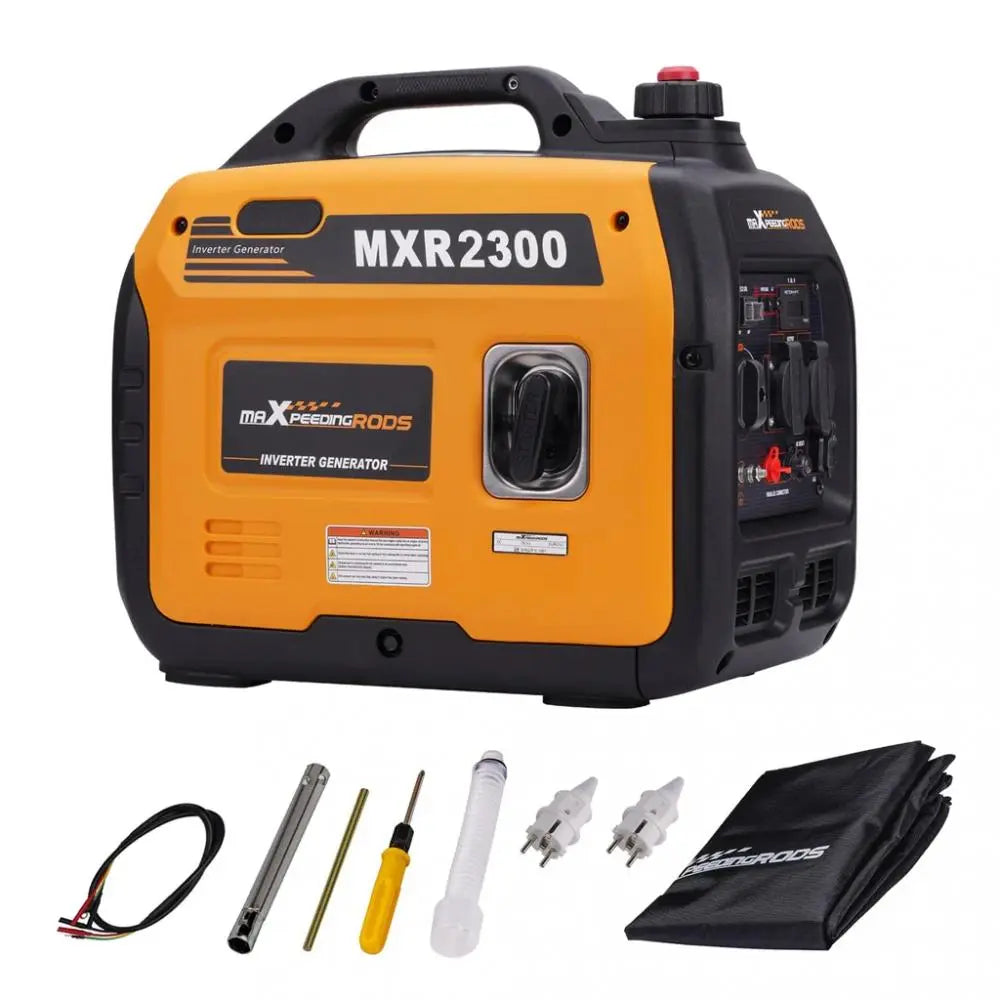
maXpeedingrods MXR 2300 – petrol inverter generator for on the go
- Output: 1,800 W rated / 2,300 W maximum – powers routers, cool boxes, lights and chargers
- Weight: just 18 kg – easy for one person to carry and store
- Tank: 4 litres – over 10 hours of runtime in eco mode
- Inverter technology: pure sine wave – safe for laptops and smartphones
- Price: from approx. 399,95 € – affordable inverter backup for camping & the garden
Backup power for a detached house
For basic supply to a detached house during a power cut, 3,000–4,000 watts of inverter power is enough – that powers the fridge, heating controls, router and lighting at the same time. Besides output, noise level is important here, because every decibel counts in a residential area. Our best-selling mid-range model, the FME XG-SF 4000ER, stays below 55 dB(A) at 7 metres – roughly the level of a normal conversation.

FME XG-SF 4000ER – petrol inverter generator with remote start
- Output: 3,600 W rated / 3,800 W maximum – fridge, heating, router and TV at the same time
- Noise level: below 55 dB(A) at 7 m – quietest in its class, suitable for residential areas
- Convenience: electric start + wireless remote control, trolley – start it from inside the house
- Inverter: pure sine wave (THD < 3 %), up to 14 h runtime, low-oil warning
- Price: from approx. 1.049,95 € – one of our best-selling home generators
If you prefer something a little cheaper, the maXpeedingrods MXR 3500 (3,300 W) – our best-selling generator – is a strong, good-value alternative for basic supply. You will find both models in our petrol generators collection.
Comfort & larger households
If you also want to run a coffee machine, microwave, washing machine or a workshop, you need 4,500–5,500 watts. Units such as the maXpeedingrods MXR 5500i cover this comfortable level of supply and, thanks to inverter technology, keep the power clean even for sensitive devices. Not everything runs at the same time – but you can switch loads on as needed without overloading the generator.

maXpeedingrods MXR 5500i – petrol inverter generator for comfort
- Output: approx. 5,000 W rated / 5,500 W maximum – comfortable supply & workshop
- Inverter technology: pure sine wave – also suitable for sensitive electronics
- Reserve: plenty of headroom for the starting currents of pumps or washing machines
- Applications: larger households, hobby workshops, powerful appliances
- Price: from approx. 1.199,95 € – a powerful petrol solution for full coverage
When diesel is the better choice
Diesel is always the better choice when you run the generator regularly, for long hours or for demanding continuous loads such as a heat pump. Diesel engines are designed for high running hours, use 20–30 % less fuel at half load, and the fuel keeps much better at 12+ months. For homeowners with a heat pump, continuous power is also decisive, because the compressor draws several times its rated power when starting.

FME XG-SF 5600D Carbon – diesel inverter generator
- Output: 5,000 W rated / 5,500 W maximum – continuous power for demanding home systems
- Diesel efficiency: −20–30 % fuel consumption at half load, long runtimes
- Inverter power quality: clean sine wave despite diesel engine
- Applications: heat pump, continuous operation, regular use
- Price: from approx. 2.699,95 € – our most popular diesel inverter model
To be honest: a diesel inverter generator costs more than twice as much as a comparable petrol model and is heavier – you only recoup this extra cost over many operating hours. If you produce power regularly, you will find suitable models in our diesel generators collection; our diesel generator buying guide covers everything you need to know about choosing one.
There is a practical middle ground between petrol and diesel: dual fuel generators that run on either petrol or liquefied petroleum gas (LPG). The big advantage for backup power: a gas cylinder can be stored for years, so the generator starts reliably even after a long period of storage. Models such as the maXpeedingrods MXR 3800DF demonstrate this in practice; you will find an overview in our gas generators collection.
Storing fuel: shelf life, E10 & safety
Petrol's biggest weakness for backup power is its limited shelf life: regular petrol goes stale after 3–6 months and forms gummy deposits in the carburettor that cause starting problems. With a fuel stabiliser, storage life extends to 12–24 months. Diesel keeps for 12+ months, and LPG can be stored practically indefinitely – a real advantage for emergency preparedness.
Fig. 3: Fuel shelf life compared – plus the legal storage limits for petrol (source: Kipor.org / German technical inspection association)
How long does petrol last – and what helps?
For your petrol generator to start reliably after a period of storage, the carburettor matters more than the tank: stale, gummy petrol clogs the fine jets. So never store the generator for months with a full tank of untreated petrol. Our guide how to start a generator after long storage shows you how to lay up a unit correctly and bring it back into service.
Expert pro tip: If you are storing the generator for a longer period, add fuel stabiliser to the petrol, let the engine run for a few minutes (so the treated petrol reaches the carburettor) and then run the carburettor dry until the engine stops by itself. This way you avoid the most common starting failure after winter.
E10 or Super E5?
For stationary equipment the type of fuel matters more than for a car: the ethanol content of E10 (up to 10 %) draws moisture from the air and accelerates ageing – with infrequent use, this can encourage starting problems. Many small-engine manufacturers therefore recommend Super E5 or a special alkylate petrol for rarely used equipment. Before refuelling, always check your model's operating manual to see which fuel is approved – and add stabiliser for longer storage.
Sizing correctly: starting current, not rated power
The right size for your petrol generator is determined not by the rated power of your appliances but by their starting current: motors and compressors – fridges, pumps, heat pumps – briefly draw 3 to 6 times their rated power when starting. Here is how to calculate correctly: add up the rated power of all appliances running at the same time, add the highest starting current and allow around 30 % reserve.
An example: a fridge with 150 watts rated power briefly draws up to 900 watts when starting. If the heating pump, router and lights are running at the same time, the continuous load adds up to 500–800 watts – but the starting peak means you should choose an inverter generator with 3,000–4,000 watts of maximum power. You will find more on calculating power for the whole house in our guide generators for home use.
Expert pro tip: On appliances with a motor, the starting current is often shown on the rating plate as “In” or “LRA” (in amps). Convert it into watts: amps × 230 V = watts. 35 A × 230 V = 8,050 watts – that is your minimum requirement, not the rated power printed on the label. If you fall just short, a soft starter can take the edge off the peak.
Safe operation: CO, feeding into the grid, refuelling
When running a petrol generator, the most important rule is non-negotiable: combustion engines belong outdoors only. The exhaust contains carbon monoxide (CO) – a colourless, odourless gas that quickly reaches deadly concentrations in enclosed spaces. An exhaust hose does not replace this rule either: it helps to direct exhaust gases, but it is no licence to run the generator in the cellar.
CO safety warning: Only run the generator outdoors, at least 5 metres away from windows, doors and ventilation openings. Carbon monoxide is odourless and deadly. Only refuel with the engine switched off and cooled down – petrol vapours are heavier than air and can ignite.
The question of feeding power into the house is just as important: you must never simply plug a generator into a socket or connect it directly to the house wiring. A permanent connection requires a changeover switch (transfer switch) and a licensed electrical contractor – the German technical inspection association also points out that backfeeding into the public grid must be prevented. DIY solutions are life-threatening and illegal (VDE 0100-551).
Grid connection safety warning: Connecting to the house wiring is only permitted via a changeover switch installed by a licensed electrician (VDE 0100-551). A direct connection can feed generator power back into the public grid and endanger lives.
A simple operating rule from practice: start the generator first and let it run steadily, then connect the appliances – and disconnect them again before switching off. When buying, also look for the GS mark for tested safety or a TÜV test mark.
Frequently asked questions about petrol generators
Petrol or diesel – which is better for me?
It depends on how often you use it. Below roughly 100 operating hours a year, a petrol generator is the better choice: cheaper, lighter, quieter. Diesel only pays off with regular continuous operation and from around 5 kW, because it uses 20–30 % less fuel at half load and the higher price is recouped over the operating hours.
How long does petrol last in a generator tank?
Regular petrol goes stale after 3–6 months and forms gummy deposits in the carburettor. With a fuel stabiliser, shelf life extends to 12–24 months. If you keep the generator as a backup power reserve, you should use a stabiliser or choose a dual fuel model – LPG can be stored practically indefinitely.
Can I use E10 in my petrol generator?
E10 is approved for most units, but it is not ideal for rarely used generators: the ethanol content attracts moisture and accelerates ageing. Many manufacturers recommend Super E5 or alkylate petrol for stationary equipment. Always check your model's operating manual and add stabiliser for longer storage.
How much petrol can I store at home?
According to the German technical inspection association, a maximum of 1 litre of petrol is permitted in a flat and no more than 20 litres in a cellar or garage. These quantities significantly limit the possible runtime. Only store fuel in sealed, approved jerry cans, in a cool place outside living areas, and only refuel the generator when the engine has cooled down.
How loud is a petrol generator?
Modern petrol inverter generators reach around 52–58 dB(A) at a distance of 7 metres in eco mode – the FME XG-SF 4000ER stays below 55 dB(A), which is about as loud as a normal conversation. Basic synchronous generators are considerably louder at 70–80 dB(A). For residential areas, a quiet inverter generator is the right choice.
Petrol inverter generator or cheap synchronous generator?
For sensitive electronics there is no way around an inverter: it delivers a pure sine wave (THD < 3 %) that safely powers laptops, heating controls and smart home devices. Cheap synchronous and AVR units fluctuate by up to ±10 % and are only suitable for robust loads such as pumps, tools or site floodlights.
Conclusion: which fuel is right for you?
For the vast majority of private buyers, a petrol generator is the right decision: it is cheaper, lighter and quieter – and perfectly adequate for camping, the garden and backup power during typical short outages. Look for inverter technology with a pure sine wave (THD < 3 %) if you want to run sensitive electronics. For basic home supply we recommend the FME XG-SF 4000ER, and the lightweight MXR 2300 for camping. Diesel only pays off if you produce power regularly and for many hours – in that case the FME XG-SF 5600D Carbon is the efficient solution.
Not sure which fuel and power class suit your application? Browse our complete generator collection or contact us for personal advice – we will calculate your exact power requirement and find the right generator together.

 Knetterhauser Straße 26

