

"What size generator do I need?" is the question behind most bad purchases – usually because watts and kVA get mixed up or the starting current is forgotten. Drawing on more than 18 years of hands-on experience, this guide shows you how to calculate watts, kVA and starting current correctly and size your generator precisely – with a formula, a worked example and specific model recommendations.
Key Points at a Glance
- Watts (W) = volts × amps: for single-phase (230 V), P = U × I × cos φ applies; for three-phase (400 V), the factor √3 (≈ 1.73) is added.
- kVA ≠ kW: kVA is apparent power, kW is usable real power. You convert using the power factor: kW = kVA × cos φ, typically cos φ 0.8 – so 10 kVA ≈ 8 kW.
- Starting current is decisive: motors and compressors draw 3 to 6 times their rated power when starting. A 150 W fridge briefly needs up to 900 W.
- The formula: add up the rated power of all appliances running at the same time + the highest starting current + around 30% reserve = minimum generator size.
- Guide values: basic supply 2,000–3,500 W, comfort 3,800–5,500 W, house with heat pump 5,000–8,000 W.
- Safety: only feed power into the house wiring via a changeover switch installed by a qualified electrician (VDE 0100-551). Only ever run the generator outdoors – carbon monoxide is odourless and deadly.
- How much power does your generator really need?
- Watts, volts, amps – and why three-phase is calculated differently
- kVA or kW? What the figure on the rating plate means
- Starting current – why rated power alone is not enough
- Calculating your power requirement in 4 steps
- How many watts for which needs? Three real-world scenarios
- Power isn't everything: inverter, AVR and the 70% rule
- Safety: feeding in power, overload and CO
- FAQ on generator sizing
- Conclusion: calculate correctly, buy correctly
How Much Power Does Your Generator Really Need?
The power your generator needs follows a simple rule of thumb: add up the rated power of all appliances that will run at the same time, add the highest single starting current and allow around 30% reserve. Working through it in exactly this order determines whether your generator copes in an emergency or overloads the first time a compressor starts.
The most common mistake is not the wrong brand but the wrong number. Many people go by the wattage on the data sheet alone and overlook two things: first, manufacturers often state the output of large generator sets in kVA rather than kW – and those are not the same watts. Second, every electric motor draws several times its normal power when starting. Ignore both and you will regularly end up with a generator that is too small.
In this guide we untangle both pitfalls step by step. You will learn how watts, kVA and amps relate to each other, how to convert kVA into usable kilowatts and how to arrive at a reliable minimum output in watts. For a quick first overview, see also our guide to generators for home use.
"The most common mistake when buying a generator is getting the size wrong. Customers calculate with the rated power and forget the starting current – and then the fridge starts up fine, but as soon as the heating pump kicks in, the generator gives up. A proper calculation takes ten minutes and saves you expensive disappointment."
– Alexander Harlinghausen, Managing Director of Kipor.org GmbH, 18+ years of experience with generators
Watts, Volts, Amps – and Why Three-Phase Is Calculated Differently
The watt (W) is the unit of electrical power and describes how much energy an appliance uses per second. It is derived from voltage (volts) and current (amps) – although not quite as simply as in the school formula once alternating current and three-phase power come into play. If you are sizing a generator, you should understand the difference, because the rest of the calculation follows from it.
The Basic Formula: Watts = Volts × Amps
On a single-phase 230-volt household supply, the formula is P = U × I × cos φ – power equals voltage times current times power factor. For purely resistive loads such as heating elements, kettles or incandescent bulbs, cos φ equals 1, so simply watts = volts × amps. An appliance that draws exactly 10 A at 230 V therefore has an output of 2,300 W.
With three-phase power (400 V, three phases), an additional factor comes in: the square root of 3, i.e. around 1.73. The formula is then P = √3 × U × I × cos φ. This matters as soon as you supply three-phase equipment such as large pumps, compressors or machinery – they spread the load across three phases and need a suitably designed generator. For purely 230 V household loads, a single-phase generator is sufficient.
Rated, Continuous and Maximum Power – Don't Mix Them Up
Every data sheet lists two power ratings that are regularly confused: continuous power (also called rated or running power) and maximum power (peak or starting power). Continuous power is the figure that counts – it tells you what the generator can reliably deliver for hours. Maximum power may only be drawn briefly, usually for a few seconds.
An example: a generator rated at "3,300 W max / 2,700 W continuous" delivers 2,700 W on a continuous basis. Always plan with continuous power – maximum power is purely a buffer for short starting peaks, not a reservoir for continuous loads. This very distinction is what separates proper sizing from wishful thinking.
Expert tip: When buying, never compare the maximum power of two units. A 3,500 W generator with 3,000 W continuous power is stronger in everyday use than a "4,000 W" unit that can only sustain 2,800 W. Continuous power is usually printed smaller – which is exactly where a second look pays off.
kVA or kW? What the Figure on the Rating Plate Means
kVA and kW both measure electrical power but describe different things: kVA is apparent power, i.e. the total power a generator must provide, while kW is the real power you can actually use. Manufacturers usually state the output of small inverter generators in watts, whereas larger generator sets are often rated in kVA – and that is exactly where the confusion arises when comparing them.
Apparent, Real and Reactive Power Explained Simply
On an AC supply, power is divided into three quantities. Real power (kW) does the actual work – it drives the motor, produces heat or light. Reactive power (kVAr) arises with loads that have to build up magnetic fields: motors, pumps, transformers, ballasts. It does no useful work, but the generator still has to supply it.
Together they make up apparent power (kVA) – the total load the generator has to handle. A good way to picture it is a glass of beer: the liquid is the real power you can drink, the froth on top is the reactive power. The whole glass – beer plus froth – is the apparent power, and that is what your generator has to hold.
Converting kVA to kW Using the Power Factor cos φ
The link between the two values is the power factor cos φ: kW = kVA × cos φ. Under the ISO 8528 standard, generators are usually rated with a reference value of cos φ 0.8. In practice this means: 1 kVA corresponds to around 0.8 kW, so a 10 kVA generator delivers about 8 kW of usable continuous power.
Conversely, you convert your requirement from kW to kVA using the formula S = P / cos φ: if you need 5 kW of real power, you need a generator of at least 5 ÷ 0.8 = 6.25 kVA. The "poorer" the power factor of the connected appliances – i.e. the more motors and reactive power – the larger the generator you need to choose.
Fig. 1: Apparent power (kVA), real power (kW) and reactive power (kVAr) in the power triangle – conversion using the reference power factor cos φ 0.8 (source: Kipor.org based on ISO 8528)
For quick reference, this conversion table for the standard power factor cos φ 0.8 helps you compare kVA-rated generators and kW-rated appliances at a glance:
| Apparent power (kVA) | Real power (kW) at cos φ 0.8 | Typical use |
|---|---|---|
| 2.5 kVA | 2.0 kW | Camping, basic supply for lighting/refrigeration |
| 4.4 kVA | 3.5 kW | Detached house, basic supply |
| 6.9 kVA | 5.5 kW | Comfort supply, larger households |
| 8.0 kVA | 6.4 kW | Heat pump, continuous operation |
| 10.6 kVA | 8.5 kW | Commercial, three-phase, construction site |
You will find a selection of generators with a clean sine wave for exactly these needs in our inverter generator category.
Starting Current – Why Rated Power Alone Is Not Enough
Starting current is the most important and most frequently overlooked factor in generator sizing: appliances with an electric motor or compressor draw 3 to 6 times their rated power at the moment they are switched on, because the motor first has to overcome its inertia. So it is not the sum of the rated outputs that determines the minimum size of your generator, but the highest single starting current.
A fridge with a rated power of 150 W briefly demands up to 900 W when it starts. A heat pump with 2,500 W continuous power can briefly demand 7,500 W or more when the compressor starts. Resistive loads such as kettles, fan heaters or LED lamps, on the other hand, have practically no starting current – their rated power is also their maximum.
Fig. 2: Rated power and starting current of typical household appliances – motors and compressors draw 3 to 6 times as much at start-up (source: Kipor.org, practical values)
Expert tip: Before you buy, read the rating plate of your heat pump or your largest motor. It states the starting current as "LRA" (locked rotor amps) or "I-start" in amps. Multiply it by 230 V: 35 A × 230 V = 8,050 W. That is your minimum requirement – not the rated power in the brochure.
If an appliance pushes your generator to its limit at start-up, there are two options: a larger generator – or a soft starter (starting current limiter) that smooths out the current peak at start-up and can thus make even smaller inverter generators suitable for heat pumps. You can read more about this in our guide to backup generators for heat pumps.
Calculating Your Power Requirement in 4 Steps
You can work out your exact power requirement in four clear steps: add up the appliances, add the highest starting current, check what runs simultaneously and plan in a reserve. This order prevents the two classic mistakes – blindly adding up every appliance and ignoring the starting peak.
Fig. 3: The 4-step calculation – from your list of appliances to a reliable minimum output (source: Kipor.org)
Worked Example: Basic Supply for a Detached House
Let's take a typical power cut: the fridge (150 W), heating controls with circulation pump (100 W), router (60 W), LED lighting (150 W) and occasionally the coffee machine (1,200 W) need to run. The total rated power is around 1,660 W. The highest starting current comes from the fridge at around 900 W instead of 150 W – so a starting peak of 750 W is added on top.
That puts you at a peak requirement of about 2,410 W. Adding 30% reserve gives around 3,130 W. An inverter generator with about 3,300 W maximum and 2,700 W continuous power covers this requirement comfortably – including a buffer for the starting peak. This is exactly the range of the basic supply for most detached houses.
Safety note: In continuous operation, a generator should not be loaded above 70–80% of its rated power. If you run it at the limit all the time, you risk overheating, premature wear and voltage drops. The 30% reserve is therefore not a luxury but protection for the generator and the connected electronics.
How Many Watts for Which Needs? Three Real-World Scenarios
In practice, most use cases fall into one of three power classes: basic supply (2,000–3,500 W), comfort supply (3,800–5,500 W) and full supply with a heat pump (5,000–8,000 W). Which class suits you depends on which appliances need to run at the same time – and whether a large motor such as a heat pump is among them.
Scenario 1: Basic Supply – Fridge, Heating, Lights, Router
For a basic supply, 2,000–3,500 W is enough. That powers the fridge, heating controls, router and lighting at the same time – in other words, everything that really has to keep running during a power cut. If you want to stay light and mobile, for example for camping or as a compact emergency reserve, a quiet inverter generator in this class will serve you well.
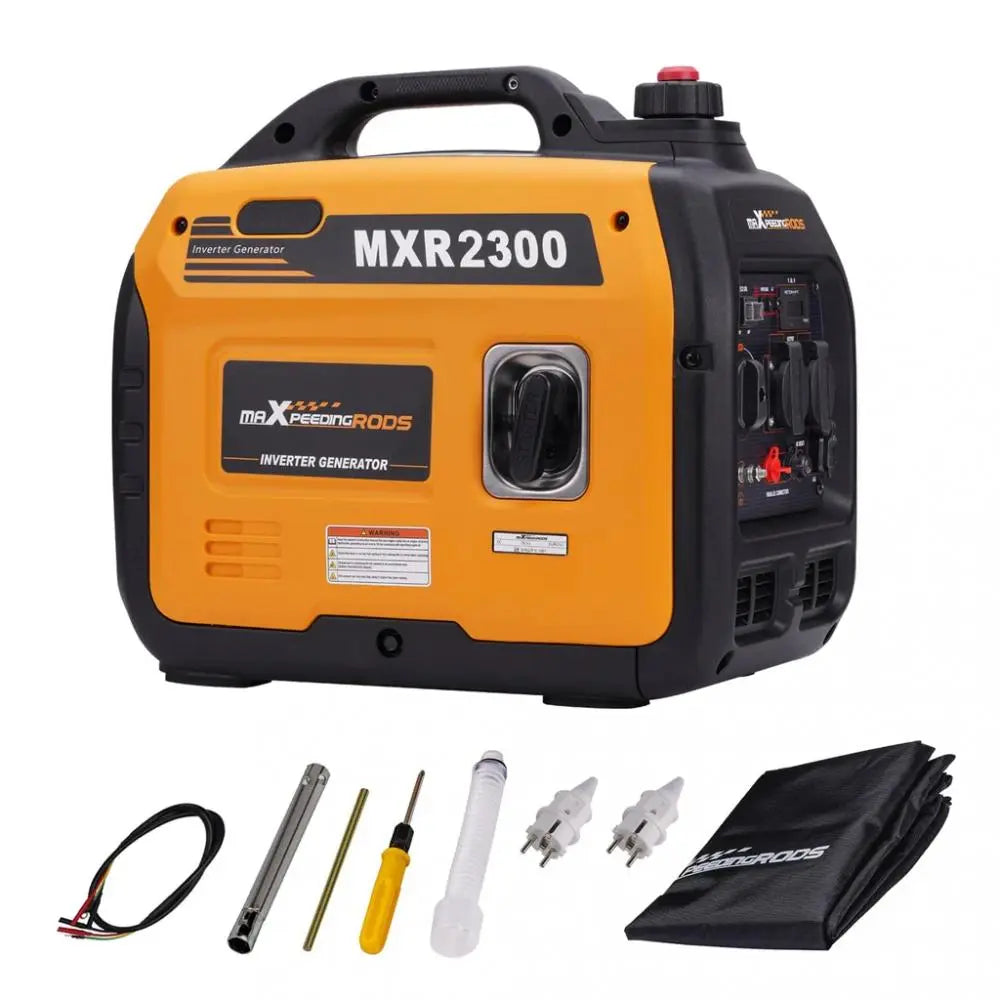
maXpeedingrods MXR 2300 – quiet entry-level model
- 1,800 W continuous / 2,300 W max – covers fridge, router and lights
- Pure sine wave (inverter) – safe even for sensitive electronics
- Just 18 kg – portable for camping, the garden and as an emergency reserve
- 4 L tank, over 10 h runtime in eco mode
- Price: ~399,95 € – the most affordable inverter back-up in our shop
Scenario 2: Comfort Supply – Plus Washing Machine, TV, Microwave
If you also want to run a microwave, TV, washing machine or workshop tools, you need 3,800–5,500 W. In this class, noise level matters as much as output: in a residential area, a generator with under 55 dB(A) at 7 m – about as loud as a normal conversation – makes a real difference to comfort.

FME XG-SF 4000ER – comfort with remote start
- 3,600 W continuous / 3,800 W max – fridge, heating, TV and microwave at the same time
- Under 55 dB(A) at 7 m – the quietest in its class, suitable for residential areas
- THD < 3% – pure sine wave for smart home and heating controls
- Electric start, wireless remote control, trolley, up to 14 h runtime
- Price: ~1.049,95 € – our most recommended model for basic supply and more
Scenario 3: Full Supply Including a Heat Pump
As soon as a heat pump needs to be powered, different rules apply: you need 5,000–8,000 W, because the compressor draws several times its continuous power at start-up. This is where diesel generators come into their own – from around 5 kW and with regular use they are more economical, using around 20–30% less fuel than petrol models at half load.

FME XG-SF 5600D Carbon – diesel inverter
- 5,000 W continuous / 5,500 W max – reserve for high starting currents
- Inverter power quality – safe for demanding building services
- Diesel – efficient in continuous operation, fuel keeps for a long time
- For heat pump, heating and sensitive electronics at the same time
- Price: ~2.699,95 € – our most popular diesel inverter generator
If the output is just short of what the heat pump needs, a soft starter can smooth out the current peak enough for a smaller generator to suffice. For an overview of suitable diesel models, see our diesel generator category, and specifically for heat pumps our collection of generators for heat pumps.
Power Isn't Everything: Inverter, AVR and the 70% Rule
The right wattage is of little use if the power quality does not suit the appliance. Inverter generators produce a pure sine wave with total harmonic distortion (THD) below 3% – essential for modern heating controls, routers, laptops and smart home technology. AVR generators are cheaper but produce voltage fluctuations of up to ±10%.
For robust loads such as heating elements, drills or site floodlights, an AVR generator is perfectly adequate and often the more economical choice. For sensitive electronics, however, this range of fluctuation is too large and can cause damage – here there is no getting around an inverter. For robust loads such as construction equipment, an AVR generator is the more economical choice.
Finally, the 70% rule applies: plan your requirement so that the generator runs at around 70–80% load in normal operation. This is the most efficient load range, keeps the generator cool and leaves you headroom for starting peaks. Running permanently at the 100% limit, on the other hand, noticeably shortens its service life.
Safety: Feeding In Power, Overload and CO
Calculating the power correctly protects against overload – but two further safety rules are just as non-negotiable when running a generator: feeding power into the house wiring properly and protecting against carbon monoxide. Both are regularly underestimated in practice, sometimes with fatal consequences.
Connection to the house wiring must only be made via a changeover switch and by a licensed electrician. Feeding power in directly via a socket is life-threatening and illegal, because it can lead to back-feeding into the public grid – a danger to anyone working on the grid. The relevant standard is VDE 0100-551 (VDE: the German Association for Electrical, Electronic & Information Technologies). A neat retrofit solution is the universal ATS box – installation must be carried out by a qualified electrical contractor.
CO safety note: Carbon monoxide is odourless, colourless and deadly. Only ever run your generator outdoors, at least 5 metres away from windows, doors and ventilation openings – never in a garage, cellar or indoors, not even with the door open.
Incidentally: although the German power grid is one of the most reliable in the world – according to the Bundesnetzagentur (the German Federal Network Agency), the average outage duration in 2024 was just 11.7 minutes per end consumer – this statistic only covers unplanned interruptions of more than 3 minutes and excludes force majeure such as storms or floods. It is precisely these longer outages that are the reason to keep a correctly sized generator ready.
FAQ on Generator Sizing
How do I convert kVA to watts?
Multiply the kVA value by the power factor cos φ. With the usual reference value of cos φ 0.8: 1 kVA = 800 W, 5 kVA = 4,000 W. A 6.25 kVA generator therefore delivers around 5,000 W of usable real power. Conversely, divide your kW requirement by 0.8 to get the kVA size you need.
Is rated power enough, or do I need to allow for starting current?
For appliances with a motor or compressor – fridge, pump, heat pump – you must allow for the starting current. They draw 3 to 6 times their rated power at start-up. What counts is the highest single starting current, not the sum of them all. Purely heating and lighting appliances, on the other hand, have no significant starting current.
How many watts do I need for a detached house?
For a basic supply to a detached house during a power cut, 2,000–3,500 W is usually enough – that covers the fridge, heating controls, router and lights. With comfort appliances such as a washing machine or microwave, the requirement rises to 3,800–5,500 W, and with a heat pump to 5,000–8,000 W.
What does cos φ 0.8 mean for a generator?
The power factor cos φ describes what proportion of the apparent power (kVA) arrives as usable real power (kW). The value 0.8 is the reference value under ISO 8528 that manufacturers use to rate their generators. A 10 kVA generator at cos φ 0.8 therefore delivers around 8 kW of usable continuous power.
How much power reserve should I allow?
Allow around 30% reserve above your calculated peak requirement. This buffer absorbs starting peaks, compensates for loss of output due to ageing and avoids continuous operation at the limit. Rule of thumb: in normal operation the generator should run at around 70–80% load, no higher.
Can a generator run continuously at full load?
No. In continuous operation, a generator should not be loaded above 70–80% of its rated power. Permanent full load leads to overheating, faster wear and voltage drops that can damage sensitive electronics. The short-term maximum power is only intended for starting peaks lasting a few seconds.
Conclusion: Calculate Correctly, Buy Correctly
Choosing the right generator size is not a matter of luck but a calculation in four steps: add up the rated outputs, add the highest starting current, check what runs simultaneously and allow a 30% reserve. If you convert kVA into usable watts via the power factor and don't forget the starting current, you will buy neither too small nor unnecessarily large. For most detached houses, this puts you at 3,000–4,000 W, or 5,000–8,000 W with a heat pump – ideally as an inverter generator with a pure sine wave.
Not sure which model suits your needs? Browse our complete generator collection or contact us for personal advice – we will work out your exact power requirement together with you.

 Knetterhauser Straße 26

