It appears again and again on the data sheets of large backup generators: performance class G1, G2, G3 or G4. But what do these generator classes actually mean – and which one do you really need for your home, a building site or a server room? Drawing on more than 18 years of hands-on experience, this guide explains all four classes defined in DIN ISO 8528-5, with specific limit values – and shows you what really matters when you buy.
Key points at a glance
- Four classes: Generator classes G1 to G4 are defined in the DIN ISO 8528-5 standard – they rate how stable voltage and frequency remain under load.
- Class G1: Lowest requirements (steady-state voltage deviation up to ±5%) – sufficient for lighting and simple motor drives.
- Class G2: Broadly matches the quality of the public grid (±2.5%) – suitable for building services, pumps, fans and lifts.
- Class G3: High requirements for voltage, frequency and waveform (±1%) – for telecommunications and sensitive electronics.
- Class G4: Strictest limits, agreed individually between manufacturer and customer – typical for IT systems and data centres.
- Practical tip: Smaller units often don't state a class at all – for household electronics, what matters most is a pure sine wave with total harmonic distortion (THD) below 3%, as delivered by inverter generators.
- What are generator classes? The DIN ISO 8528-5 standard explained
- G1 to G4 at a glance: the comparison table
- Class G1: basic power for simple loads
- Class G2: grid-quality power for homes and building services
- Class G3: stable power for sensitive electronics
- Class G4: individual limits for critical applications
- G class vs. inverter and AVR: how do they fit together?
- Which class do you need? Decision guide by application
- FAQ: generator classes G1–G4
- Conclusion: the right class protects your devices – not the biggest one
What are generator classes? The DIN ISO 8528-5 standard explained
Generator classes G1, G2, G3 and G4 are defined in the DIN ISO 8528-5 standard and rate how stable a generating set keeps its voltage and frequency – both in continuous operation and during sudden load changes. The higher the class, the tighter the permitted tolerances: a G1 set may let the steady-state voltage deviate by up to ±5%, a G3 set by only ±1%.
An important point to understand: the standard always rates the complete generating set – that is, the interaction of combustion engine, alternator, voltage regulator and control system. Manufacturers such as Caterpillar or Kohler test their sets with defined load steps, because the frequency dips briefly whenever a large load is suddenly switched on. How deep that dip is – and how quickly the set recovers – determines the class. For a good technical deep dive, see the white papers on ISO 8528-5 from Caterpillar and Kohler.
For you as a buyer, the classification acts as a translation aid: it tells you the minimum power quality your devices need – from a simple site lamp (G1) to a server installation (G4). Incidentally, the standard itself explicitly recommends choosing the lowest class that meets your requirements. A higher class means more control effort and therefore higher cost – with no benefit if your devices don't need it.
Why the class measures something different from the wattage
The wattage describes how much power a generator delivers – the performance class describes how cleanly and stably it delivers it. These are two separate questions: an 8,000 W set may regulate coarsely, a 2,300 W inverter very precisely. For sizing, the familiar rule still applies: devices with a motor or compressor draw 3 to 6 times their rated power when starting – the inrush current determines the minimum size. Our guide Generators for home use shows you how to calculate your power requirement.
Since 2007 we have seen the same mix-up again and again in our consultations: customers ask for a "G3 unit" but actually mean clean power for their electronics. The two topics are related but not identical – more on this later in the section G class vs. inverter and AVR.
G1 to G4 at a glance: the comparison table
The four performance classes differ in the permitted limits for voltage and frequency behaviour: G1 allows the largest deviations, G3 the smallest fixed ones – and for G4, manufacturer and customer agree the limits individually. The table below compares the most important steady-state limits from Table 4 of DIN ISO 8528-5.
| Criterion | G1 | G2 | G3 | G4 |
|---|---|---|---|---|
| Voltage deviation (steady-state) | ≤ ±5% | ≤ ±2.5% | ≤ ±1% | individual (AMC) |
| Frequency band (steady-state) | ≤ 2.5% | ≤ 1.5% | ≤ 0.5% | individual (AMC) |
| Frequency recovery time after load change | ≤ 10 s | ≤ 5 s | ≤ 3 s | individual (AMC) |
| Waveform requirement | low | medium | high | highest |
| Typical application | Lighting, simple drives | Building services, pumps, fans, lifts | Telecommunications, sensitive equipment | IT systems, data centres |
Limits according to DIN ISO 8528-5, Table 4. AMC = agreement between manufacturer and customer.
Fig. 1: The four performance classes G1–G4 with typical applications (source: DIN ISO 8528-5 / Kipor.org)
Class G1: basic power for simple loads
Performance class G1 sets the lowest requirements for voltage and frequency behaviour: in steady state, up to ±5% voltage deviation and a frequency band of 2.5% are permitted, and after a load change frequency recovery may take up to 10 seconds. This class is sufficient for loads where only the basic electrical parameters need to be specified – in other words, lighting and simple electric drives.
In practice, this means halogen floodlights, fan heaters with simple electrics or a rugged mixer motor will run on G1 power without any problems. An incandescent bulb simply doesn't care whether the voltage swings between 218 V and 242 V – it just glows slightly brighter or dimmer. For any kind of control electronics, however, this tolerance window is too wide: sensitive power supplies respond to repeated voltage spikes with failures in the long run.
On the German market you will rarely see an explicit G1 rating, because it mainly plays a role in tenders and in the planning of large generating sets. For compact units below about 5 kW, many manufacturers leave out the class rating altogether – a point that becomes important for your buying decision (more on this in the section Recognising power quality).
Class G2: grid-quality power for homes and building services
Class G2 requires voltage and frequency behaviour that broadly matches the quality of the public grid: a maximum of ±2.5% steady-state voltage deviation, a frequency band of 1.5% and a frequency recovery time of no more than 5 seconds after load changes. According to the standard, typical applications are building services, pumps, fans and lifts.
This makes G2 the reference class for classic home backup power: if your generator holds this level, your heating pump, fridge and lighting receive power of the quality they are used to from the mains socket. Brief, tolerable deviations during load changes are explicitly allowed – for example when the fridge compressor starts up and briefly draws 3 to 6 times its rated power.
In our experience, 2,000–3,500 W of continuous power is enough to cover the basic needs of a detached house – but besides output, the power quality for the heating controls is crucial. An inverter model such as the FME XG-SF 4000ER delivers both: plenty of reserve and a pure sine wave that, in practice, clearly exceeds the G2 requirement for household loads.
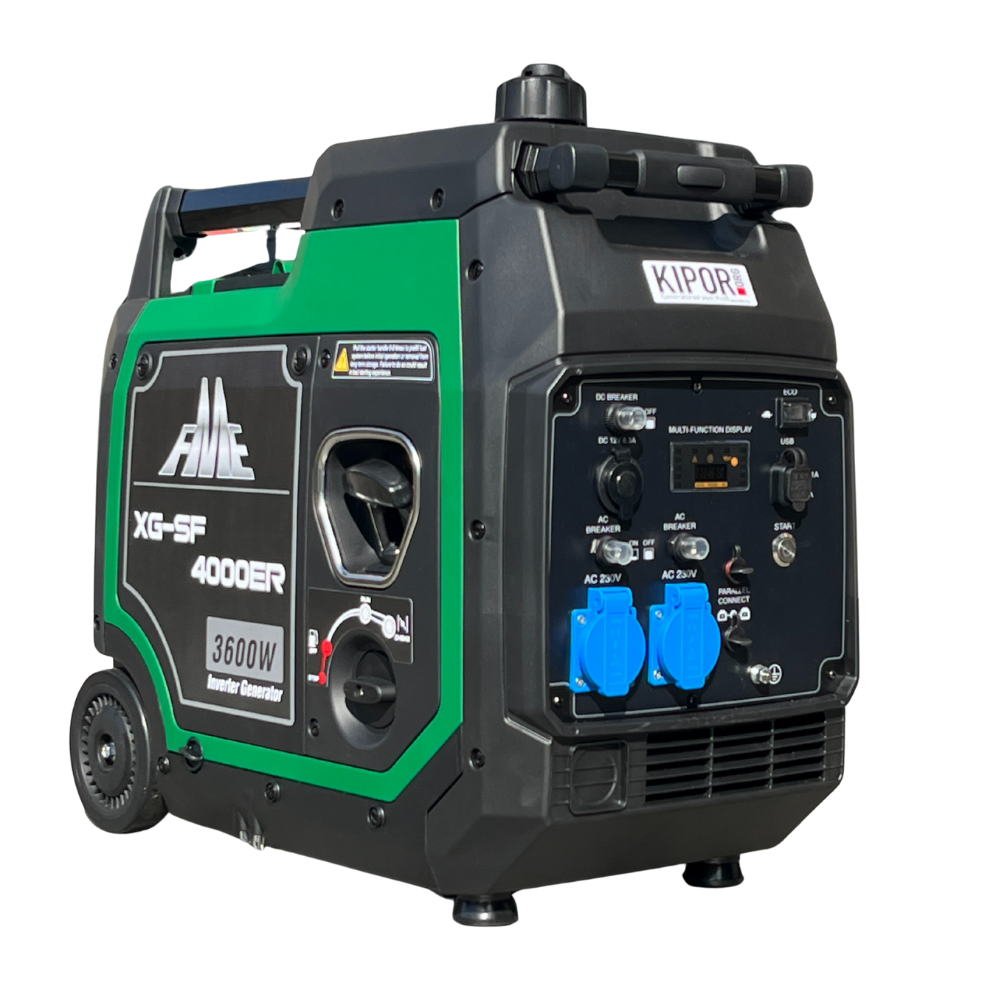
FME XG-SF 4000ER – inverter with wireless remote control
- 3,600 W rated / 3,800 W maximum power – runs fridge, heating, router and TV at the same time
- Pure sine wave with THD < 3% – safe for heating controls and smart home devices
- Below 55 dB(A) at 7 m – about as loud as a normal conversation, suitable for residential areas
- Electric start + wireless remote and up to 14 h runtime – start it without going outside
- Price: approx. 1.049,95 € – mid-range with convenience features (check the current price in the shop)
Expert tip: Can't find the performance class on the rating plate? Search the data sheet for "ISO 8528" – on larger generating sets the class is stated there, often for each load step. Compact units usually don't state it. In that case, total harmonic distortion (THD) is your most reliable figure: a value below 3% means a clean sine wave – and that is the property that really matters for household electronics.
Class G3: stable power for sensitive electronics
Class G3 sets high requirements for voltage, frequency and waveform: in steady state, only ±1% voltage deviation and a frequency band of 0.5% are permitted, and the frequency must recover within 3 seconds after load changes. The standard names telecommunications equipment as a typical application – technology that depends on a particularly stable supply.
Because modern loads such as UPS systems, frequency converters and control electronics are becoming ever more sensitive to voltage and frequency deviations, G3 generating sets are increasingly specified in commercial tenders – as Caterpillar also confirms in its white paper on ISO 8528-5. What this means for you: as soon as an inverter-controlled heat pump, a PV system with a hybrid inverter or a telephone system in your home is to run on backup power, you are effectively in the requirement range of this class.
Fig. 2: Steady-state voltage and frequency tolerances of classes G1–G4 (source: DIN ISO 8528-5, Table 4)
For demanding building services in continuous operation, the diesel inverter has proven to be the most reliable solution in our experience: it combines inverter-quality power (THD < 3%) with the efficiency of a diesel engine, which uses around 20–30% less fuel at half load than a comparable petrol engine. You can read in detail about the specific requirements of heat pumps in our guide Backup generator for heat pumps.

FME XG-SF 5600D Carbon – diesel inverter
- 5,000 W rated / 5,500 W maximum power – reserve for a heat pump and building services
- Inverter power quality – clean sine wave for sensitive control electronics
- Diesel engine – approx. 20–30% lower consumption at half load, designed for continuous operation
- Diesel can be stored for 12+ months – petrol, by contrast, starts to degrade after just 3–6 months
- Price: approx. 2.699,95 € – our most requested diesel model (check the current price in the shop)
Class G4: individual limits for critical applications
Class G4 is the highest performance class – with one special feature: its limits are not fixed in the standard but are agreed individually between manufacturer and customer (marked "AMC" in the standard's table – "agreement between manufacturer and customer"). Typical applications are IT systems, data centres and other systems with particularly strict requirements for frequency, voltage and waveform.
The reason for this approach is practical: critical installations have such different load profiles that a blanket fourth set of limits would be of little use. Instead, the operator – of a data centre, for example – defines its exact requirements, and the generator manufacturer proves compliance. Caterpillar also points out that G4 applies whenever a project defines its own load steps that differ from the standardised steps in ISO 8528-5.
For private customers, G4 is practically never relevant. However, if you are planning for commercial use – such as a standby power system for production or a server room with continuous three-phase operation – you enter the realm of engineered installations. You'll find an overview of generating sets from 8 kW with 400 V three-phase power and an ATS option in our industrial generators category; for the specific design, we'll advise you personally – we'll calculate your exact power requirement, including starting currents.
G class vs. inverter and AVR: how do they fit together?
Performance class and generator technology describe two different levels: the G class is the standardised rating result for the complete generating set, while the technology (inverter, AVR, SVR) is the means by which a manufacturer achieves voltage stability and waveform. An inverter produces a pure sine wave with total harmonic distortion (THD) below 3% – an AVR generator only corrects the voltage level and allows fluctuations of up to ±10%.
This leads to the most important practical takeaway of this article: in the small and medium power range, you'll meet the waveform and stability requirements that the standard sets for G3 most reliably with an inverter generator. An AVR generator, on the other hand, covers the requirement profile of rugged G1/G2 loads – and is noticeably cheaper. To be honest: for a building site with an angle grinder and a pump, an expensive inverter would be money down the drain.
"In 18 years, not a single private customer has asked me about the performance class – but almost everyone has asked about 'clean power'. That is exactly what the standard regulates in the background. My advice: small units rarely carry a G rating on their data sheet. Look at the total harmonic distortion instead: THD below 3% means your heating controls, your router and your laptop are on the safe side."
– Alexander Harlinghausen, Managing Director, Kipor.org GmbH, 18+ years of experience with generators
Fig. 3: Typical loads matched to AVR and inverter power quality (source: Kipor.org)
How to really recognise clean power quality when buying
When buying a generator below about 5 kW, check the power quality in three specific places: first, the technology (inverter = pure sine wave, AVR = voltage regulation only); second, the total harmonic distortion (THD < 3% is the benchmark for sensitive electronics); and third – on larger generating sets – the ISO 8528 class rating in the data sheet. If all three are missing, that in itself is a warning sign.
A common misconception: "brand-name unit = clean voltage". In fact, even a conventional AVR generator from a big-name manufacturer is technically unable to smooth the waveform – its ±10% voltage fluctuation is inherent in its design. That doesn't make it bad; it makes it a specialist for rugged loads. Models such as the FME SP7000D play to exactly this strength.
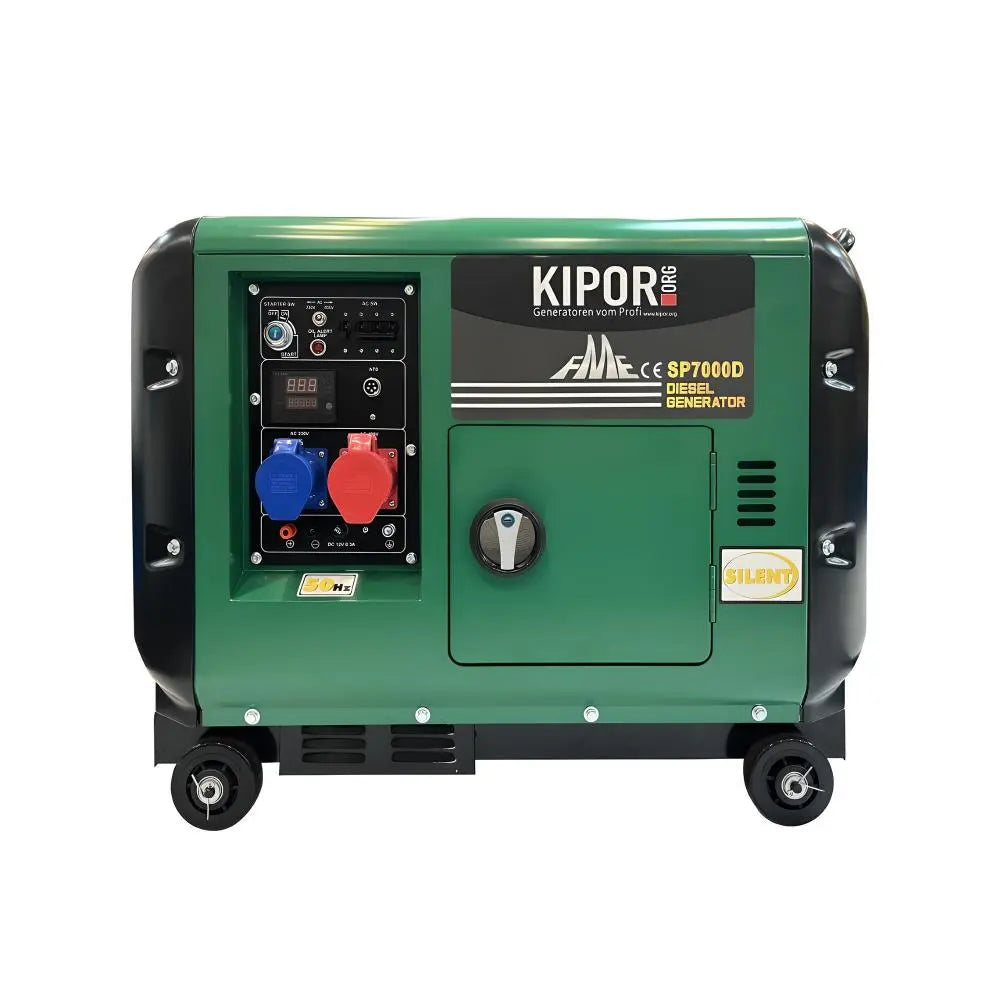
FME SP7000D Same Power – AVR diesel with three-phase power
- Approx. 5,500 W output – plenty of reserve for pumps, air compressors and construction machinery
- 230 V and 400 V three-phase – also for three-phase loads on the building site
- Rugged diesel engine – designed for continuous operation and tough jobs
- AVR technology – ideal for rugged loads; not suitable for sensitive electronics due to voltage fluctuations of up to ±10%
- Price: approx. 1.799,95 € – significantly cheaper than comparable diesel inverters (check the current price in the shop)
Which class do you need? Decision guide by application
For most applications, the right power quality can be clearly assigned: building sites and rugged equipment manage with the G1/G2 profile of an AVR generator, homes and home offices need inverter quality at G2/G3 level, and critical commercial installations are individually engineered as G3 or G4 projects. The overview below sums up our advisory experience since 2007.
Quick guide: application → power quality
| Application | Requirement profile | Suitable solution |
|---|---|---|
| Building site, pumps, tools | G1/G2 – rugged loads | AVR generator, e.g. FME SP7000D (approx. 5,500 W, 230/400 V) |
| Home backup power, essential supply | G2 level + clean sine wave | Inverter 2,700–3,800 W, e.g. FME XG-SF 4000ER |
| Heat pump & demanding building services | G3 requirement profile, continuous operation | Diesel inverter from 5,000 W, e.g. FME XG-SF 5600D Carbon |
| Commercial, server room, standby power | G3/G4 – engineered with ATS | Diesel inverter 8–19 kW from the industrial generators category |
Keep in mind the basic sizing rule, which applies regardless of class: add up the rated power of all devices running at the same time, add the highest starting current and plan in 30% reserve. A fridge with 150 W rated power briefly draws up to 900 W when starting – with a heat pump without soft start, the compressor start can reach 3 to 5 times its rated power.
Expert tip: The performance class says nothing about the size of generator you need. Before buying, check the rating plate of your largest motor or compressor: there you'll find the starting current (marked "In" or "LRA", in amps). Multiply it by 230 V – for example: 35 A × 230 V = 8,050 W. That is your minimum requirement for peak power, whatever class the unit meets.
Safety note: Whatever the class: only ever run a generator outdoors, at least 5 metres away from windows, doors and ventilation openings – carbon monoxide (CO) is odourless and deadly. And if the generator is to feed into your home's wiring, a changeover switch is mandatory, installed by a licensed electrician in accordance with VDE 0100-551 (the German Association for Electrical, Electronic & Information Technologies). DIY feed-in connections are life-threatening and illegal.
FAQ: generator classes G1–G4
Is the performance class shown on a generator's rating plate?
Usually not. You'll find the ISO 8528-5 class rating – if at all – in the technical data sheet, mainly for larger generating sets from about 5 kW. Compact portable units are often sold without a class rating. Search the data sheet for "ISO 8528" or go by the total harmonic distortion (THD).
What class are typical DIY-store generators?
Most low-cost compact units carry no official class rating at all. With voltage fluctuations of up to ±10%, conventional AVR units typically sit at the requirement level of simple loads (G1/G2 profile). For sensitive electronics, it's not the price tag that matters but inverter technology with a pure sine wave.
What does "AMC" mean for class G4?
AMC stands for "agreement between manufacturer and customer". For class G4, the DIN ISO 8528-5 standard does not set fixed limits; instead, the operator of a critical installation (e.g. a data centre) defines its own requirements, and the manufacturer proves compliance.
Is class G2 enough for my home office with a PC and router?
G2 describes power quality that broadly matches the public grid – on paper, that's sufficient. In practice, however, you should pay attention to the waveform for your PC, router and monitors: an inverter generator with a pure sine wave and THD below 3% is the safe choice for power supplies and sensitive electronics.
Does ISO 8528-5 also apply to portable power stations?
No. The standard applies to generating sets driven by a combustion engine. Portable power stations are battery storage units with an electronic inverter – by design they produce a pure sine wave and run without exhaust fumes, so they can also be used indoors. For them, what counts is capacity (Wh) and maximum output power (W).
Is an inverter generator automatically class G3?
Not automatically. The performance class rates the complete generating set, including its behaviour during load changes, and is verified by the manufacturer for each model. However, an inverter meets the core requirement behind G3: a stable, clean waveform with total harmonic distortion below 3% – exactly what sensitive electronics need.
Conclusion: the right class protects your devices – not the biggest one
Generator classes G1 to G4 under DIN ISO 8528-5 break a complex question down into four clear levels: how stable do voltage and frequency need to be for your devices? For lighting and tools, the G1/G2 profile of a low-cost AVR generator is enough; for homes and home offices, inverter quality with THD below 3% is the right choice; and for a heat pump or commercial use, the way forward is a diesel inverter from 5,000 W. The standard itself puts it most clearly: choose the lowest class that meets your requirements – anything above that costs money without adding value.
Browse our complete generator collection – from an 18 kg inverter to a 19 kW standby power system. Not sure what power quality your devices really need? Contact us for personal advice – we'll calculate your exact power requirement, including starting currents.

 Knetterhauser Straße 26