Your solar PV system produces more than enough electricity during the day – and yet you're left in the dark at the next power cut? That's exactly what happens with most PV systems in Germany. Drawing on more than 18 years of hands-on experience, I'll explain which generator for solar PV systems really works, how to connect it correctly and which mistakes could cost you your inverter or your generator.
Key Points at a Glance
- The core problem: Around 95% of PV systems are grid-tied – they shut down during a power cut, even in bright sunshine (source: saurugg.net).
- The solution: SVR generators such as the Genergy Moncayo SOL (4,000 W rated / 4,500 W peak power) are designed specifically as PV backup – including auto start via dry contact.
- Connection: The generator belongs on the generator input of a hybrid inverter or on a separate backup power circuit – never plugged directly into a household socket.
- Sizing: Motors and compressors draw 3 to 6 times their rated power when starting – the starting current determines the minimum size of the generator.
- Alternative: Portable power stations with a solar input (e.g. 3,072 Wh capacity, 2,100 W PV input) are emission-free and the only solution that is safe to use indoors.
- Safety: Only run generators outdoors, at least 5 m away from building openings – connecting to the home's wiring is a job for a qualified electrician (German standard VDE 0100-551).
- Why your solar PV system shuts down during a power cut
- Which generator suits a solar PV system?
- Three ways to combine a generator and a PV system
- Auto start via dry contact: how the generator starts by itself
- Sizing: how much power does your PV backup need?
- Safety and regulations: feeding in, CO and qualified electricians
- Alternatives: portable power station and off-grid system
- FAQ: generators for solar PV systems
- Conclusion: sort out the connection first, then buy the generator
Why your solar PV system shuts down during a power cut
Around 95% of solar PV systems in Germany are grid-tied – they only produce electricity when the public grid is present at 50 hertz. If the grid fails, the inverter switches off for safety reasons – even when the sun is shining at full strength on your panels. This figure comes from blackout expert Herbert Saurugg, whose overview of emergency power supply is one of the most authoritative sources in the German-speaking world.
The reason is not a design flaw but a protective function: the so-called NA protection (grid and system protection) required by the German grid connection rule VDE-AR-N 4105 automatically disconnects your system from the grid in the event of a power failure. This protects engineers working on what they assume is a de-energised line. Without the grid's 50-hertz reference, the inverter also lacks the signal it synchronises to.
A battery storage system doesn't automatically solve the problem either. Many storage systems with a “backup power function” can only supply their battery charge via a socket during a power cut – the PV system does not recharge the battery in the meantime. Only off-grid-capable systems build up their own household grid and keep using the solar panels without the public grid. We've summarised step by step what you should do in the first hours of an outage in our guide What to do in a power cut.
This is exactly where the generator comes in: it bridges the gap when the grid is down, the battery is running empty and, in winter, there is hardly any solar yield for days on end. In December, a PV system in Germany often delivers only a fraction of its summer yield – precisely when heating and lighting need the most power.
Fig. 1: Why grid-tied PV systems shut down during a power cut – and how an off-grid-capable system with generator backup solves the problem. (Source: Kipor.org)
Which generator suits a solar PV system?
A generator for solar PV systems has to deliver two things that a simple site generator cannot guarantee: a stable voltage and a clean frequency close to 50 hertz. Inverters and battery chargers are sensitive power electronics – if the generator voltage fluctuates too much, the inverter refuses to cooperate or, in the worst case, gets damaged. That's why SVR generators have established themselves as a separate class of equipment for this purpose.
SVR technology: the voltage regulator for PV backup
SVR stands for Smart Voltage Regulator – an electronic voltage regulator that keeps the output voltage constant even under fluctuating loads. According to the manufacturer Genergy, SVR offers considerably more starting reserve than conventional AVR regulators: a 3,300 W SVR generator can handle short-term load peaks of up to 4,200 W, and a 6,500 W model up to 8,400 W. At the same time, the electronics protect the generator itself against overload and overheating.
For PV use, there is a second feature: models such as the Genergy Moncayo SOL come with a dry contact input for automatic starting. The inverter sends the start signal to the generator as soon as the battery is empty – without you having to go out into the garden at night. An integrated battery charger keeps the generator's starter battery permanently at the optimum charge level, powered with 230 V from the inverter.
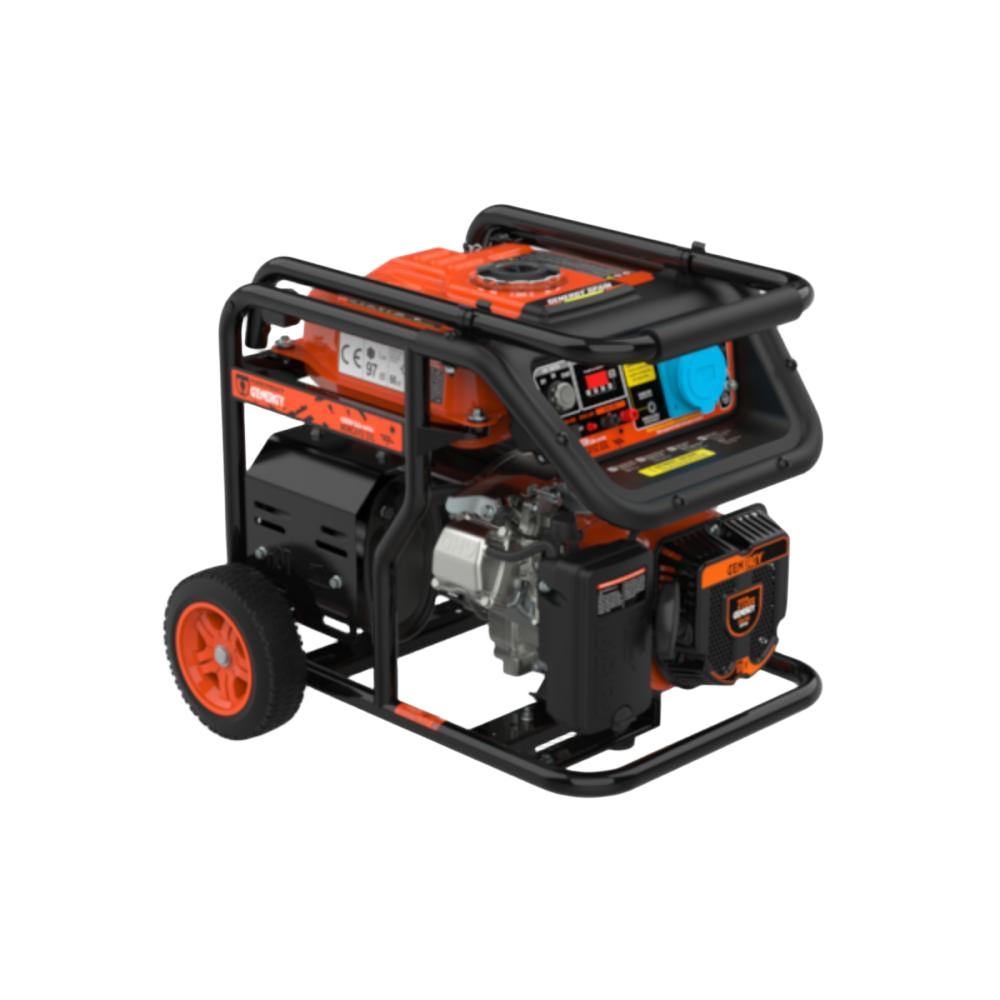
Genergy Moncayo SOL – designed specifically for solar PV systems
- Power: 4,000 W rated / 4,500 W peak power – covers battery recharging and essential loads
- SVR technology – stable voltage even with load fluctuations and appliances with high starting currents
- Auto start via dry contact – the inverter starts and stops the generator fully automatically, with up to 5 start attempts
- Integrated battery charger – the starter battery is kept permanently charged via the inverter
- 13-litre tank and EURO V engine (272 cc) – long runtimes with low emissions
- Price: 969,95 € – the most affordable fully automatic PV backup in our range
Why standard AVR generators are problematic
Conventional AVR generators (Automatic Voltage Regulator) do stabilise the voltage, but allow deviations of up to ±10% – no problem for a drill, but critical for an inverter's power electronics. Many inverters do not recognise the fluctuating generator signal as a valid grid and disconnect again after a few seconds. You're then left with a running generator without a single watt-hour reaching the battery.
Then there's the frequency: with simple generators, it depends directly on engine speed. If the engine speed briefly drops under load, the frequency also dips below 50 hertz – and the inverter interprets this as a grid fault. If you already own an AVR generator, it is therefore usually only suitable for the separate backup power circuit (Option 3 below), not for direct coupling with the PV system.
Inverter generators as an alternative
Inverter generators produce the cleanest power of all combustion generators: a pure sine wave with total harmonic distortion (THD) below 3% – comparable to a household socket. As a result, even fussy inverter chargers generally accept the power without any problems. You'll find an overview of suitable models in our collection of inverter generators.
The downside compared with SVR models such as the Moncayo SOL: only a few inverter generators offer fully automatic starting via dry contact, and comparable power classes often cost more. If you start the generator manually anyway and also want to power household appliances directly, an inverter is still a good choice – it's the more versatile solution.
| Criterion | SVR generator | AVR generator | Inverter generator |
|---|---|---|---|
| Voltage stability | High (electronically regulated) | Medium (up to ±10% deviation) | Very high (pure sine wave) |
| Power quality (THD) | Good | Moderate | Below 3% |
| PV/inverter coupling | Designed for it | Frequent dropouts | Usually no problem |
| Auto start via dry contact | Yes (e.g. Moncayo SOL) | Rare | Rare |
| Starting reserve | High (e.g. 3,300 W → 4,200 W peak) | Medium | Depends on model |
| Entry price (approx.) | from approx. 970 € | cheapest entry point | mid to upper segment |
Three ways to combine a generator and a PV system
Three connection methods have proven themselves for combining a generator with a solar PV system: the generator input on a hybrid inverter, recharging the battery storage, and a completely separate backup power circuit. Which option suits you depends mainly on which inverter is already installed – and how much convenience you want in an emergency. You'll find suitable storage solutions in our PV & energy storage collection.
Option 1: Hybrid inverter with generator input
The most convenient solution is a grid-forming hybrid inverter with a dedicated generator input (often labelled “GEN port” or “AC-In 2”). Grid-forming means that, in the event of a power failure, the inverter builds up its own stable island grid with a precise 50-hertz frequency, on which the PV panels, battery and household loads continue to operate – as the specialist guide from photovoltaik.info explains in detail.
The generator is connected to the system as a third energy source: if the sun and battery aren't enough, the inverter brings the generator online. Integrated current sensors prevent energy from flowing back into the generator – because this backfeed can damage a generator that isn't protected against it. The Genergy Moncayo SOL is built for exactly this interaction and, according to the manufacturer, is fully compatible with Genergy's Zero Emission solar inverters.
Option 2: Recharging battery storage with the generator
With the second option, the generator doesn't power the house directly but charges the battery storage – the house continues to draw its power from the battery. The advantage lies in efficiency: the generator only runs for a few hours a day at its optimum load point instead of chugging along at partial load around the clock. This saves fuel, reduces running hours and is easier on the neighbours.
The prerequisite is an inverter that allows charging from an external AC source in off-grid mode. Whether your model can do this is stated in the data sheet under terms such as “generator support” or “AC charging in backup mode”. With a typical charging power of 3,000 W, the generator will theoretically fully recharge a 10 kWh battery in just over three hours – enough buffer for a whole evening of heating controls, fridge and lights.
Option 3: Separate backup power circuit without PV coupling
The simplest and cheapest option dispenses with coupling altogether: a qualified electrician installs a manual changeover switch that disconnects selected circuits – heating, fridge, lights, router – from the grid when needed and switches them over to the generator. The PV system remains switched off in the meantime, but in return this solution works with almost any generator and any inverter.
This option makes sense if your existing inverter is neither grid-forming nor has a generator input, and replacing it isn't on the cards. The costs are limited to the generator and the changeover switch – in our experience, having the switch installed by an electrician costs considerably less than a new hybrid inverter.
Fig. 2: Three ways of connecting a generator and PV system compared – convenience, effort and requirements. (Source: Kipor.org)
Expert tip: Before buying a generator, check your inverter's data sheet for the terms “Dry Contact”, “Generator Start” or “GEN port”. If none of these are listed, save yourself the extra cost of an auto-start model – in that case, Option 2 or Option 3 with manual starting is the more honest and cheaper solution.
Auto start via dry contact: how the generator starts by itself
A dry contact is a potential-free switching contact on the inverter that the inverter uses to control the generator remotely – without carrying any voltage of its own, hence the name. If the battery's state of charge falls below an adjustable threshold, the inverter closes the contact and the generator starts automatically. Once the battery is full again, the contact opens and the generator switches off.
On the Genergy Moncayo SOL, this process is fully automatic: a servo-controlled automatic choke ensures reliable cold starts at any temperature, and the controller makes up to five start attempts before reporting a fault. A delay circuit (OPD) only releases the power once the engine is running smoothly – so no unstable start-up current reaches the inverter.
The practical difference shows at night and when you're away: without auto start, you have to keep an eye on the battery level and start the generator yourself at the right moment. With a dry contact, the system can even bridge an outage lasting several days while you work or sleep – it manages itself.
Expert tip: After installation, run the inverter and generator combination under real load once a quarter – for at least 30 minutes. That way you make sure the starter battery, choke and dry contact will work in an emergency. And don't forget the fuel: without a stabiliser, petrol deteriorates after 3–6 months and can then cause starting problems.
Sizing: how much power does your PV backup need?
For most detached houses with a PV system and battery storage, a generator with 3,500 to 5,000 W rated power is enough – what matters is the sum of the inverter's charging power and the appliances running at the same time, plus a reserve for starting currents. The basic rule from more than 18 years of advising customers: add up the rated power of all devices running at the same time, add the highest starting current and then add a 30% reserve.
Starting current is the most common planning mistake. Devices with a motor or compressor – fridge, heat pump, water pump – draw 3 to 6 times their rated power when starting. A fridge with a rated power of 150 W can therefore briefly demand 450 to 900 W when it starts up. This is exactly where the SVR starting reserve plays to its strengths: the Moncayo SOL with 4,000 W rated power absorbs peaks of up to 4,500 W without shutting down.
A worked example for Option 2 (recharging the battery): if your inverter charges the battery at 3,000 W, you shouldn't plan for a generator with exactly 3,000 W, but with around 4,000 W rated power. In continuous operation, generators should run at around 80% of their rated load – this extends their service life and leaves headroom for small appliances running in parallel. You'll find a detailed step-by-step calculation of your power requirements, with typical appliance wattages, in our guide Generators for home use.
“The classic call to our workshop goes like this: ‘My generator is running, but the inverter won't accept the power.' Nine times out of ten, it's a simple DIY-store generator whose voltage or frequency is outside the inverter's tolerance. That's why I tell every customer: first find out what your inverter accepts – then buy the generator. The other way round gets expensive.”
– Alexander Harlinghausen, Managing Director of Kipor.org GmbH, 18+ years of experience with generators
Safety and regulations: feeding in, CO and qualified electricians
Connecting a generator to your home's electrical installation is not a DIY project – clear rules apply here that save lives. The German standard VDE 0100-551 governs the connection of generating sets to building installations and, among other things, requires reliable isolation from the public grid. In addition, a backup power supply generally has to be registered with the grid operator.
Safety warning – never feed power in via a socket: Never connect a generator to a household socket using a cable with two plugs (a so-called “suicide cable”). Without proper grid isolation, you will feed voltage back into the public grid and endanger engineers working on the line – and you also risk damaging the generator and your home's wiring. Connection to the home's distribution board must always be carried out by a qualified electrician in accordance with VDE 0100-551.
The installation location is just as non-negotiable. Combustion generators produce carbon monoxide (CO) – an odourless, invisible and deadly gas that builds up in enclosed spaces even with the doors open. An exhaust hose helps to direct the fumes, but does not replace the basic rule of running the generator outdoors.
Safety warning – carbon monoxide: Only run the generator outdoors, at least 5 metres away from windows, doors and ventilation openings – never in a garage, cellar or carport. Make sure the wind carries the exhaust fumes away from the building, and install a CO detector in the house as an additional safeguard.
Alternatives: portable power station and off-grid system
Not every PV system necessarily needs a combustion generator as backup – depending on the scenario, portable power stations with a solar input and self-sufficient all-in-one systems can be the more elegant solution. A portable power station with a 2,100 W solar input can be connected directly to PV panels via MC4 cables, creating a small solar island that is independent of the household grid – with no exhaust fumes and no noise, making it the only option that can also be used in a flat or cellar. You'll find an overview of all models in our portable power station collection.
The limits are capacity and cold: even a large 3 kWh battery will be largely empty after a day of running a fridge, router and lights if there is hardly any solar yield in winter – and at temperatures below 0 °C, usable battery capacity can drop by up to 50%. For outages lasting several days, a combination remains the strongest solution: a portable power station for silent nights, a generator for recharging during the day.

Genergy GZE-3036-E – portable power station with 3,072 Wh
- Capacity: 3,072 Wh – powers a fridge, router and lighting for many hours
- Power: 3,600 W continuous / 7,000 W peak power – also starts appliances with high starting currents
- Solar input: 2,100 W with MC4 connection – charges directly from PV panels, independently of the household grid
- EPS backup function: 20 ms switchover time – router, PC and refrigeration appliances keep running without interruption
- Expandable: an additional battery can be added for a total capacity of up to 5,120 Wh
- Price: 1.799,95 € – emission-free home backup with wheels and telescopic handle
If you want maximum independence, you can go one step further: all-in-one solar systems such as Sirius (4 kW, from approx. 6.199,95 €) and Vega (6 kW, from approx. 7.999,95 €) are designed as self-sufficient off-grid systems – PV panels, inverter and battery work independently of the grid from the outset. For holiday homes, remote properties or thorough blackout preparedness, this is the complete solution where the question “What happens in a power failure?” never even arises.
Fig. 3: SVR generator, portable power station or off-grid system – a decision guide by application. (Source: Kipor.org)
Expert tip: If you run a portable power station as a PV island, don't connect it to the panels of your rooftop system while they are connected to the inverter. Use one or two separate panels or foldable panels instead – the open-circuit voltage of a complete rooftop string far exceeds the permissible solar input of most portable power stations.
FAQ: generators for solar PV systems
Can I connect a normal generator directly to my PV inverter?
No. A grid-tied PV inverter cannot feed surplus energy into the generator – and this backfeed can damage the generator. Coupling only works safely via a hybrid inverter with a dedicated generator input and integrated current sensors, or via a properly isolated backup power circuit with a changeover switch.
What does SVR technology mean on a generator?
SVR stands for Smart Voltage Regulator – an electronic voltage regulator that keeps the output voltage stable even when the load changes. Compared with conventional AVR regulators, SVR offers more starting reserve (according to the manufacturer Genergy, a 3,300 W model can handle peaks of up to 4,200 W) and protects the generator and connected electronics against overload.
Can I recharge my battery storage with a generator?
Yes, if your hybrid inverter supports charging from an external AC source in off-grid mode – the data sheet often calls this “generator support”. The generator then charges the battery, while the house continues to run on battery power. With 3,000 W charging power, a 10 kWh battery is theoretically full in just over three hours.
Will my PV system keep running while the generator powers the house?
Only in an off-grid-capable system with a grid-forming inverter that manages PV, battery and generator together. With a separate backup power circuit, the PV system remains switched off while the generator is running, because the grid-tied inverter lacks a stable grid reference – the generator then only supplies the switched-over circuits.
Do I need an electrician to connect the generator?
Yes, as soon as the generator is connected to your home's electrical installation. The German standard VDE 0100-551 requires reliable isolation from the public grid, which only a qualified electrician can install properly. In addition, a backup power supply generally has to be registered with the grid operator. You may only run individual appliances yourself, plugged directly into the generator via an extension cable.
Conclusion: sort out the connection first, then buy the generator
A generator for solar PV systems turns your rooftop system, which otherwise shuts down, into a genuine backup power supply – but only if the generator and inverter are compatible. So first clarify which connection method your system allows: generator input on the hybrid inverter, battery recharging or a separate backup power circuit. For the fully automatic solution with auto start, the Genergy Moncayo SOL with SVR technology and dry contact is our clear recommendation; for flats and short outages, there's no getting around a portable power station with a solar input such as the GZE-3036-E. You'll find all suitable models in our collection of SVR generators.
Not sure whether your inverter has a generator input or how much power you really need? Contact us for personal advice – we'll check compatibility with your system and calculate your exact power requirements before you spend a single euro.

 Knetterhauser Straße 26