On a building site, the nearest socket is usually a long way off – the temporary site power connection often only arrives weeks after ground is broken. A generator for construction sites delivers power for tools, machinery and lighting exactly where the work is being done. Drawing on more than 18 years of hands-on experience, this guide shows you how to calculate the right output, when you need three-phase power and which model suits your site.
Key points at a glance
- Output: 5,000–7,000 W is enough for most building sites – the starting current of the largest machine determines the minimum size, not the sum of the rated outputs.
- Fuel: Diesel pays off from around 5 kW of continuous operation (roughly 20–30% lower consumption at half load) and stores much longer than petrol.
- Three-phase power: Machines with a 400 V drive – such as large table saws, screed pumps or cranes – need a three-phase generator with a CEE socket.
- Power quality: Robust loads run fine on AVR generators (voltage fluctuations up to ±10%); battery chargers and measuring equipment need a pure sine wave (inverter, THD < 3%).
- Regulations: DIN VDE 0100-704 requires RCDs ≤ 30 mA on sockets up to 32 A and AC/DC-sensitive type B RCDs on three-phase sockets up to 63 A – connection via a site distribution board.
- Safety: Only ever run the generator outdoors, at least 5 m away from doors, windows and vents – carbon monoxide is odourless and deadly.
- Why a building site needs its own generator
- How much power does a construction site generator need?
- 230 V or 400 V? When you need three-phase power
- Diesel, petrol or dual fuel for the building site?
- Inverter or AVR – the right power quality
- Which generator for which size of site?
- Safety and regulations: VDE 0100-704, RCD and CO
- What else to look for in a construction site generator
- Frequently asked questions about generators for building sites
- Conclusion: how to find the right generator for your site
Why a building site needs its own generator
A building site needs its own generator because the regular mains connection is simply not yet available during most construction phases – the temporary site power connection is often only installed weeks after work begins. Until then, rotary hammers, saws, submersible pumps and site lighting all have to be powered independently, with larger machines often needing 400 V three-phase power.
Beyond conventional building construction, too, the generator is the workhorse: in civil engineering, gardening & landscaping or renovations away from paved roads, there is simply no power line nearby. A portable generator on a trolley or frame can be placed exactly where the work is happening and powers several loads at once – from a 100 W LED floodlight to a 2,200 W site air compressor.
The third reason is reliability. If the power fails while screed or concrete is being poured, it can cause costly consequential damage. A reliable generator set bridges these risks and makes your construction schedule independent of the grid operator's progress. You can see which types Kipor.org stocks for this in our generator collection.
“The most common mistake on building sites is simply adding up the rated outputs of the tools. What really matters is the starting current of the largest machine – a site compressor or submersible pump draws three to four times as much when it starts. Ignore that, and the first time several machines start together you'll have a generator that buckles under the load and shuts down.”
– Alexander Harlinghausen, Managing Director of Kipor.org GmbH, 18+ years of experience with generators
How much power does a construction site generator need?
For most building sites, the sensible power range is 5,000–7,000 watts – enough to run several robust tools plus lighting at the same time. However, the right size is not determined by the sum of the rated outputs but by the highest starting current: motors, compressors and pumps briefly draw three to six times their rated power when starting. This peak value determines the minimum size of your generator.
Power requirements of typical site equipment
Purely resistive loads such as LED floodlights or battery chargers have practically no starting current – they draw their rated power from the very first moment. It is a different story for anything with an electric motor: a submersible pump rated at 1,100 W can briefly demand around 3,300 W on start-up, and a site compressor rated at 2,200 W as much as 6,600 W. The chart below shows the gap between rated power and starting current for typical site equipment.
Fig. 1: Rated power vs. starting current of typical site equipment (source: Kipor.org, guide values depending on the model)
The sizing formula with a 30% reserve
The rule of thumb for building sites is: add up the rated power of all tools running at the same time, add the highest single starting current and plan in a reserve of around 30%. The reserve stops the generator from constantly running at its limit – this protects the engine and alternator windings and compensates for voltage dips.
A worked example: you run a table saw (start-up peak up to 4,000 W), an angle grinder at the same time (2,400 W rated power) and two LED floodlights (200 W together). On start-up, the saw is the biggest load at 4,000 W, plus 2,400 W and 200 W of running load – that makes around 6,600 W at the worst possible moment. Add a 30% reserve and you end up at roughly 8,500 W, putting you in the 8 kW class. All tools rarely start at the same time, but that is exactly the case you have to size for.
Expert tip: First identify your largest single machine and read its starting current from the rating plate (shown as “LRA” or starting current in amps). Multiply by 230 V: a value of 30 A gives 6,900 W – that alone is your lower limit for this one machine. Only then add the smaller continuous loads.
230 V or 400 V? When you need three-phase power
You need three-phase power (400 V) whenever a machine has a three-phase drive – recognisable by the red five-pin CEE plug. On a building site, this mainly applies to large stationary table saws, screed and mortar pumps, construction hoists, cranes and powerful air compressors. For hand tools, battery chargers and lighting, on the other hand, single-phase 230 V AC is sufficient.
A generator that supplies 400 V usually has both a CEE 400 V three-phase socket and standard 230 V Schuko sockets. Unbalanced load is an important issue: if you draw power mainly from a single phase of a pure three-phase generator, the unit can be loaded asymmetrically. So if you regularly run lots of 230 V loads on a 400 V generator, make sure you choose a model that can handle unbalanced loads.
Pure 230 V generators are lighter, cheaper and perfectly adequate for many interior fit-out and renovation sites. If, however, you need three-phase power now or are likely to in future, a 230/400 V unit is worth buying straight away – three-phase power cannot be retrofitted. You will find an overview in our diesel generator collection, which lists most of the 400 V-capable models.
Diesel, petrol or dual fuel for the building site?
For building sites, diesel is the more economical choice in most cases, because the higher purchase price quickly pays for itself from around 5 kW output and with regular, long use: diesel engines use around 20–30% less fuel at half load and are designed for continuous operation. Petrol scores for occasional use and a low purchase price, dual fuel (petrol + LPG) for maximum storage life. The table below compares the three fuels for construction use.
| Criterion | Diesel | Petrol | Dual fuel (petrol/LPG) |
|---|---|---|---|
| Worthwhile from | approx. 5 kW, continuous operation | up to approx. 5 kW, occasional use | flexible mid-range |
| Consumption at half load | around 20–30% lower | higher | as petrol (slightly more on gas) |
| Fuel storage life | 12+ months | only 3–6 months | LPG virtually unlimited |
| Purchase price | higher | low | medium |
| Strength on site | robust, durable, three-phase | light, portable | reliable start after standing idle |
A practical advantage of diesel on large sites: there is often diesel on site anyway for excavators, wheel loaders or heaters, so you only need to stock one fuel. If, on the other hand, your generator sits unused for months – for example as a seasonal reserve – a dual fuel unit has the edge, because unlike petrol, LPG does not age. How to get a generator running reliably again after long storage is explained in our article How to start a generator after long storage. Our diesel generator buying guide goes deeper into the fuel comparison.
Inverter or AVR – the right power quality
The power quality you need depends on what you connect. Robust loads such as rotary hammers, mixers or submersible pumps cope well with an AVR generator – its automatic voltage regulation keeps the voltage stable enough for such loads, with fluctuations of up to ±10%. Sensitive electronics – battery chargers, laser measuring devices, control units or laptops – on the other hand require a pure sine wave with total harmonic distortion (THD) below 3%, as supplied by an inverter generator.
To be honest about it: an AVR generator is cheaper and very robust, but its voltage fluctuations can damage modern charging electronics and measuring equipment. So if you charge batteries or run surveying equipment on site, you should either opt for an inverter or connect these devices only to an inverter generator. You will find our range with clean power quality in the inverter generator collection, and the robust workhorses in the AVR generator collection.
Expert tip: If a machine with a high starting current regularly overloads your inverter generator on start-up, you don't necessarily need a bigger unit. A Softlife RS-1 soft starter (inrush current limiter) reduces the start-up peak and lets you run more powerful loads on a 3.5 kW inverter generator too.
Which generator for which size of site?
The right power class depends on the size and type of site: small renovation sites manage with 2,000–4,000 W, medium-sized trade sites needing three-phase power are at 5,000–7,000 W, and large sites with continuous operation start at 8,000 W and up. The overview below classifies the three categories along with the recommended technology.
Fig. 2: Power classes and recommended technology by site size (source: Kipor.org)
Small sites & renovation
On small sites and renovation jobs, you usually only run one or two tools at a time, charge batteries and power the lighting. Here, clean power quality matters more than raw output – an inverter with a pure sine wave protects charging electronics and measuring devices. A quieter petrol generator is also the more considerate choice in residential surroundings.
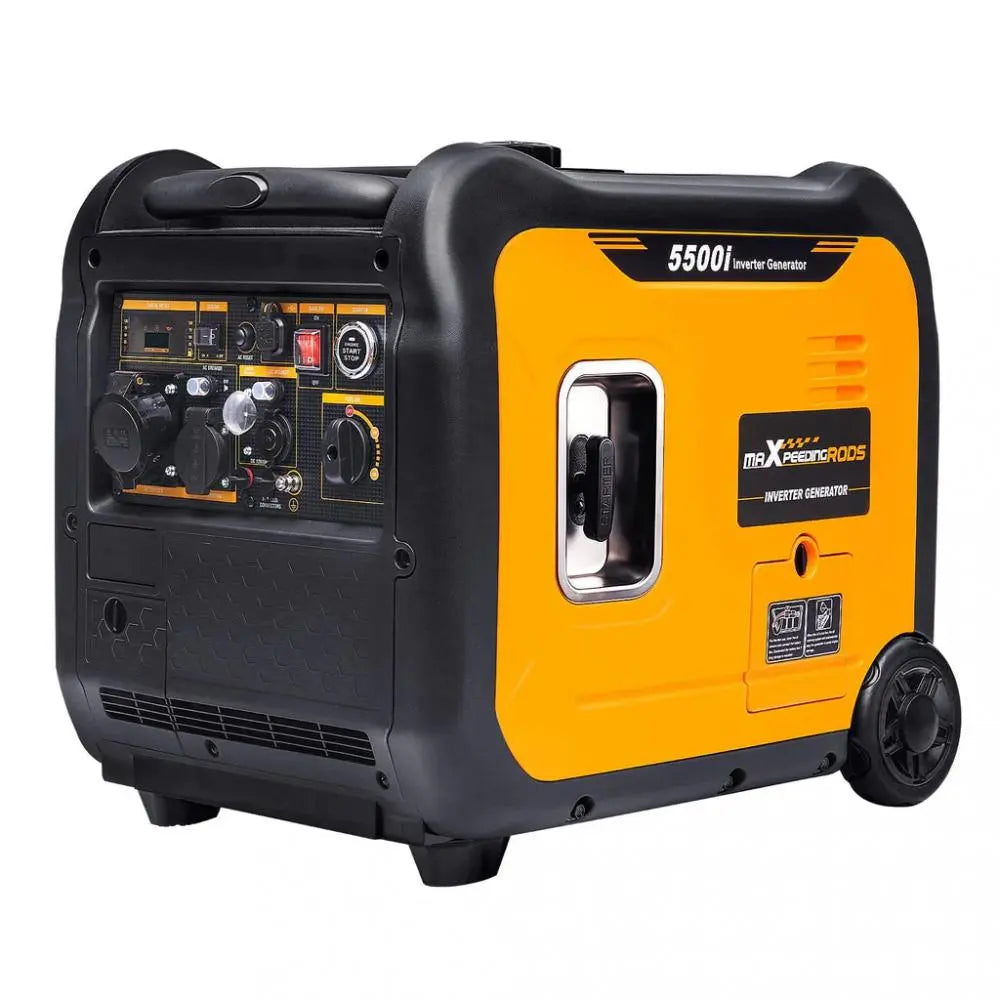
maXpeedingrods MXR 5500i – comfort-class inverter generator
- approx. 5,000 W rated / 5,500 W max. – powers several tools plus lighting
- Pure sine wave (inverter) – safe for battery chargers and measuring equipment
- Petrol – light, portable and quieter than a diesel in residential areas
- Robust workshop/site reserve for 230 V loads
- Price: approx. 1.199,95 € (as of June 2026 – check the current price in our shop)
Medium-sized sites & trade businesses
As soon as several robust machines are running at the same time and three-phase power comes into play, a diesel generator with 230 V and 400 V is the right basis. An AVR diesel generator with around 5,500 W covers a table saw, air compressor and pump and is built for tough continuous use. It is better not to connect sensitive electronics directly to such an AVR unit – keep a smaller inverter generator on hand for that.
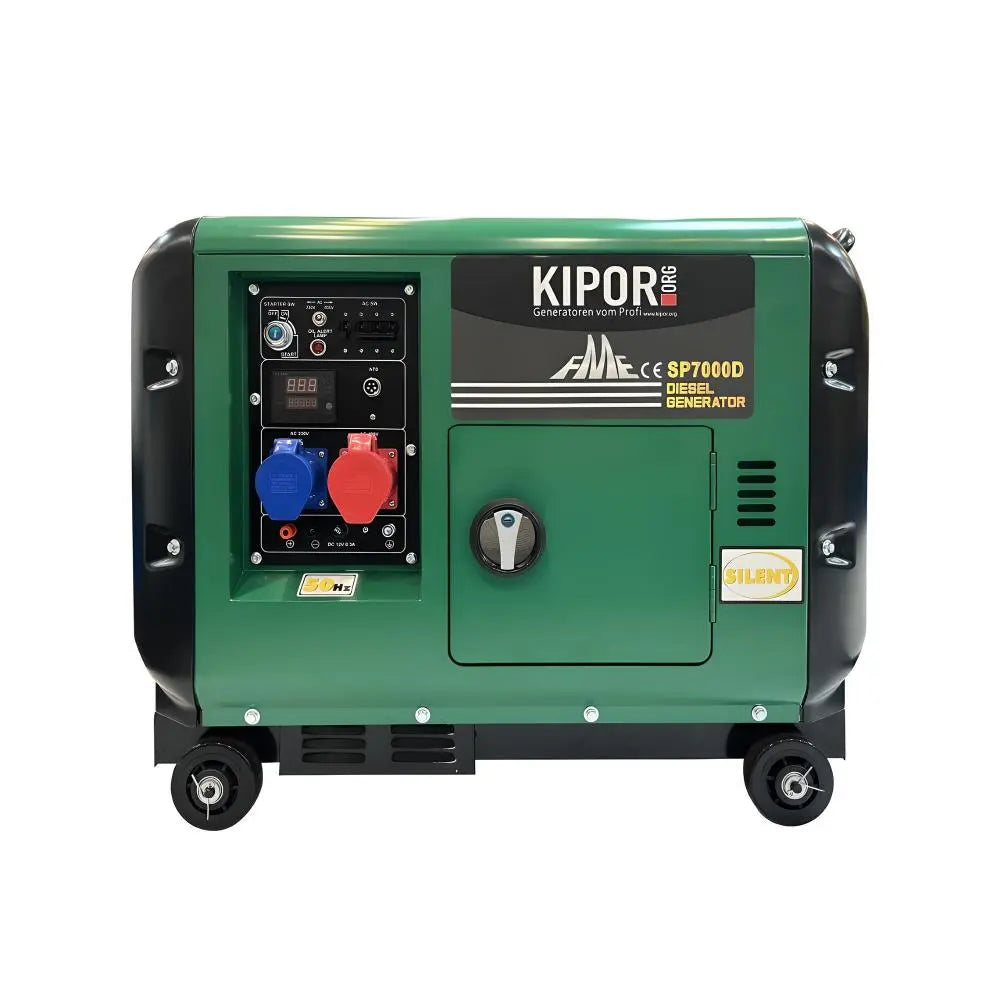
FME SP7000D Same Power – AVR diesel generator with three-phase power
- approx. 5,500 W – built tough for demanding site use
- 230 V & 400 V three-phase – powers CEE machines directly
- Diesel – economical in continuous operation, long storage life
- AVR voltage regulation – ideal for pumps, air compressors and tools
- Price: approx. 1.799,95 € (as of June 2026 – check the current price in our shop)
Important to bear in mind: the SP7000D is an AVR unit and is therefore made for robust loads – because of possible voltage fluctuations, it is not the first choice for sensitive electronics without additional protection.
Large sites & continuous operation
On large sites with a continuous load, lots of three-phase consumers and a need for clean power quality, the way forward is a diesel inverter generator. Units such as the FME 8000iD deliver 7,500 W continuous and 8,000 W peak power at 230 V and 400 V and come with an integrated ATS input, through which the generator switches in automatically when needed. For even larger loads, the models go all the way up to the FME 15000iD with 15.5 kW.

FME XG-SF 5600D Carbon – diesel inverter generator
- 5,000 W rated / 5,500 W max. – diesel efficiency in continuous operation
- Inverter power quality – a clean sine wave, even for demanding equipment
- Diesel – economical at half load, long service intervals
- For demanding continuous loads where diesel and clean voltage are required
- Price: approx. 2.699,95 € (as of June 2026 – check the current price in our shop)
If you need genuine three-phase continuous power beyond 5.5 kW – say 8,000 W and up with ATS automation – you will find suitable models such as the FME 8000iD, FME 10000iD-S or FME 15000iD in our industrial generator collection.
Safety and regulations: VDE 0100-704, RCD and CO
Site power is not a makeshift arrangement but a safety issue: since its revision in 2018-10 (mandatory since 18 May 2021), DIN VDE 0100-704 (the German standard for electrical installations on construction and demolition sites) has governed the power supply to building sites. It requires circuits with sockets up to 32 A to be protected by a residual current device (RCD) rated at no more than 30 mA. For three-phase sockets up to 63 A, the standard specifies an AC/DC-sensitive type B RCD.
The reason for type B lies in the frequency-controlled drives of modern construction machinery – cranes, hoists or pumps. They can generate DC fault currents that render a conventional type A RCD ineffective. The connection is therefore made via a site distribution board as the permitted supply point, which must be type-tested to DIN EN 61439-4. The diagram below shows the set-up between generator and loads.
Fig. 3: Safe site power chain from the generator via the site distribution board to the loads (source: Kipor.org, based on DIN VDE 0100-704)
Safety warning – carbon monoxide: Carbon monoxide (CO) is odourless and deadly. Only ever run the generator outdoors, at least 5 metres away from windows, doors and ventilation openings – never inside the building shell, in an underground car park or under a canopy.
Safety warning – connection & standards: Have the site power distribution set up by a qualified electrician in accordance with DIN VDE 0100-704. A permanent connection to the house wiring requires a changeover switch and a licensed electrician (VDE 0100-551) – DIY set-ups are life-threatening and illegal. Details on the standards are available from the VDE (German Association for Electrical, Electronic & Information Technologies), and on site safety from BG BAU (the German employers' liability insurance association for the construction industry).
What else to look for in a construction site generator
Besides output, fuel and power quality, suitability for site use determines how long your generator will last. A robust frame with a protective roll cage, rubber feet and a dust-protected housing withstand the vibration, dust and knocks that are part of everyday life on every building site. Models with a trolley and large wheels can be moved over uneven ground too.
Noise is a real issue in residential areas: diesel generators are considerably louder in operation than inverter generators; noise levels between 52 and 60 dB(A) roughly correspond to a normal conversation and are specified at a distance (for example “at 7 m”). Sound-insulated housings reduce the level noticeably. For lighting large areas, it is also worth taking a look at our lighting tower collection.
To make sure the generator starts when it matters, regular maintenance is essential – check the oil level, keep the air filter clean, drain the tank or stabilise the fuel before long periods of standing idle. Our guide Generator maintenance & care sums up how to keep your unit ready to run.
Expert tip: Run the generator for around 15 minutes under some load every four to six weeks, even when work on site is paused. This keeps the carburettor or injection system clear and stops you from being faced with a unit that won't start after weeks of standing idle – the most common reason for workshop visits after long periods of disuse.
Frequently asked questions about generators for building sites
How many watts does a construction site generator need?
For most building sites, 5,000–7,000 W makes sense. What matters is not the sum of the rated outputs but the highest starting current: a submersible pump or air compressor draws three to six times as much when it starts. Add up the running loads, add the largest starting current and plan in a reserve of around 30%.
Which generator is suitable for 400 V three-phase machines?
Machines with a red CEE plug need a generator with a 400 V three-phase output, such as a diesel generator with 230 V and 400 V. Make sure it can handle unbalanced loads if you also run lots of single-phase 230 V loads on it. Pure 230 V units cannot be retrofitted for three-phase power.
Do I need an RCD (residual current device) on a building site?
Yes. DIN VDE 0100-704 requires an RCD rated at no more than 30 mA for socket circuits up to 32 A and an AC/DC-sensitive type B RCD for three-phase sockets up to 63 A. The connection is made via a type-tested site distribution board – setting it up is a job for a qualified electrician.
Diesel or petrol on a building site – which is better?
For regular continuous operation from around 5 kW, diesel is usually the better choice: roughly 20–30% lower consumption at half load, longer-lasting and storable for more than 12 months. Petrol scores for infrequent use and a low purchase price. If the unit stands idle for months, a dual fuel model with LPG has the edge.
Can I run the generator inside a building shell or in an underground car park?
No. Generators with a combustion engine produce carbon monoxide – odourless and deadly. They may only be operated outdoors, at least 5 metres away from doors, windows and vents. An exhaust hose does not replace this rule either; it only helps to route exhaust gases outside.
Conclusion: how to find the right generator for your site
The right generator for construction sites comes down to three questions: how high is the starting current of your largest machine, do you need three-phase power, and how clean does the voltage need to be? For small sites with sensitive electronics, an inverter generator such as the maXpeedingrods MXR 5500i is ideal; for robust three-phase loads, the FME SP7000D with 230/400 V; and for heavy continuous operation, diesel inverter generators from the FME 8000iD upwards. Always plan in a reserve of around 30% and set up the site power distribution in line with the standards.
Not sure which model suits your site? Browse our complete generator collection or contact us for personal advice – we will calculate your exact power requirements and find the robust power solution for your application.

 Knetterhauser Straße 26