Finding the right camping generator can quickly become overwhelming – especially when you have to weigh up inverter technology, power classes and noise limits. Drawing on more than 18 years of hands-on experience, this guide shows you which generator suits your style of camping and what really matters when buying one in 2026.
Key Points at a Glance
- Power requirement: 1,000–2,500 watts is enough for most camping uses – motorhomes with air conditioning need 3,000+ watts
- Inverter technology: Produces a pure sine wave (±2% voltage tolerance) and protects sensitive electronics such as laptops and on-board computers
- Noise level: According to the ADAC (Germany's largest motoring club), campsites in Germany often have limits of 55–60 dB – modern inverters manage this in eco mode
- Choice of fuel: Petrol inverters are the standard; dual fuel models (petrol + LPG) offer more flexibility on long trips
- Weight: Compact inverter models weigh 18–25 kg and are easy to transport
- Safety: Generators belong outdoors only – carbon monoxide is odourless and deadly even in low concentrations
- Why Take a Generator Camping?
- The Main Types of Camping Generator in 2026
- Sizing: How Many Watts Do I Need for Camping?
- Key Buying Criteria for Camping Generators
- Using Your Camping Generator Correctly
- Alternatives to a Generator When Camping
- Our Top Picks: Camping Generators 2026 Compared
- Frequently Asked Questions About Camping Generators
- Conclusion
Why Take a Generator Camping?
A camping generator lets you run your cool box, coffee machine and chargers even away from pitches with electric hook-up – for true self-sufficiency in the great outdoors. While mains hook-up is available at many campsites, having your own generator gives you independence for wild camping, remote pitches or as a backup when the campsite's power supply is overloaded.
The benefits go beyond mere convenience. With a generator you can:
- Safely run medical devices such as CPAP machines
- Use power tools for repairs on your motorhome
- Spare your leisure battery during longer stays
- Use electric fan heaters on cold nights
Modern inverter generators have also significantly reduced the drawbacks that used to be common, such as extreme noise and high fuel consumption. Today's models are compact, efficient and often no louder than a normal conversation.
"The most common mistake we see with camping customers: buying too much power and then complaining about noise and weight. A well-sized 2,000–3,000-watt inverter covers 90% of all camping needs – quieter, lighter and cheaper."
– Alexander Harlinghausen, Managing Director of Kipor.org GmbH, 18+ years of experience with generators
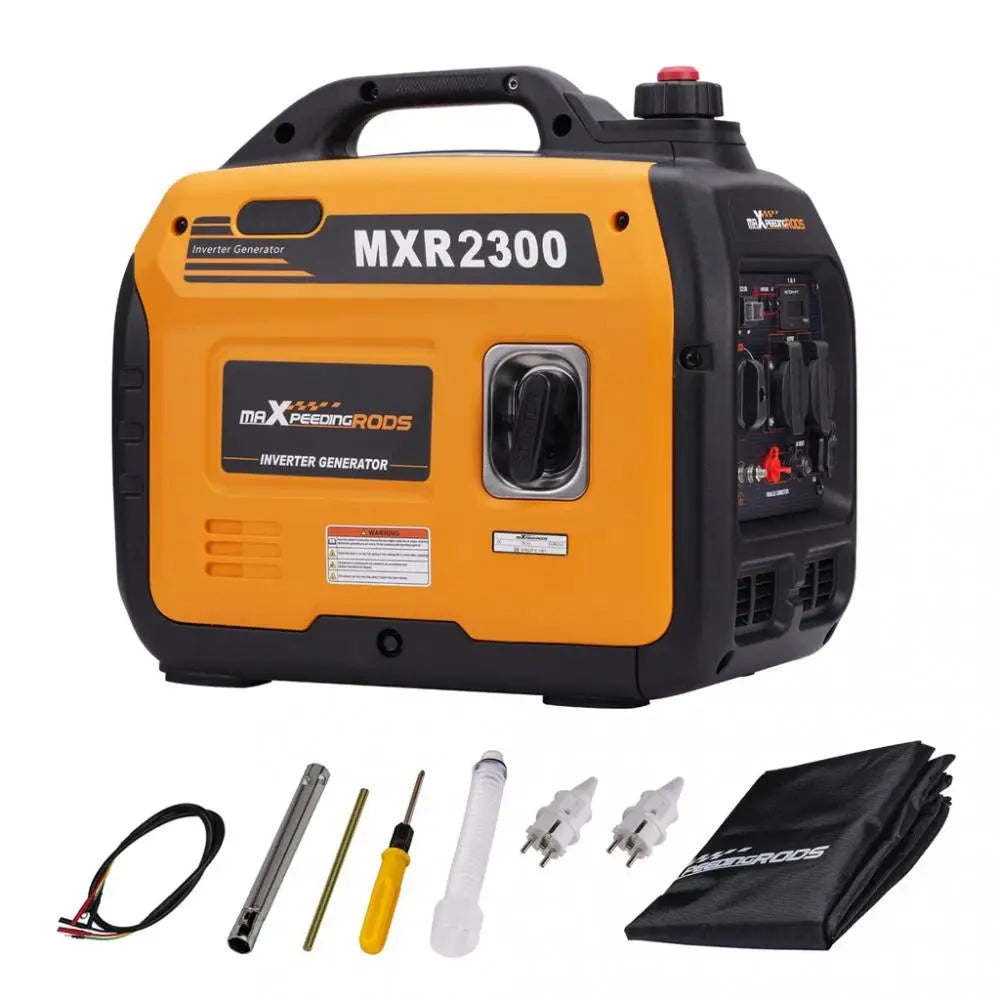
maXpeedingrods MXR 2300 – The Compact Choice for Beginners
- Output: 2,300 watts max. – reliably powers your cool box, chargers and lighting
- Weight: Just 18 kg – one person can easily carry it to the pitch
- Inverter technology: Pure sine wave protects laptops, smartphones and LED TVs
- Tank: 4 litres – up to 10+ hours of runtime in eco mode
- Price: 399,95 € – best value for money for occasional campers
The Main Types of Camping Generator in 2026
Choosing the right type of generator has a decisive impact on your comfort when camping. An inverter generator is a generator that uses double power conversion (AC → DC → clean AC) to produce a pure sine wave with a voltage tolerance of just ±2%. These are the types you should know about:
Inverter Generators – The Camping Favourite
Inverter generators produce a pure sine wave, making them the first choice for sensitive electronics such as laptops, smartphones or modern motorhome control systems. The technology first converts the generated power into direct current and then back into clean alternating current – this makes them slightly more expensive, but also far more versatile.
The advantages for campers are clear:
- Compact design: Usually 30–50% smaller than comparable conventional models
- Low weight: From 18 kg for 2,000-watt models
- Quiet operation: Often below 55 dB(A) at 7 metres in eco mode
- Fuel-efficient: Automatic engine speed control adapts to the load and saves up to 40% fuel
Expert tip: Why inverters for sensitive electronics? Conventional generators can show voltage fluctuations of up to ±10%. With sensitive devices such as laptop power supplies or LED TVs, this can cause damage. Inverter models keep the voltage constant at 230V (±2%) and deliver a total harmonic distortion (THD) of less than 3% – the same quality as from a household socket. Particularly important: modern motorhomes often have sensitive on-board computers that only work with clean power.
Inverters produce clean power just like a household socket – conventional generators can damage sensitive devices.
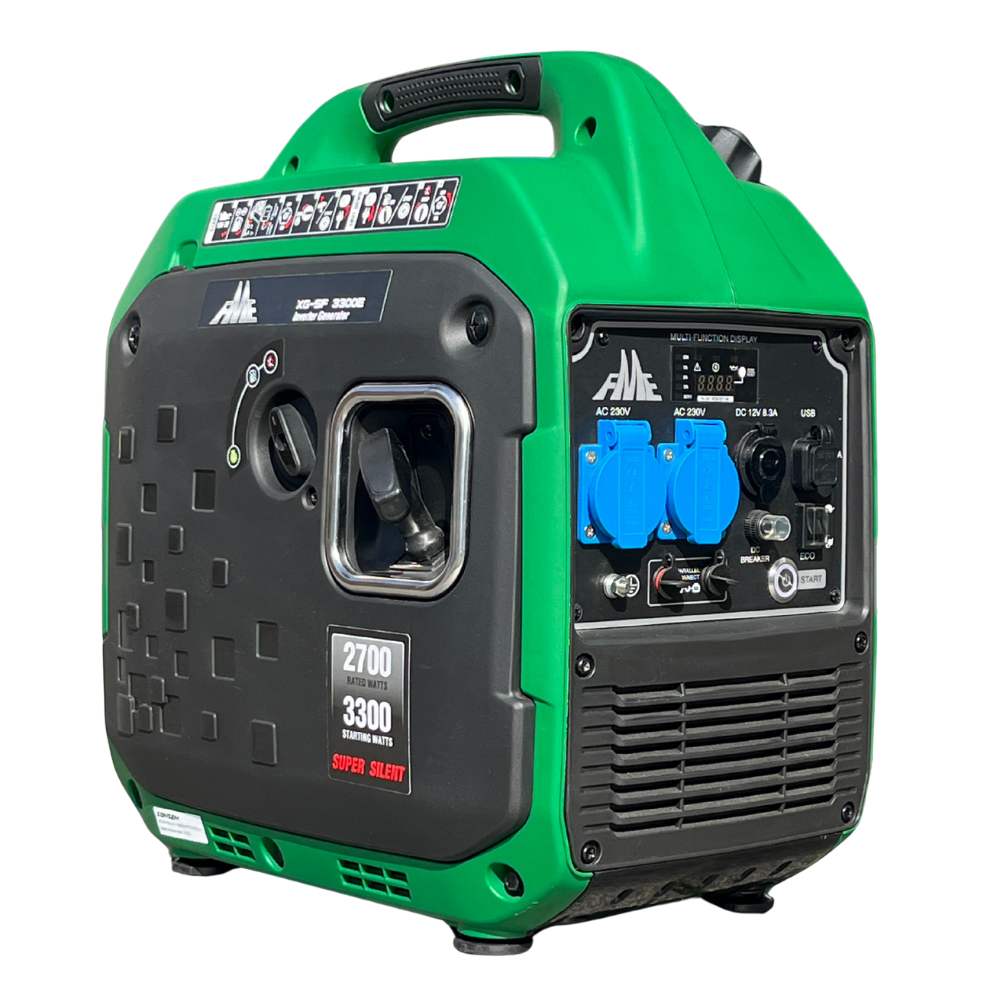
FME XG-SF 3300E – The All-Rounder with Electric Start
- Output: 2,700 W rated / 2,900 W maximum power – also powers a microwave and fridge
- Weight: Just 21.4 kg – compact yet powerful
- Convenience: Push-button electric start – no wrestling with a recoil starter in the morning
- Technology: Inverter with pure sine wave – safe for all devices
- Price: 539,95 € – solid quality from FME with service in Germany
AVR Generators – Robust for Simple Appliances
AVR generators (automatic voltage regulator) offer electronic voltage regulation and are suitable for robust appliances such as drills, simple cool boxes or lighting. They are cheaper than inverter models, but also louder and heavier.
They are suitable for camping if:
- You mainly run simple electrical appliances
- Price is the deciding factor (entry-level models from around 400 €)
- You are pitched away from other campers (noise level often 65–75 dB)
- Robustness matters more than comfort
Dual Fuel Generators – Flexible Choice of Fuel
A dual fuel generator is a generator that can run on both petrol and liquefied petroleum gas (LPG/propane). This is ideal for longer camping trips where fuel availability is uncertain. Gas bottles are available at many campsites, and storage is safer than with petrol. What's more, propane can be stored indefinitely – a big advantage over petrol, which deteriorates after 3–6 months.
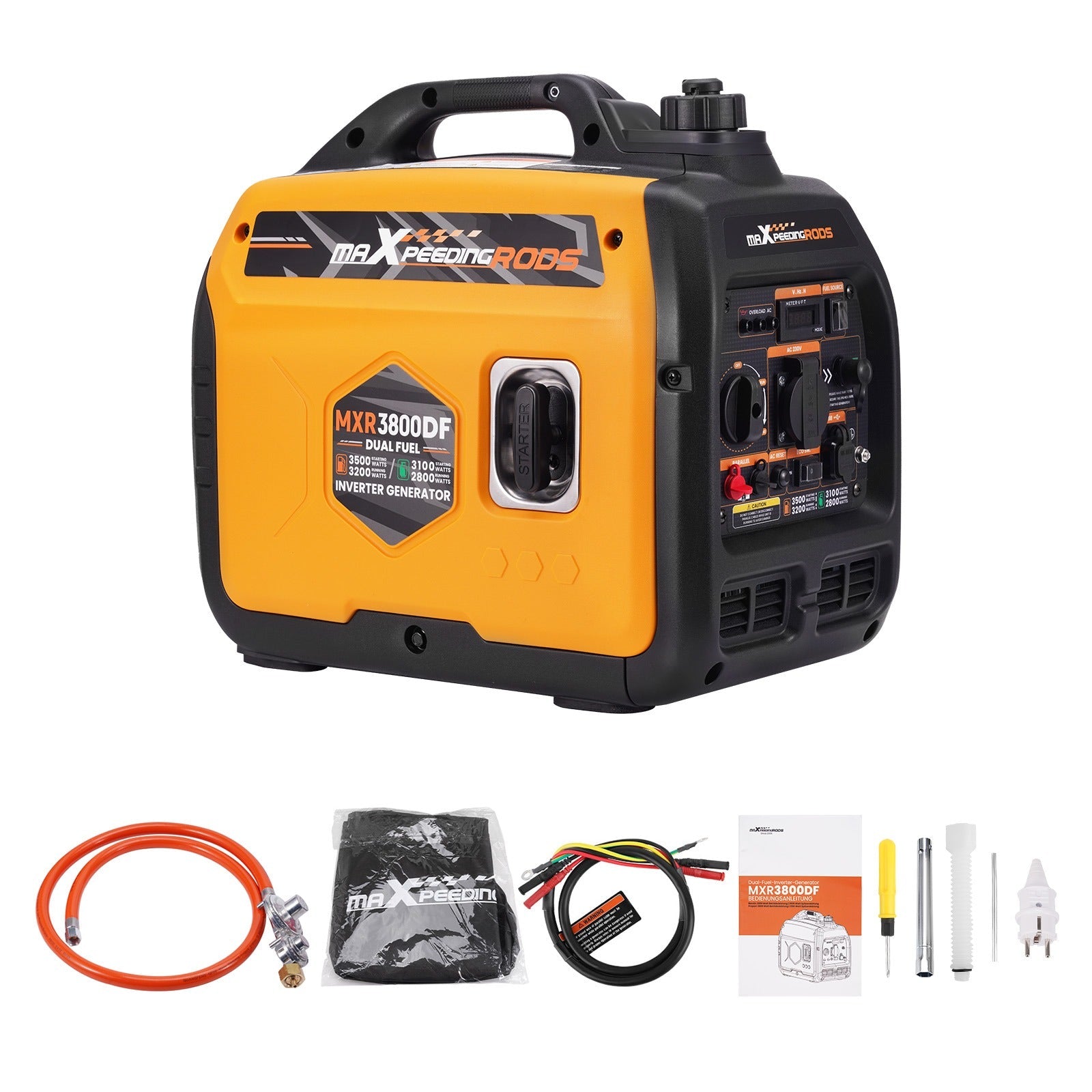
maXpeedingrods MXR 3800DF – Dual Fuel Inverter
- Output: 3,500 W rated / 3,800 W max. – also powers demanding appliances
- Fuel: Petrol or LPG – selectable via a switch
- Technology: Inverter with clean sine wave (THD < 3%) – safe for all electronics
- Weight: 25 kg with carry handle – still portable for one person
- Advantage: Propane is cheaper, cleaner and can be stored indefinitely
Our in-depth hands-on test of the MXR 3800DF shows the benefits of dual fuel in detail – including consumption measurements with both types of fuel.
Sizing: How Many Watts Do I Need for Camping?
For typical camping uses, 1,000–2,000 watts is enough, while motorhomes with several appliances need 2,500–3,500 watts – what matters is the total of all appliances running at the same time plus a safety margin of 30–50% for starting currents.
Sample Calculations for Typical Camping Scenarios
Minimalist tent camping (800–1,000 watts):
- LED lighting: 20–30 watts
- Smartphone charging: 10–20 watts
- Laptop: 50–80 watts
- Small cool box: 60–80 watts
- Coffee machine (briefly): 600–800 watts
Comfort camping in a caravan (1,500–2,500 watts):
- Compressor fridge: 100–150 watts
- Microwave: 700–1,000 watts
- TV/satellite system: 100–150 watts
- Water pump: 60–100 watts
- Lighting/small appliances: 100–200 watts
Fully equipped motorhome (2,500–3,500 watts):
- Air conditioning: 1,000–1,500 watts
- Electric heating: 1,000–2,000 watts
- All comfort appliances: 500–800 watts
- Induction hob: 1,500–2,000 watts
Power consumption of typical camping appliances – add up the appliances you run at the same time + a 30% reserve.
Expert tip: Watch out for the starting current of cool boxes & coffee machines! Compressor fridges and coffee machines need 3–5 times their rated power when starting. An 80-watt cool box can briefly draw 400 watts! So always plan for a 30–50% power reserve. With inverter generators, the stated peak power is designed for exactly this – it safely absorbs these starting currents.
Key Buying Criteria for Camping Generators
Choosing the right camping generator depends on several factors – noise level and weight are often more important than raw power figures. Here are the decisive criteria in detail.
Noise Level – Consideration for Other Campers
Campsites in Germany typically have noise limits of 55–60 dB during the day and complete quiet from 10 pm under their usual site rules. Modern inverter generators easily achieve these values in eco mode. For comparison: 60 dB is roughly a normal conversation, while older generators often reach 70–80 dB (as loud as a vacuum cleaner).
Typical noise levels by generator type (measured at a distance of 7 metres):
- Inverter in eco mode: 52–58 dB(A)
- Inverter under load: 58–65 dB(A)
- AVR generator: 65–75 dB(A)
- Conventional generator: 70–85 dB(A)
Also think about where you place it: an exhaust extension hose or positioning the generator behind your motorhome reduces the perceived noise by a further 4–5 dB.
Modern inverter generators in eco mode are quieter than a normal conversation.
Weight and Portability
Ideally, a camping generator should weigh less than 25 kg so that one person can still move it comfortably. Inverter models generally meet this requirement with ease. Weight is directly linked to output:
- Inverters up to 2,300 watts: 18 kg (e.g. MXR 2300)
- Inverters up to 3,300 watts: 21–22 kg (e.g. FME XG-SF 3300E)
- Inverters up to 3,800 watts: 25 kg (e.g. MXR 3800DF)
- Comparable AVR models: 30–50% heavier
Look for ergonomic carry handles and compact dimensions. Some models, such as the FME XG-SF 4000ER, come with a wireless remote control, so you can set the generator up at a distance and start it conveniently.
Fuel Consumption and Runtime
An economical camping generator uses around 0.3–0.5 litres per hour at 25% load and runs for about 8–12 hours on one tank (4–6 litres). Consumption depends heavily on the load:
- Eco mode (25% load): 0.3–0.4 l/h
- Half load (50%): 0.5–0.7 l/h
- Full load (100%): 0.8–1.2 l/h
Modern inverter generators automatically adjust their engine speed to the load (eco mode), saving up to 40% fuel compared with conventional models running at a constant speed.
Sockets and Outputs
For camping, your generator should have at least two 230V sockets and USB ports – ideally also a 12V DC output and a CEE connector for motorhomes. The most important connection types:
- 230V Schuko sockets: At least 2, preferably 3
- USB ports: Built into the generator, so no adapters needed
- 12V DC output: For charging the leisure battery
- CEE connector: Blue (230V, 16A) for the motorhome's hook-up inlet
Pay attention to the protective features: an RCD (residual current device) should be integrated, as well as overload protection and low-oil shutdown to protect the engine.
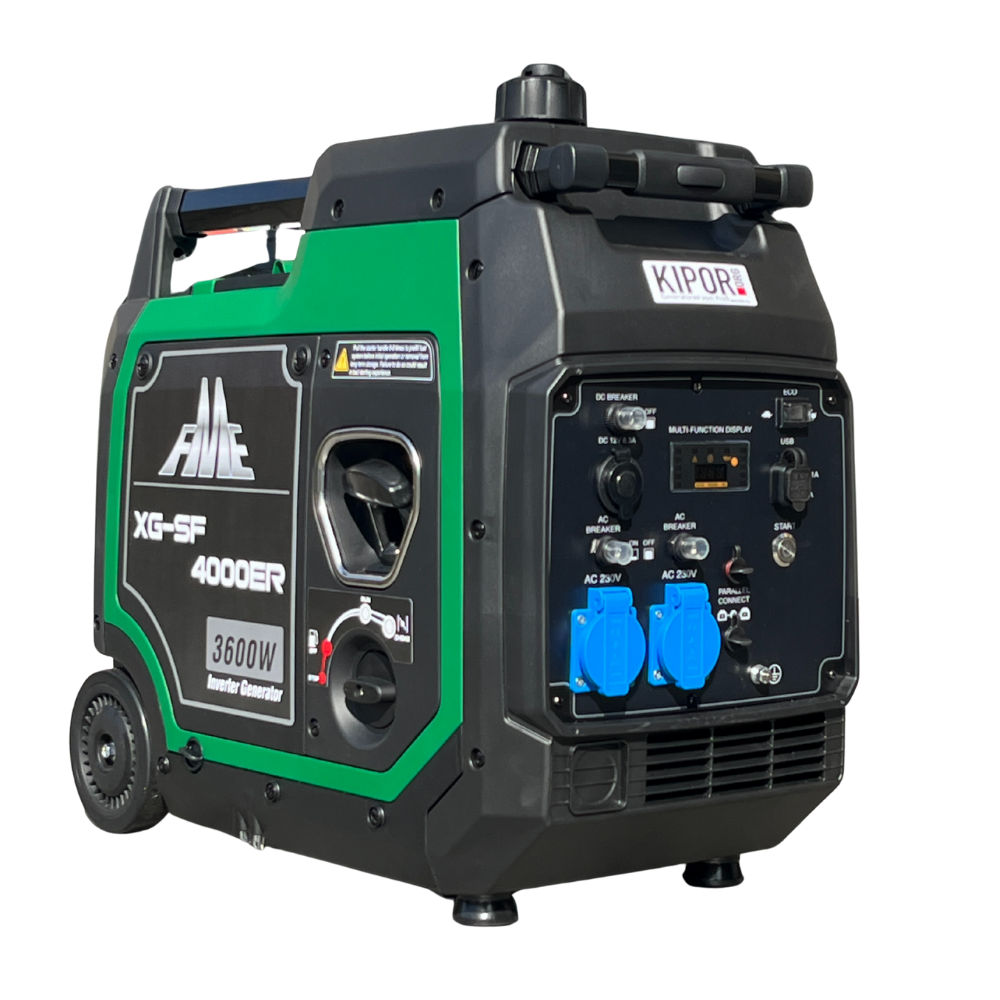
FME XG-SF 4000ER – Premium with Remote Control
- Output: 3,600 W rated / 3,800 W max. – also powers air conditioning and heating
- Noise level: Below 55 dB(A) – one of the quietest in its class
- Convenience: Electric start + wireless remote control – set the generator up at a distance and start it from your motorhome
- Technology: Inverter with pure sine wave and low-oil shutdown
- Price: 699,95 € (instead of 819,95 €) – premium quality at a fair price with service in Germany
Using Your Camping Generator Correctly
Operating a generator safely when camping means following some basic safety rules – above all, avoiding carbon monoxide (CO) poisoning, which according to the BfR (German Federal Institute for Risk Assessment) causes serious accidents among campers every year.
Safety Rules on the Campsite
Always place your generator at least 5 metres away from your motorhome and never in an enclosed space – carbon monoxide is odourless and deadly even in low concentrations. Even awnings or the area under a sun canopy pose a risk to life!
Other important safety rules:
- Level, firm ground: Prevents tipping over and overheating
- Rain protection: Generator tent or covered area (well ventilated!)
- Earthing: For longer use, via an earth rod in accordance with DIN VDE 0100-708
- Cable routing: Avoid trip hazards, do not kink cables
- Refuelling: Only when the engine is cold, never while it is running
⚠️ Safety notice: Avoid CO poisoning – never use indoors! According to the BfR, numerous people are seriously injured or killed every year by carbon monoxide poisoning while camping. CO is odourless and makes you drowsy – victims fall asleep and never wake up. Fit a CO alarm in your motorhome (from 20 €) and NEVER run the generator in enclosed or semi-enclosed spaces. Not even "just for a moment" or "with the window open"!
Maintenance for the Camping Season
Before every camping season, you should check the oil level, clean the air filter and do a test run – after the season, draining the fuel or adding a stabiliser is a must. The most important maintenance steps:
Before the season:
- Check the oil level and change it if necessary (after 50–100 operating hours)
- Clean or replace the air filter
- Check the spark plug
- Test run under load (at least 30 minutes)
- Check the fuel system for leaks
After the season:
- Empty the tank or add a fuel stabiliser
- Preserve the engine with fresh oil
- Store in a dry, frost-free place
- Disconnect the battery (if fitted)
You will find detailed instructions in our generator maintenance guide. And if your generator won't start after a long period of storage, our article Starting a generator after a long period of storage will help.
Alternatives to a Generator When Camping
A generator is not always the best solution – portable power stations and solar systems offer quiet, emission-free alternatives for certain camping situations. The choice depends on your energy needs and camping style.
Portable Power Stations vs. Generators
Portable power stations with 500–2,000 Wh capacity are suitable for camping with low power requirements, but lose up to 30 watts to self-consumption through the built-in inverter. They are ideal for:
- Weekend camping: 500–1,000 Wh is enough for lighting and charging
- Quiet campsites: Completely silent
- Indoor use: No emissions, safe in a tent or awning
- Short load peaks: High instantaneous output possible
Disadvantages compared with generators:
- Limited capacity (flat after 1–3 days)
- Long charging times (6–10 hours from a socket)
- High purchase costs (500–2.000 € for comparable performance)
- Loss of capacity in the cold (up to 50% at temperatures below 0°C)
Our range also includes portable energy solutions and power stations that are ideal as a complement to a generator – for example for silent power during the night-time quiet hours.
Solar Solutions for Sustainable Camping
Solar systems with 100–200 watts of output can cover basic needs on sunny days, but require battery storage and depend on the weather. As a complement to a generator, they are often the most sensible combination. Typical camping solar systems:
- Folding solar panels: 100–200 W, 2–5 kg, 200–500 €
- Rigid roof-mounted panels: 200–400 W for motorhomes
- Solar power station kits: Integrated solutions with storage
With 5 hours of sunshine, a 100 W panel delivers around 400–500 Wh per day – enough for LED lights, phones and small appliances, but not for a fridge or coffee machine. Explore our renewable energy solutions for suitable solar and storage products.
Our Top Picks: Camping Generators 2026 Compared
With more than 18 years of experience in advising on and selling generators, we recommend these four proven models for different camping needs.
The following comparison table shows the key differences at a glance:
| Feature | MXR 2300 | FME XG-SF 3300E | MXR 3800DF | FME XG-SF 4000ER |
|---|---|---|---|---|
| Ideal for | Tent, festival | Caravan | Long-term camping | Motorhome |
| Rated power | 2,000 W | 2,700 W | 3,500 W | 3,600 W |
| Maximum power | 2,300 W | 2,900 W | 3,800 W | 3,800 W |
| Weight | 18 kg | 21.4 kg | 25 kg | approx. 25 kg |
| Fuel | Petrol | Petrol | Petrol + LPG | Petrol |
| Starting method | Recoil start | Electric start + recoil start | Electric start + recoil start | Electric start + wireless remote control |
| Technology | Inverter | Inverter | Inverter (dual fuel) | Inverter |
| Noise level | ~58 dB(A) | ~58 dB(A) | ~59 dB(A) | <55 dB(A) |
| Price | 399,95 € | 539,95 € | See price in shop | 699,95 € |
| View product | MXR 2300 → | XG-SF 3300E → | MXR 3800DF → | XG-SF 4000ER → |
Our recommendation by type of camper:
Occasional campers & tent camping: At 18 kg and 2,300 watts, the maXpeedingrods MXR 2300 offers the best balance of power, weight and price. Ideal for weekend trips and festivals.
Caravans & comfort camping: The FME XG-SF 3300E impresses with electric start, 2,700 W rated power and a weight of just 21.4 kg – our best-selling camping model.
Seasonal campers & long trips: With its dual fuel technology, the maXpeedingrods MXR 3800DF is perfect for anyone who also wants to run on gas – ideal for trips to southern Europe, where gas bottles are available on every corner.
Motorhome owners & high comfort expectations: With less than 55 dB, wireless remote control and 3,600 W rated power, the FME XG-SF 4000ER is the premium choice – it also powers air conditioning and demanding on-board equipment.
Still not sure? Contact us for personal advice – we will help you find the right model for your camping style.
Frequently Asked Questions About Camping Generators
What size generator do I need for my motorhome?
For a standard motorhome, 2,000–2,500 watts is usually enough. This powers the fridge (150 W), water pump (100 W), lighting (100 W) and chargers at the same time. With air conditioning or electric heating, you should plan for 3,000–3,500 watts. Always allow a 30% reserve for starting currents.
Can I run the generator at night?
At most campsites in Germany, quiet hours start at 10 pm – generators must then be switched off. Some sites allow ultra-quiet inverter models (below 55 dB) until 11 pm. There are no fixed rules for wild camping, but out of consideration for others and for safety reasons (CO risk when running unattended) you should switch to a battery or power station at night.
Petrol or diesel for camping?
Petrol generators are lighter, quieter and cheaper to buy – ideal for camping. Diesel only pays off from 5 kW output or with very frequent use (e.g. commercial). The fuel saving of 20–30% only offsets the higher purchase price after around 500 operating hours. Petrol is also available at every filling station. Find out more in our diesel generator buying guide.
How loud is an inverter generator really?
In eco mode, modern inverter generators reach 52–58 dB(A) at a distance of 7 metres – the equivalent of a normal conversation. Under full load, the noise level rises to 60–65 dB(A) (a typical office). For comparison: a lawn mower reaches 85–90 dB(A). Particularly quiet models such as the FME XG-SF 4000ER even stay below 55 dB(A).
Can I connect sensitive electronics?
You can safely connect laptops, smartphones, LED TVs and other sensitive electronics to an inverter generator. They produce a pure sine wave with total harmonic distortion (THD) below 3% – comparable to the quality from your household socket. AVR or conventional generators can produce voltage spikes that damage modern electronics. If in doubt: always go for an inverter.
How much fuel does a camping generator use?
A 2,000-watt inverter uses around 0.3–0.4 litres per hour at 25% load (500 W) and 0.8–1.0 litres at full load. With a 4-litre tank, you can therefore run for 10–13 hours in eco mode or 4–5 hours at full load. Dual fuel models are often 10–15% cheaper to run on LPG/propane.
Conclusion
Choosing the right camping generator depends largely on your individual needs – while occasional campers will be happy with a compact 2,000-watt inverter such as the MXR 2300, seasonal campers with a motorhome are more likely to need 3,000–3,800 watts, as offered by the FME XG-SF 4000ER. By 2026, inverter technology has firmly established itself as the standard, because it is quiet, economical and safe for all electronic devices.
When choosing, look beyond raw power: weight, noise level and fuel consumption often say more about a generator's suitability for camping than its maximum wattage. A generator that is too big is a nuisance with its unnecessary noise and consumption, while one that is too small is frustrating because it is constantly overloaded.
Whichever model you choose: always follow the safety rules, especially regarding the danger of carbon monoxide, and make sure it is serviced regularly. Then nothing stands in the way of relaxed camping adventures with a reliable power supply! Take a look at our complete inverter generator collection or contact us for personal advice.

 Knetterhauser Straße 26