A sudden power cut can bring your whole household to a standstill within minutes – from the fridge to the heat pump. A generator for home use gives you genuine self-sufficiency: you decide which appliances keep running, independently of the grid. Drawing on more than 18 years of hands-on experience, this guide shows you which model suits your household – from basic backup to whole-home power including a heat pump.
Key points at a glance
- Basic backup: 2,000–4,000 watts are enough for the fridge, heating controls, lighting and router – covered by modern inverter models from 699 €
- Heat pump: Needs at least 5,000–7,500 watts of continuous power, because the compressor draws 3–5 times its rated power on start-up
- Inverter technology: Produces a pure sine wave (THD < 3%) – essential for modern heating controls, smart home systems and on-board computers
- Diesel vs. petrol: Diesel pays off from 5 kW output and regular use – petrol inverter generators are the more economical choice for most households
- Installation: Connecting to the house wiring requires a changeover switch and a licensed electrician – DIY set-ups are life-threatening and illegal (VDE 0100-551)
- Safety: Carbon monoxide (CO) is odourless and deadly – operate outdoors only, at least 5 metres away from doors, windows and vents
- Why a generator for home use in 2026?
- How much power do I really need?
- Which type of generator suits your household?
- The key buying criteria for home generators
- Installation and legal requirements
- Our top picks: home generators 2026
- Maintenance and keeping your generator ready to run
- Frequently asked questions about generators for home use
- Conclusion: how to find the right generator for your home
Why a generator for home use in 2026?
The German power grid is considered one of the most reliable in the world – but there is no such thing as absolute certainty. According to the Bundesnetzagentur (Germany's Federal Network Agency), the average interruption per household in 2023 was 12.2 minutes, with large regional differences. Extreme weather – storms, floods, freezing rain – causes much longer outages in the regions affected. For households that rely on heat pumps, chest freezers or medical equipment, even a few hours without power are critical.
A generator for home use is not a panic reserve but a strategic investment in self-sufficiency. At the same time, home generators handle plenty of everyday jobs: powering electric tools away from a socket, the garden and shed, pond pumps and irrigation systems, or acting as a reliable backup during planned shutdowns by the grid operator.
“The most common mistake when buying a home generator is getting the size wrong. Customers either buy too small – and are frustrated at the first power cut – or too big, because more power supposedly means better. A well-sized 3,000–4,000-watt inverter generator reliably powers 90 per cent of all detached houses during a standard power cut, without any compromises.”
– Alexander Harlinghausen, Managing Director of Kipor.org GmbH, 18+ years of experience with generators
How much power do I really need?
Working out the right output is the most important step when buying – too little means overloading and shutdowns, too much means unnecessarily high purchase and running costs. As a rule of thumb: add up the rated power of all appliances running at the same time, add the highest starting current, and plan in a 30% reserve.
Power requirements of key household appliances
Fig. 1: Rated power and starting current of key household appliances – the starting current determines the minimum size of the generator
Especially important: appliances with an electric motor or compressor need 3–6 times their rated power when starting. A fridge rated at 150 watts briefly draws up to 900 watts on start-up. A heat pump with 2,500 watts of continuous power briefly needs 7,500–12,500 watts when the compressor starts. The generator has to be able to cover these starting current peaks.
Three backup scenarios compared
Scenario 1 – basic backup (2,000–3,500 W): Sufficient for most power cuts in Germany. Powers the fridge, heating controls (gas/oil), router, lighting and charging for mobile devices at the same time. Total load in typical use: 500–800 watts, maximum starting current: approx. 2,000–2,500 watts. Recommendation: an inverter generator with 3,000–4,000 watts maximum power.
Scenario 2 – comfort backup (3,500–6,000 W): In addition to basic backup, the coffee machine, microwave, TV and washing machine. Not all at once, but switched on as needed. Typical maximum load including starting current: 3,000–5,000 watts. Recommendation: an inverter generator with 4,000–5,500 watts.
Scenario 3 – whole-home power with heat pump (6,000–12,000 W): For modern homes heated by a heat pump. What matters is not the continuous power of the heat pump (usually 2,000–5,000 watts) but its starting current (3–5 times as much). A 3 kW heat pump needs up to 15,000 watts on start-up – modern heat pumps with soft start reduce this factor to around 2. Recommendation: a diesel inverter generator with 5,000–8,000 watts of continuous power.
Expert tip: Before you buy, check the rating plate of your heat pump! There you will find the “starting current” (In or LRA), often given in amps. Multiplied by 230V, this gives you the starting current in watts. A heat pump with a 35A starting current briefly needs 35 × 230 = 8,050 watts – that is your minimum requirement for the generator. Many modern heat pumps from Viessmann, Buderus and Vaillant can be retrofitted with a soft starter, which reduces the starting current by 50–70%.
Which type of generator suits your household?
Three technologies are suitable for home use, and they differ fundamentally in power quality, noise level and intended use. The type you choose determines which appliances you can run safely.
Inverter generators: the first choice for modern homes
In 2026, inverter generators are the first choice for households because they produce a pure sine wave with total harmonic distortion (THD) below 3% – comparable to the mains quality from your wall socket. This matters because modern heating controls, smart home systems, routers and laptop power supplies can be damaged or even fail when fed with dirty power. Repairing a damaged heating control board costs 500–1.500 € – so the price difference between an inverter and a conventional generator quickly pays for itself.
The technical advantages for home use:
- Eco mode: Engine speed adapts to the load – at 25% load, consumption is only 0.3–0.4 l/h instead of constant full throttle
- Much quieter: 52–60 dB(A) in eco mode instead of 65–75 dB(A) for conventional models
- Compact design: 18–30 kg instead of 40–80 kg for comparable AVR output
- Parallel operation: Two identical inverter generators can be combined for double the power
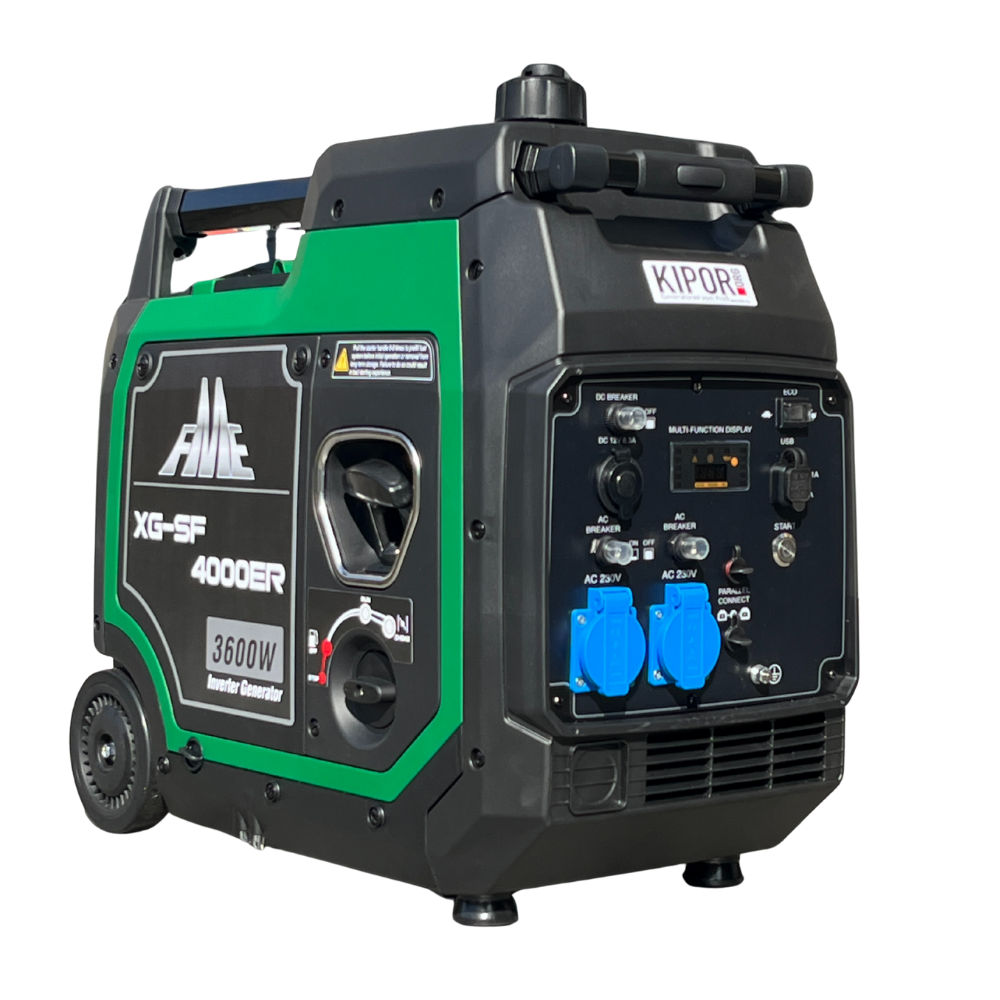
FME XG-SF 4000ER – inverter generator with remote control
- Output: 3,600W rated / 3,800W max. – powers the fridge, heating, router and TV at the same time
- Noise level: below 55 dB(A) – the quietest in its class, suitable for residential areas
- Convenience: electric start + wireless remote control – start it from inside the house while the generator sits in the garden
- Inverter technology: pure sine wave (THD < 3%) – safe for all sensitive electronics
- Price: 1.049,95 € – excellent value for money for basic backup
AVR generators and diesel models
AVR generators (Automatic Voltage Regulator) are suitable for robust loads such as pumps, air compressors and simple household appliances. They are cheaper to buy but produce power with voltage fluctuations of up to ±10% – too much for modern electronics. For households that only want to run a water pump, lighting and simple electric tools, they are an economical option.
Diesel generators pay off from 5 kW output and with regular use. At half load, diesel engines use around 20–30% less fuel than comparable petrol models and are designed for long-term operation. Diesel also stores better than petrol, which starts to age after just 3–6 months and can cause starting problems. The FME XG-SF 5600D Carbon is the most popular diesel inverter generator at Kipor.org: it combines diesel efficiency with inverter power quality – ideal for heat pumps and demanding home technology.
Petrol, diesel or dual fuel?
For home generators, the choice of fuel matters more in the long run than for camping – a backup generator has to start reliably straight away, even after 12 months of standing idle.
| Criterion | Petrol inverter | Diesel inverter | Dual fuel (petrol + LPG) |
|---|---|---|---|
| Purchase price | From 699 € (3,600W) | From 1.799 € (5,000W) | From 799 € (3,800W) |
| Consumption at 50% load | 0.5–0.8 l/h | 0.4–0.6 l/h (–20%) | 0.5–0.8 l/h (petrol) |
| Fuel storage | Problematic (ages after 3–6 months) | Good (stable for 12+ months) | LPG can be stored indefinitely |
| Recommended power class | Up to 5,500 W | From 5,000 W | Up to 4,000 W |
| Ideal for | Occasional backup power | Heat pump, continuous operation | Long-term storage, flexibility |
| Noise level | 52–65 dB(A) | 58–70 dB(A) | 52–63 dB(A) |
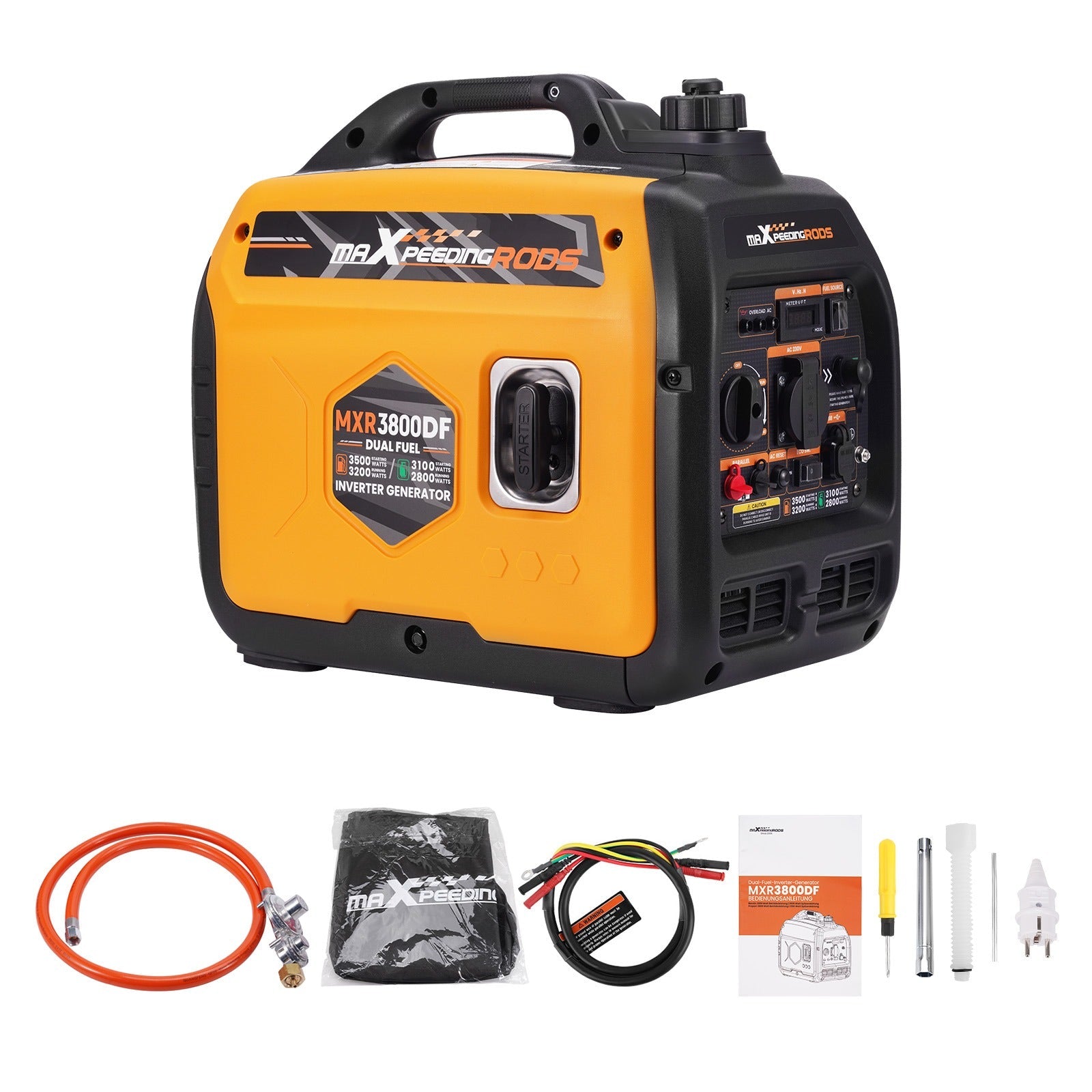
maXpeedingrods MXR 3800DF – dual fuel for backup power
- Output: 3,500W rated / 3,800W max. – basic backup plus comfort appliances
- Fuel: petrol or LPG/propane – selectable at the flick of a switch, no conversion needed
- Storage: propane can be stored indefinitely – the generator starts reliably even after 2 years of standing idle
- Technology: inverter with pure sine wave – safe for all electronic devices
- Advantage: if petrol runs short after a disaster, switch to gas cylinders – true independence
The key buying criteria for home generators
Home use comes with different priorities than camping or the building site. Long-term operating capability, a wide range of sockets and automatic functions matter more here than weight or compactness.
Noise levels in residential areas
Under the Bundesimmissionsschutzgesetz (Germany's Federal Immission Control Act), a maximum of 55 dB(A) during the day (6 am–10 pm) and 40 dB(A) at night (10 pm–6 am) is considered acceptable in residential areas – measured at the neighbour's window. Modern inverter models achieve 52–58 dB(A) at 7 metres in eco mode. Structural measures – placing the generator behind the garden shed, shielded with soundproofing panels – can gain you another 4–8 dB. An exhaust hose also directs exhaust noise away from living areas.
Sockets and three-phase power
For home use, CEE sockets are particularly important alongside standard Schuko sockets. The blue CEE connector (230V, 16A) is the standard campsite and backup power socket, through which a power inlet plug establishes the connection to the changeover switch. For heat pumps or other 400V three-phase loads, you need either a three-phase generator or a generator with separate 230V outputs for three phases.
ATS automatic start: useful or a luxury?
An ATS system (automatic transfer switch) detects the power cut and starts the generator automatically – usually within 10–30 seconds. For households with a heat pump, chest freezer or medical equipment, this is not a luxury feature but sensible protection, especially when you are on holiday or away from home. The FME 8000iD has an integrated ATS input that can be connected directly to an external changeover switch.
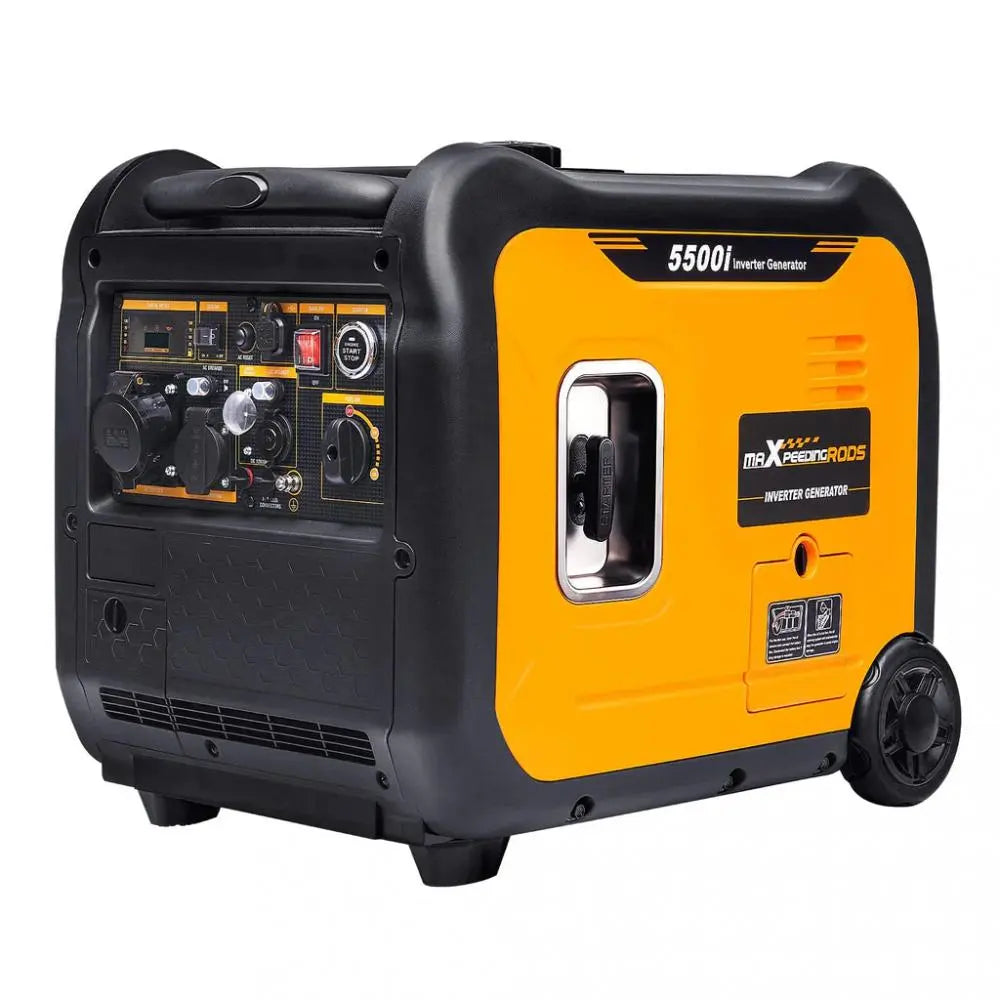
maXpeedingrods MXR 5500i – inverter generator for comfort backup
- Output: 5,000W rated / 5,500W max. – powers almost the entire household, including the washing machine
- Fuel: petrol with a 13.5L tank – up to 15 hours of runtime at half load
- Start: electric start + wireless remote control – convenient operation from inside the house
- Technology: inverter with pure sine wave – all appliances can be connected safely
- Price: 1.199,95 € – plenty of power potential for larger households
Installation and legal requirements
Installing a home generator safely takes more than setting it up in the garden and plugging in an extension cable. If you want to power critical loads such as the heating and fridge on a regular basis, there is no way around a professionally installed changeover switch.
Changeover switch: why it is a legal requirement
Feeding generator power into the house wiring without a changeover switch (mains isolation switch) is prohibited in Germany and life-threatening. Without isolation from the grid, generator power can flow back into the public network – with fatal consequences for line workers working on cables they believe to be dead. VDE 0100-551 (a standard of the German Association for Electrical, Electronic & Information Technologies) stipulates that every connection to the house installation requires safe isolation from the grid, carried out by a licensed electrical contractor. A professional changeover switch costs a one-off 500–1.500 €, depending on the work involved – an investment that pays for itself the first time you use it.
CO safety and where to place the generator
Every combustion engine produces carbon monoxide (CO) – an odourless, colourless gas that is deadly even in low concentrations. You cannot smell or taste CO; victims become drowsy and fall asleep. According to the BfR (German Federal Institute for Risk Assessment), serious accidents caused by CO poisoning occur regularly when generators are operated improperly indoors or in garages.
⚠️ Absolute safety rule – risk of death from CO: NEVER run your generator in enclosed or partially enclosed spaces – not in the basement, not in the garage, not in the garden shed. Even with doors and windows open, natural air circulation is not enough to dilute CO. Minimum distance from doors, windows and vents: 5 metres. Also install a CO detector in the house (from 20 € at a DIY store) – it saves lives.
The ideal location is:
- Outdoors, at least 5 metres away from windows, doors and air intakes
- Under a canopy or tarpaulin (well ventilated!)
- On firm, level ground – prevents tipping over and oil deposits
- With the exhaust pointing away from living and seating areas
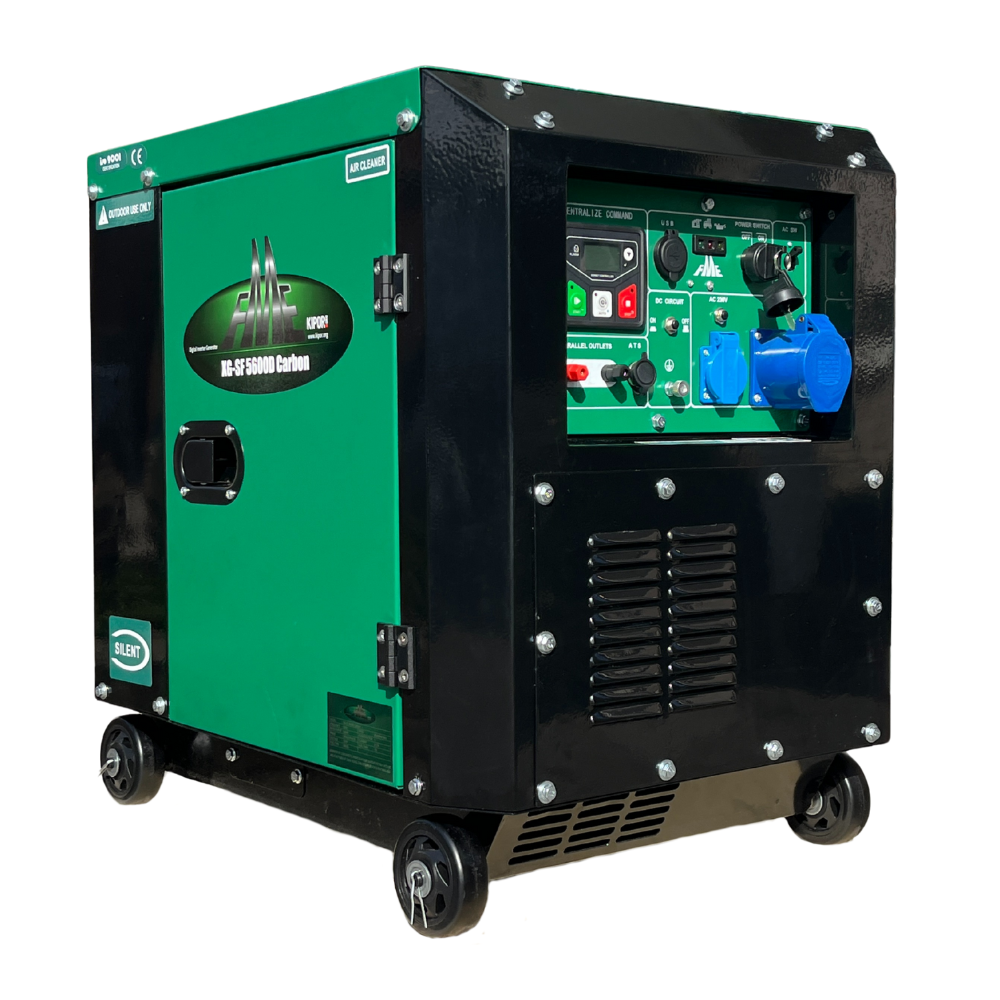
FME XG-SF 5600D Carbon – diesel inverter generator for heat pumps
- Output: 5,000W rated / 5,500W max. – also powers heat pumps with soft start
- Fuel: diesel or heating oil – cheaper to run and better storage life than petrol
- Technology: inverter with pure sine wave – safe for sensitive heating controls
- Convenience: electric start + wireless remote control + digital display with hour meter
- ATS input: can be retrofitted for automatic start in the event of a power cut
Our top picks: home generators 2026 compared
With more than 18 years of advisory experience at Kipor.org, we have the right model for every type of household. The overview below shows which unit is the best choice for which scenario.
Fig. 2: Three backup scenarios for households – from basic backup to whole-home power with a heat pump
The comparison table below shows all recommended models with their key figures at a glance:
| Model | FME XG-SF 4000ER | MXR 3800DF | MXR 5500i | FME XG-SF 5600D Carbon | FME SP7000D |
|---|---|---|---|---|---|
| Ideal for | Basic backup | Long-term standby storage | Comfort backup | Heat pump | Whole-home power |
| Rated power | 3,600 W | 3,500 W | 5,000 W | 5,000 W | 6,000 W |
| Maximum power | 3,800 W | 3,800 W | 5,500 W | 5,500 W | 6,500 W |
| Fuel | Petrol | Petrol + LPG | Petrol | Diesel / heating oil | Diesel |
| Technology | Inverter | Inverter | Inverter | Inverter | AVR (230V+400V) |
| Start | Electric start + remote control | Electric start + recoil start | Electric start + remote control | Electric start + remote control | Electric start + remote control |
| Noise level | < 55 dB(A) | ~59 dB(A) | ~60 dB(A) | ~60 dB(A) | ~65 dB(A) |
| Price | 1.049,95 € | 604.95 | 1.199,95 € | 1,889.95 | 1.799,95 € |
| View product | XG-SF 4000ER → | MXR 3800DF → | MXR 5500i → | XG-SF 5600D → | SP7000D → |
Recommendations by household type:
Detached house with gas or oil heating: With 3,600W rated power and less than 55 dB(A), the FME XG-SF 4000ER covers all essential loads – fridge, heating controls, router and lighting. The most efficient solution for emergency preparedness.
Households that need long-term storage: Thanks to its dual fuel technology, the maXpeedingrods MXR 3800DF starts reliably even after years in storage – simply connect the gas cylinder, switch the lever to LPG and start.
Larger households or businesses: The maXpeedingrods MXR 5500i delivers 5,000 watts of continuous power – enough for almost all household appliances except large heat pumps.
Homes with a heat pump: With diesel inverter technology and 5,000W of continuous power, the FME XG-SF 5600D Carbon is the ideal solution for heat pumps with soft start. For heat pumps without soft start or with higher output, we recommend the FME SP7000D with 6,000W rated and 6,500W maximum power plus a 230V/400V output.
Not sure which to choose? Contact us directly – we will calculate your power requirements free of charge and recommend the right model.
Maintenance and keeping your generator ready to run
A backup generator has to start immediately and reliably after months of standing idle – and that only works with consistent maintenance. The most common reason for a generator failing to start after long storage is stale petrol: fuel ages after 3–6 months and forms sticky, resinous deposits in the carburettor.
Mandatory annual maintenance (spring):
- Open the fuel tap and do a test run (30 minutes under load)
- Check the oil level and change if necessary (every 50–100 operating hours, at least once a year)
- Clean or replace the air filter
- Check the spark plug for wear (replace roughly every 100 hours)
- Charge or replace the battery (on electric start models)
Storing after the season:
- Drain the tank OR add a fuel stabiliser (e.g. STA-BIL) – prevents petrol from ageing for 12+ months
- Fill with fresh oil and let the engine run briefly – protects it against corrosion
- Disconnect the battery and store it in a dry place
You will find detailed step-by-step instructions in our generator maintenance and care guide. If you have starting problems after long storage, our article How to start a generator after long storage will help.
Expert tip: Carry out a 30-minute test run under real load twice a year – for example by connecting an extension cable with a 1,500-watt site light. That way you spot problems before the power cut happens, and all seals and diaphragms stay lubricated. Models with an hour meter also show you exactly when the next oil change is due.
Frequently asked questions about generators for home use
What size generator do I need for a detached house?
For basic backup covering the fridge, heating controls, router and lighting, 3,000–4,000 watts of inverter power is enough. If you also want to run a coffee machine, microwave or washing machine, 5,000–6,000 watts makes sense. With a heat pump, you should plan for at least 5,000 watts of continuous power – the compressor's starting current (2–5 times its rated power) determines the minimum requirement.
Can I simply connect the generator to my house wiring?
No – feeding power directly into the house installation without a changeover switch is prohibited in Germany (VDE 0100-551) and life-threatening. Generator power can flow back into the public grid and endanger line workers there. A licensed electrical contractor is mandatory for a permanent connection to the house wiring. A changeover switch including installation costs 500–1.500 €.
How long does petrol last in a generator tank?
Regular petrol (E10) starts to age after just 3–6 months and forms resinous deposits in the carburettor, leading to starting problems. A fuel stabiliser (e.g. STA-BIL) extends its shelf life to 12–24 months. Alternatively, the MXR 3800DF with dual fuel technology lets you switch to LPG/propane – propane can be stored indefinitely and is ideal for emergency preparedness.
Can I run a heat pump on a standard inverter generator?
That depends on your heat pump. Modern heat pumps with a soft start function reduce the starting current to 1.5–2 times the rated power – in that case a 5,000-watt inverter generator is enough for a 2,500-watt heat pump. Older models without soft start draw 3–5 times as much on start-up (i.e. up to 12,500 watts) – here you need a larger unit such as the FME SP7000D with 6,500 watts. Check the rating plate of your heat pump or ask the manufacturer for the starting current (LRA).
How loud is an inverter generator in a residential area?
Modern inverter generators reach 52–58 dB(A) at 7 metres in eco mode – comparable to a normal conversation. The FME XG-SF 4000ER runs at below 55 dB(A). Structural measures (placing it behind a screen or a noise barrier) can reduce the noise by another 4–8 dB. In residential areas, up to 55 dB(A) at the neighbour's window is permitted during the day – quiet inverter models easily stay below this.
Do I need to register a generator or get a permit?
In Germany, portable generators for occasional home use do not require official approval. For a permanent connection to the house wiring (standby power system), registration with the grid operator and installation by an electrical contractor are mandatory. The Federal Immission Control Act (BImSchG) and local noise regulations also apply – for commercial use or operation for more than 44 hours a year, additional requirements may apply.
How much does a backup generator for a detached house cost?
For basic backup (3,500–4,000-watt inverter), prices start at 699 € (e.g. FME XG-SF 4000ER). Comfort models with 5,000–6,000 watts cost 1.000–1.500 €, diesel inverter generators for heat pumps from 1.800 €. On top of this comes a one-off 500–1.500 € for the professional installation of a changeover switch if you want to connect the generator permanently to your house wiring.
Conclusion: invest in security that really fits
A generator for home use is a long-term investment – so the choice deserves careful thought. For most detached houses with gas or oil heating, the FME XG-SF 4000ER (699,95 €) is the ideal entry-level unit: below 55 dB(A), wireless remote control and a pure sine wave that protects all modern devices. If long-term storage is your priority, you are better off with the MXR 3800DF with dual fuel technology.
For homes with a heat pump, there is no getting around a 5,000+ watt diesel inverter generator: the FME XG-SF 5600D Carbon delivers 5,000 watts of continuous power on diesel or heating oil, with clean inverter power for sensitive heating controls. If you are planning automatic backup switching, consider the ATS-capable FME SP7000D with a 230V/400V output.
Don't be guided by the power rating alone: fuel choice, starting current reserve and maintenance effort determine satisfaction and safety in the long run. Our team in Versmold will advise you free of charge – just give us a call or send us a message. You can also browse our full generator collection for more options to suit your budget.

 Knetterhauser Straße 26