

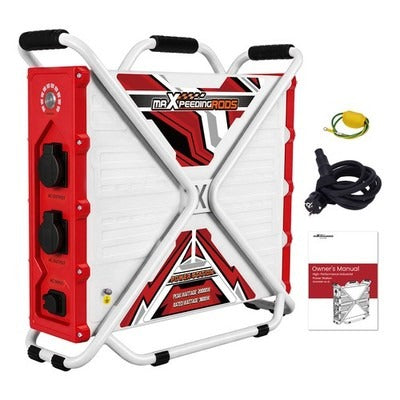
GENERGY GZE-3040 Portable Power Station 4000 W and 3072 Wh
2.075,95 EURincl. VAT

Independent. Sustainable. Cost-saving.
With modern portable power stations and balcony solar systems, you bring your own energy source right into your home. Whether for everyday electricity use, as a reliable backup power solution or for complete flexibility when camping – you decide when and where you use your power.


For campers, the right size of power station depends heavily on how long you're away and which devices you want to run. If you only take the van out at weekends and mainly want to charge your phone, camera and a few lights, 300 to 500 Wh of storage capacity will do the job.
If you also want to run a compressor cool box, a laptop or small kitchen appliances, you should plan for at least 1,000 to 2,000 Wh.
For longer trips or for running power-hungry appliances such as induction hobs or kettles, models with 2,000 to 3,600 Wh and a continuous output of 1,500 W or more make sense.
We recommend power stations with LiFePO₄ batteries, as they last considerably longer and can handle several thousand charge cycles.
If you want to charge independently with solar panels, also look for an MPPT solar charge controller and sufficient input power (at least 200–400 W).
Formula for your size:
Daily requirement (Wh) = sum(power W × hours) × 1.2 buffer.
Recommended capacity = daily requirement × travel days ÷ (solar yield factor 0.6–0.8, if using PV).
Yes, that's possible, but not directly via the power station's 12 V outputs. Instead, you should use a smart car battery charger plugged into the power station's AC socket. A typical car starter battery has around 60 Ah at 12 V, which equates to roughly 720 Wh. Allowing for charging losses, you'll need around 850 to 900 Wh.
So it's clear: a power station with at least 1,000 Wh of capacity makes sense if you want to fully recharge a flat car battery. Important: a power station is not suitable as a jump starter. Dedicated jump starters are designed for starting an engine directly and can deliver very high currents for a short time – something a normal power station generally cannot do.
In principle, it is technically possible to charge an electric car with a power station, but in practice it only makes sense in an emergency. Portable EV chargers (EVSE) usually draw between 1.3 and 2.3 kW, so your power station must be able to supply at least this continuous output.
Converted into driving range, 1 kWh of energy stored in the power station gives the car only around 4 to 6 kilometres. A 2,000 Wh power station therefore adds at most 8 to 12 kilometres – enough as an emergency reserve to reach the next charging point, but by no means a regular solution. On top of that, many portable chargers require a working earth connection, and not every power station meets this requirement. So the rule is: it works, but it remains strictly a stopgap.
Feeding a power station into your home's electrical system is only permitted under clear conditions. The commonly seen method of plugging a Schuko plug into a normal wall socket (“backfeeding”) is potentially fatal and prohibited in Germany.
If you want to use your power station as a backup power supply, you need safe isolation from the grid. This is achieved with a changeover switch or an inlet socket and must always be installed by an electrician. This is the only way to prevent power from flowing back into the public grid and endangering line workers or neighbours. Many modern power stations also offer a so-called EPS or UPS function. This allows certain devices or circuits to stay powered automatically as soon as the public grid fails – without feeding power into the wider network.
So if you want backup power, you should either consider a fixed installation, e.g. by means of a balcony solar system, or run individual essential appliances directly from the power station.
A cool box is one of the most common appliances when camping and should be taken into account when choosing a power station. Compressor cool boxes are efficient and, depending on size, need around 250 to 600 Wh per day, because they don't run continuously but only cycle on periodically. A power station with 500 to 1,000 Wh is usually more than enough for this.
If you want to keep your cool box running permanently, you should also plan for solar panels so that the battery is recharged during the day. It's a different story with thermoelectric cool boxes: they draw power constantly and can need 1,000 to 1,500 Wh per day. Here you'll need a power station with at least 1,000 Wh – or, better still, switch straight to a compressor cool box, which is far more energy-efficient in the long run.
The runtime depends heavily on the capacity of the power station (Wh) and the connected device. Example: a 500 Wh power station can run a 50 W cool box for around 10 hours. The higher the capacity and the lower the consumption of your devices, the longer the runtime.
Yes, most power stations can be charged with compatible solar panels. What matters is that the voltage, power and connectors match. Many manufacturers offer matching solar panels. This lets you run your power station independently on renewable energy, even on the go.
Depending on the model, power stations have different ports:
Power stations are usually almost silent, as they have no combustion engine. Only under heavy load or while charging can the built-in fan become audible – and even then it's much quieter than a petrol generator.
A generator produces electricity with an engine (usually petrol or diesel) and is often loud, heavy and needs fuel. A power station, on the other hand, stores electricity in a battery and supplies it quietly and with zero emissions. Generators are suited to very long runtimes, while power stations are ideal for eco-friendly, mobile use.
Delivery time: 7–10 working days
Delivery time: 7–10 working days
Delivery time: 7–10 working days
Delivery time: 7–10 working days
Delivery time: 7–10 working days
Delivery time: 7–10 working days
Delivery time: Ships from approx. end of May
Delivery time: 7–10 working days
Delivery time: 7–10 working days
Delivery time: Ships from approx. end of May
Delivery time: 7–10 working days
Delivery time: 7–10 working days
Delivery time: 7–10 working days
Delivery time: 7–10 working days
Delivery time: Ships from approx. end of May
Delivery time: Ships from approx. end of May
Delivery time: Coming soon
Delivery time: 7–10 working days
Delivery time: 7–10 working days
Delivery time: 3–5 working days
Delivery time: 3–5 working days
Delivery time: 3–5 working days
Delivery time: 7–10 working days
Delivery time: 7–10 working days
Delivery time: 7–10 working days
Delivery time: 10–12 working days (available from end of June)
Delivery time: 2–4 working days




 Knetterhauser Straße 26