Buy a Diesel Generator – the Most Economical Solution for Continuous Operation, Backup Power and Professional Use
Diesel generators are the clear choice for anyone who needs more than a camping solution: they're more fuel-efficient, more durable in continuous operation and better suited to stationary backup power systems than any petrol generator of comparable output.
At Kipor.org you'll find diesel generators in every relevant power and equipment class – from compact 5 kW units for the farmyard and workshop and sound-insulated professional models for construction and industry to modern diesel inverter generators with Same Power function and unbalanced load capability for demanding home backup power.
Honest Advice: When a Diesel Generator Is the Right Choice – and When It Isn't
Technically, diesel generators are often the better product – but not always the most economical choice. At Kipor.org we tell you the truth:
A diesel generator is the right choice if:
– You use the generator regularly or continuously – from around 100 operating hours a year, the lower fuel consumption pays off.
– You need a long-term backup power reserve – heating oil with an additive stays usable for years, petrol for only a few months.
– You need high outputs (6 kW and above) – diesel is clearly more economical here.
– You're planning home backup power with ATS – almost all ATS-ready generators are diesel models.
– You want to power a heat pump, modern heating controls or sensitive IT – a diesel inverter generator is the best choice here.
A diesel generator is NOT the right choice if:
– You only use it very rarely (a few hours a year) – the extra cost won't pay for itself.
– You need a particularly light, portable unit – diesel generators are always heavier than their petrol counterparts.
– Long-term fuel storage isn't an issue for you and you keep petrol at home anyway.
We're happy to work out which technology suits your particular application in a short conversation.
What Diesel Generators Are the Right Choice For
Building sites & trades in continuous use: construction hoists, air compressors, welders, mortar mixers, large pumps – anything that runs for hours or days at a time. Clearly more economical than petrol.
Agriculture & farming: milking systems, automatic feeders, yard lighting, water pumps, barn ventilation – as a fixed backup power solution or a mobile generator.
Home backup power with ATS: for the heat pump, heating controls, refrigeration and all essential appliances in modern detached houses. A diesel inverter generator with ATS is by far the best choice here.
Business & critical infrastructure: cold stores, server and IT rooms, workshops, retail outlets – for business continuity during a power cut.
Events with long running times: large marquees, catering, stage equipment, mobile refrigeration over several days – diesel is more economical and longer-lasting here.
Marine, emergency services and military: with IT/TN switch, German emergency services (BOS) equipment to DIN 14684 or special equipment for emergency vehicles, field camps and maritime applications.
Diesel AVR or Diesel Inverter – What's the Difference?
Diesel AVR generators are the conventional design: a synchronous alternator with automatic voltage regulation (AVR), driven by a diesel engine. Robust, proven and ideal for tools, pumps, lighting and all standard appliances. The more affordable way in.
Diesel inverter generators are the modern alternative: the diesel engine drives an alternator whose raw output is processed by an electronic inverter into a clean sine wave with stable voltage and frequency – on a par with mains quality. That makes them suitable for laptops, heat pumps, heating controls, servers, medical equipment and hybrid PV systems too – in other words, everything a conventional AVR generator shouldn't be powering.
At Kipor.org our own FME line includes diesel inverter generators such as the FME 5600D Carbon, the FME 8000iD and the FME 15000iD – depending on the model with Same Power function (the same output at 230 V and 400 V), unbalanced load capability, ATS connection and wireless remote control.
Power Classes and Their Typical Applications
5–8 kW: Entry into the diesel range. For farms, smaller workshops, mobile service and simple home backup power solutions. Models such as the FME 5600D Carbon cover a wide range of uses here.
8–10 kW: The best-selling class in the professional segment. Powers entire detached houses including the heat pump, smaller businesses and complete building site setups. Models such as the FME 8000iD-SP are the typical choice here.
10–15 kW: Premium home backup power and commercial use. Also for homes with high consumption (EV charging, several heat pumps), smaller industrial operations and apartment buildings. Models such as the FME 15000iD-SP top the list here.
15–50 kVA: Commercial and industrial generators, sound-insulated, often with ATS and three-phase output. For workshops, businesses and large agricultural operations.
Over 50 kVA: Industrial standby power systems up to well over 1,000 kVA – see our separate category Standby Power Systems & Industrial Generators.
Key Buying Criteria for Diesel Generators
1500 or 3000 rpm? Diesel generators running at 1500 rpm are the professional design – longer-lasting, quieter and suitable for continuous operation. Units running at 3000 rpm are more compact and cheaper, but only recommended for short-term use and emergencies.
Unbalanced load capability (three-phase): If you want to use a three-phase generator for single-phase loads (e.g. only 230 V appliances), you need a model with unbalanced load capability – otherwise only about a third of the total output is available per phase. Check the exact model specification.
AVR or inverter? If you want to power a heat pump, modern heating controls or servers, go for a diesel inverter generator. If you're "only" running conventional appliances, a diesel AVR is the more economical option.
Noise insulation: Check the dB(A) figure at 7 m. Open-frame diesel generators are often at 75–85 dB(A), sound-insulated "silent" models at 60–68 dB(A) – a significant difference in a residential area.
Starting system & automation: Electric start is standard today. If you want automatic backup power operation, look for an ATS connection or an integrated ATS module. Municipal installations and emergency service applications often add wireless remote control, PLC control and remote monitoring.
Engine quality: Proven engine brands (Yanmar, Kubota, Perkins, Cummins, Doosan, MTU, Baudouin) last longer and have better spare parts availability. For FME models, we check the installed engines model by model and document them transparently.
HVO 100 / biodiesel compatibility: If you want to switch to alternative, renewable fuels, look for HVO 100 approval. Many modern FME diesel generators are approved for it.
Diesel Generator Brands at Kipor.org
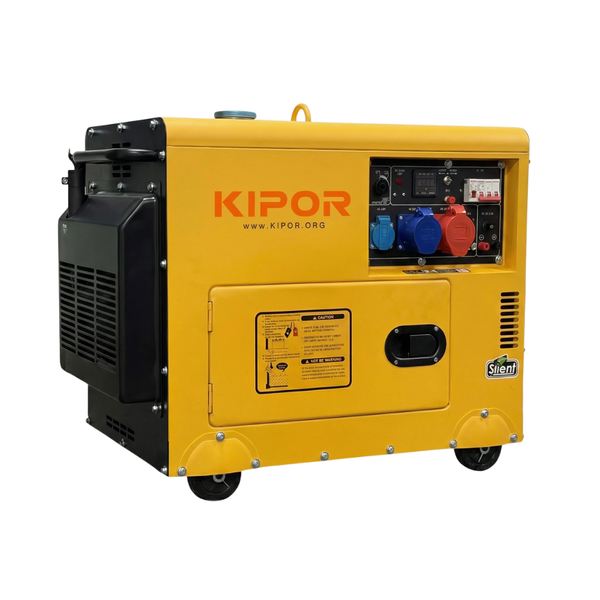
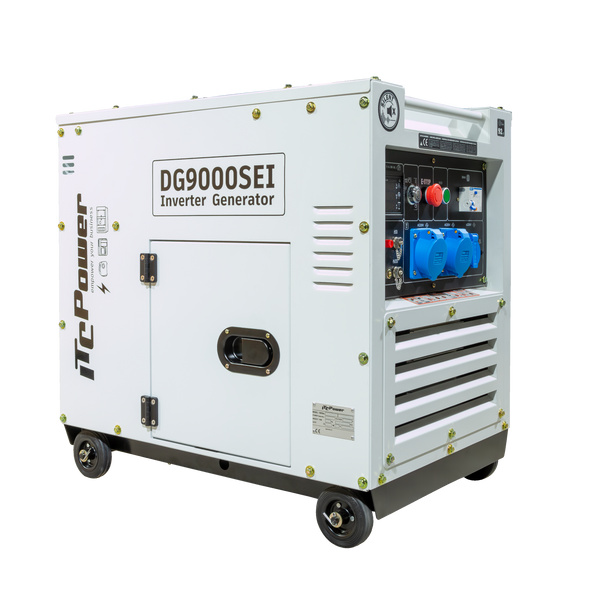
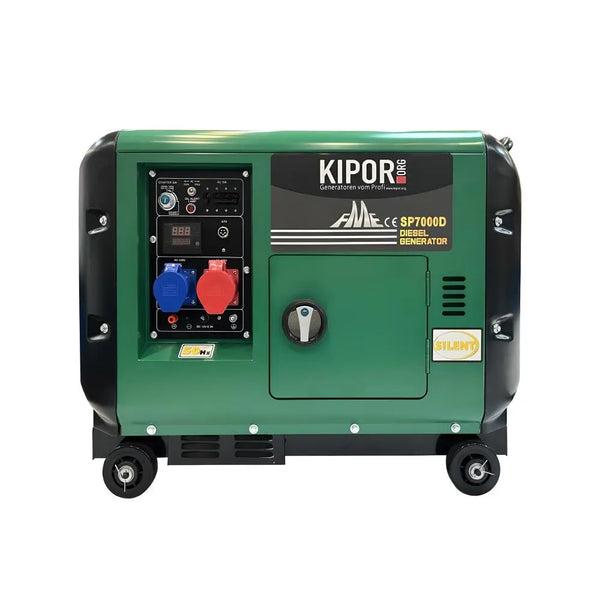
In our diesel generator range we stock FME, Genergy, KIPOR, Hyundai, ITC Power and other brands. We technically check every model and make sure it's suited to the European market.
For our own FME diesel inverter generators (FME 5600D Carbon, FME 8000iD, FME 15000iD) we rely on proven engine manufacturers and inverter electronics whose features (unbalanced load capability, Same Power, overload protection) we document model by model.
For industrial standby power systems and large generator sets we work with engines from Cummins, Doosan, Baudouin, Perkins, MTU, Mitsubishi, Scania, Volvo and others – you'll find details in our Standby Power Systems & Industrial Generators category.
FAQ – Frequently Asked Questions About Diesel Generators
Is a diesel generator worth it compared with petrol?
From regular use of around 100 hours a year, and especially at outputs of 6 kW and above, diesel is clearly more economical: lower consumption, longer service life and heating oil that can be stored long-term. With very rare use (e.g. purely as a backup power reserve, a few hours a year), a petrol generator can make more sense as the cheaper purchase.
How much fuel does a diesel generator use per hour?
Rough figures by power class: a 5 kW diesel generator uses around 1.4–1.8 litres per hour at full load and 0.7–1.0 litres at half load. A 10 kW model uses around 2.5–3.2 litres at full load. Diesel inverter generators with eco mode are considerably more economical again, as the engine speed adapts to the load.
How long does a diesel generator last?
With proper maintenance, diesel engines typically reach 10,000 to 30,000 operating hours – which, with moderate use, means decades. High-quality engines from branded manufacturers (Yanmar, Kubota, Perkins, Cummins) are clearly superior to cheap no-name generators here.
Can I use heating oil instead of diesel?
Yes – heating oil (light grade, "Heizoel EL" in Germany) and diesel are chemically almost identical. The main differences are tax and a colour marker (heating oil is dyed red). In Germany, heating oil is permitted for stationary backup generators that aren't used on public roads, and it's considerably cheaper. Important: with a suitable heating oil additive, it stays usable for many years – a decisive advantage for backup power reserves. Rules on using heating oil differ from country to country, so check your local regulations.
What size diesel generator do I need for my house?
That depends on how much you want to back up: for basic supply (fridge, lighting, heating controls, router), 5–7 kW is often enough. For full home backup power including the heat pump, we recommend 8–10 kW. For homes with high consumption (several heat pumps, EV charging, PV backup power), 12–15 kW is realistic. With three-phase models, make sure you check the unbalanced load capability, and choose inverter technology if modern electronics are involved.
What is "Same Power" on diesel inverter generators?
Same Power means the generator can deliver its full rated power either as 230 V single-phase or as the 400 V three-phase total – as an alternative, not in addition. So an 8 kW diesel inverter with Same Power delivers either 8 kW single-phase or 8 kW as the three-phase total. Important: in balanced three-phase operation, the power is physically split across three phases, so around a third is available per phase – not 8 kW on each phase in parallel.
What does 100% unbalanced load capability really mean?
100% unbalanced load capability means the entire rated power can be delivered on a single phase (when only that one phase is loaded). In balanced three-phase operation, however, the basic laws of physics still apply: the total output is split across three phases, so only around a third of the rated power is available per phase. This distinction is crucial for sizing your backup power system correctly – we're happy to advise you in detail.
How does an ATS (automatic transfer switch) work?
When there's a power cut, an ATS unit detects the loss of voltage, sends the start signal to the generator after a short delay (typically 5–15 seconds), switches the home supply from the mains to the generator and automatically switches back as soon as the public grid is stable again. That gives you fully automatic backup power without any manual intervention – ideal even when nobody is at home.
How loud is a diesel generator?
Open-frame diesel generators are typically at 75–85 dB(A) at 7 m. Sound-insulated "silent" models reach 60–68 dB(A) – roughly the level of conversation or an office. With an additional soundproof enclosure, or installation in a cellar with a professionally installed exhaust system, even levels suitable for town centres are possible.
Are modern diesel generators suitable for HVO 100?
Many current FME diesel generators are approved for HVO 100 (hydrotreated vegetable oil – a paraffinic fuel from renewable sources). With HVO 100, you can cut the CO₂ footprint of running a generator by up to 90% without any engine modifications. You'll find the exact approval for each model in its data sheet.
How do I maintain a diesel generator?
Diesel generators need little maintenance: change the oil every 100–250 operating hours (depending on the model) and the fuel and air filters every 250–500 hours. Even if you rarely use it, run the unit under load for 15–30 minutes at least twice a year to renew the lubricating film and charge the battery. For our FME models we offer matching maintenance and filter kits in our accessories range.
What connections does a diesel generator have?
Depending on the model, typical connections are: CEE 16 A / 32 A / 63 A (400 V) for three-phase equipment, CEE 16 A / 32 A (230 V) for powerful single-phase appliances, and Schuko sockets (230 V) for standard household appliances. ATS connections are provided separately. Diesel inverter models often add an RJ port for wireless remote control.
Free Advice – in Person or Online Around the Clock
Not sure whether a conventional diesel AVR or a diesel inverter generator suits your application, which power class is right for your home backup power, or whether ATS and unbalanced load capability are a must? Our technical team will give you free, brand-independent advice on +49 (0) 5423 477400.
Outside our business hours, our free online Generator Advisor is available 24 hours a day, 7 days a week. We deliver throughout the EU.

 Also runs on HVO100 and heating oil






 Knetterhauser Straße 26